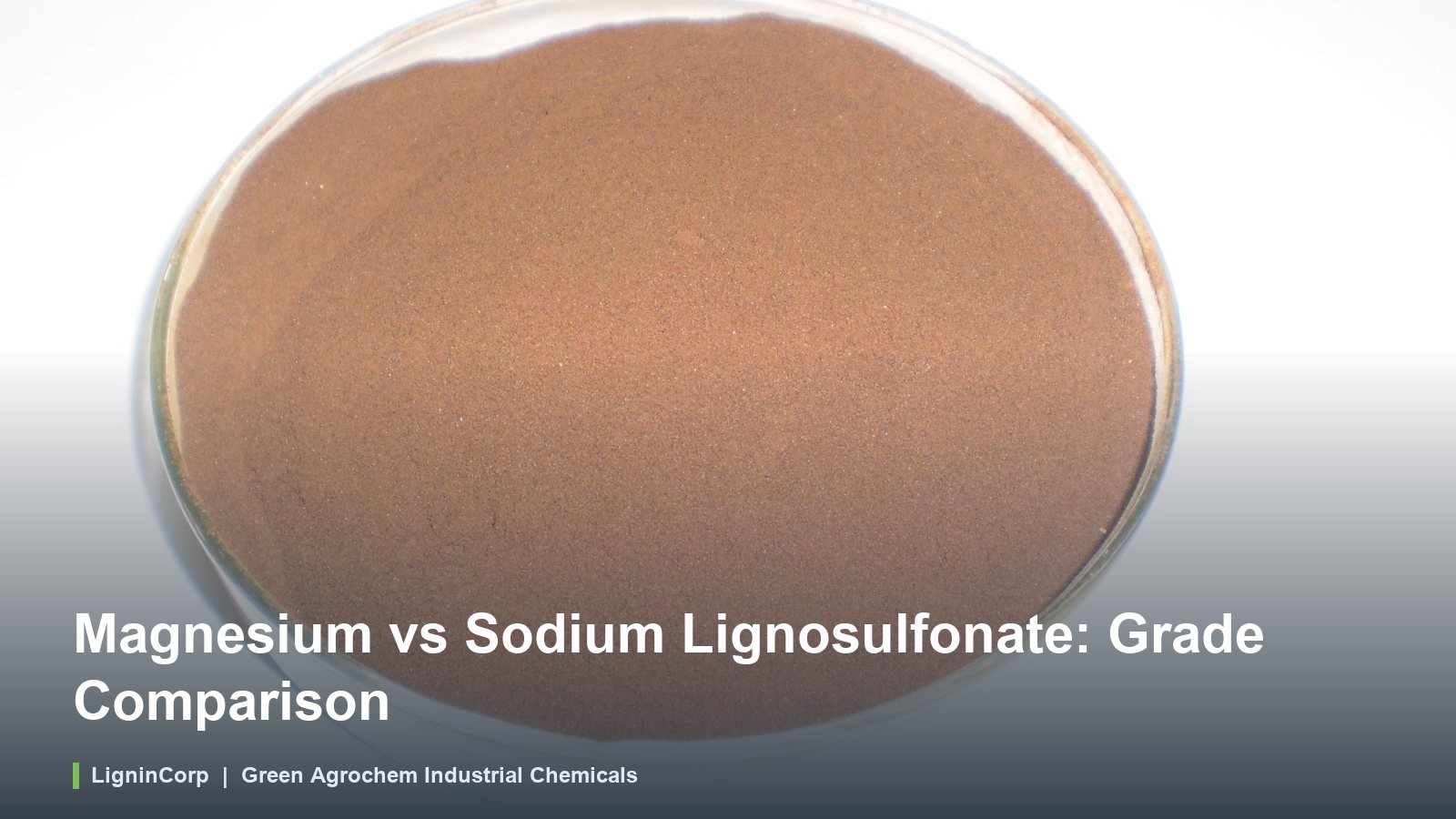
Magnesium and sodium lignosulfonates share sulfonated lignin-derived structures but differ in counter-ion designation and, more importantly, in the complete composition of each commercial grade. Ion valence alone does not prove stronger binding, slower leaching, higher thermal stability, better drilling performance or greater solubility. Select by exact-grade documents and side-by-side application tests.
Matched current-grade comparison
The table compares two current Green Agrochem industrial powder documents: GAC-MgLS-1, Magnesium Lignosulfonate Grade One, TDS Rev. 1.0 and GAC-NaLS-1, Sodium Lignosulfonate Grade One, TDS Rev. 2.0. Both TDS documents describe the values as typical production results for reference; the signed shipment COA provides lot results and the purchase specification controls acceptance.
| Property | GAC-MgLS-1 | GAC-NaLS-1 | Buyer interpretation |
|---|---|---|---|
| Appearance | Yellow-brown powder | Yellow-brown powder | Visual identity only; colour is not performance |
| pH | 4–7 | 7.0–9.5 (10% solution) | Confirm Mg test concentration/method before direct numerical comparison |
| Dry matter | 95% min | 95% min | Supports dry-solids normalization |
| Water-insoluble matter | 1.0% max | 1.5% max | Test filtration, sediment and equipment passage in actual water |
| Mineral/counter-ion-related value | Total magnesium and calcium 8% min | Calcium and magnesium 0.5% max | Definitions and methods must be confirmed; not a nutritional or chelation claim |
| Lignosulphonate content | 55% min | 55% min | Method/basis still need alignment |
| Sulphate | 2% min | 2–5% | Review units and analytical definition |
| Reducing matter/sugar | Total reducing matter 7% min | Reducing sugar 7% max | Different terms and opposing limits; not comparable until methods are reconciled |
| Density | 0.55 g/cm³ | Not stated in current TDS | Confirm bulk-density method before packaging or feeder design |
| Moisture | 5% max | 5% max | Typical production limit for the identified powder grades |
What the counter-ion can—and cannot—tell you
Magnesium is divalent and sodium is monovalent, but commercial lignosulfonates are polydisperse mixtures containing multiple functional groups, residual carbohydrates and inorganic constituents. Their behaviour depends on molecular distribution, sulfonation, salts, pH, concentration, substrate, water and process conditions. It is therefore inaccurate to infer a fixed “cross-link strength” or optimal use from valence alone.
- pH and electrolyte balance: use the exact-grade result and test the complete formulation.
- Solubility and solution clarity: define concentration, temperature, mixing, time, water quality, screen/filtration and residual solids.
- Binding: compare green and dry strength, abrasion, moisture response and drying under the same solids basis.
- Dispersion: compare viscosity, particle size, sedimentation and stability across relevant pH/electrolyte conditions.
- Cementitious systems: measure flow, water demand, air, setting and strength with the actual cement and supplementary materials.
Application selection matrix
| Application | Do not decide from | Required comparison |
|---|---|---|
| Concrete/cement | “Magnesium for heat” or “sodium for alkaline cement” alone | Equal dry-active trials covering flow, water demand, air, setting, early/late strength and compatibility |
| Dust control | Assumed divalent rain resistance or generic solubility | Surface/fines, application basis, climate, traffic, wash-off/runoff, corrosion and maintenance interval |
| Ceramic/mineral slurry | Counter-ion label or one-point viscosity | Rheology curve, solids loading, sedimentation, filtration, drying and final body properties |
| Industrial binding/granulation | Claimed universal cross-linking strength | Binder solids, granule strength, abrasion/fines, moisture sensitivity, drying and downstream processing |
| Drilling-fluid evaluation | Unverified high-temperature/high-pressure positioning | Base fluid, clay, salinity, contaminants, rheology, filtration and ageing under the required method |
Evidence status of former fixed comparisons
| Former comparison | Evidence/status | Correct treatment |
|---|---|---|
| Magnesium is less soluble/leaches more slowly; sodium washes away rapidly | No matched grade, surface, rainfall, dosage or leaching method | Test the exact formulations under defined wetting and runoff conditions |
| Magnesium stable to 150°C and sodium degrades faster | No source, exposure time, atmosphere, measurement endpoint or exact grade | Retained for source recovery; not a thermal specification |
| Magnesium strongly chelates Ca/Fe; sodium has minimal chelation | Overgeneralized from counter-ion identity without a defined metal/speciation method | Measure complexation/dispersion in the actual pH and ionic system |
| Both reduce concrete water by 10–15% | No cement, mix, dosage basis, standard, control or exact grades | Unverified performance result; conduct matched concrete testing |
| Magnesium is superior for heat, rain and HPHT drilling; sodium is optimal for general/dry use | No comparative application programme | Do not use as a selection rule |
| Magnesium provides bioavailable nutrition; sodium provides none and increases salinity | Industrial-grade identity does not establish feed/fertilizer value or crop/animal safety | Use separately qualified feed or agricultural grades and applicable regulatory evidence |
| Magnesium is more expensive; sodium is universally more available | Undated and undefined grade, quantity, packaging, origin, destination and Incoterm | Compare current technically equivalent quotations and landed usable cost |
Side-by-side qualification protocol
- Select exact candidate codes and obtain current TDS/SDS plus signed lot COAs.
- Align analytical methods and compare specifications without mixing typical and guaranteed values.
- Normalize candidate addition on both as-supplied and dry-active bases.
- Use the same raw-material lots, water, pH, temperature, mixing and conditioning.
- Include a blank control and incumbent grade, then measure the application-specific endpoints.
- Confirm the chosen grade at production scale and establish change-control and incoming-QC limits.
Product and knowledge routes
- Industrial magnesium lignosulfonate
- Industrial sodium lignosulfonate
- Magnesium grade-property comparison
- Neutral technical comparison at Lignosulfonate.com
For exact-grade documents, samples and a matched application trial, contact info@greenagrochem.com.
