
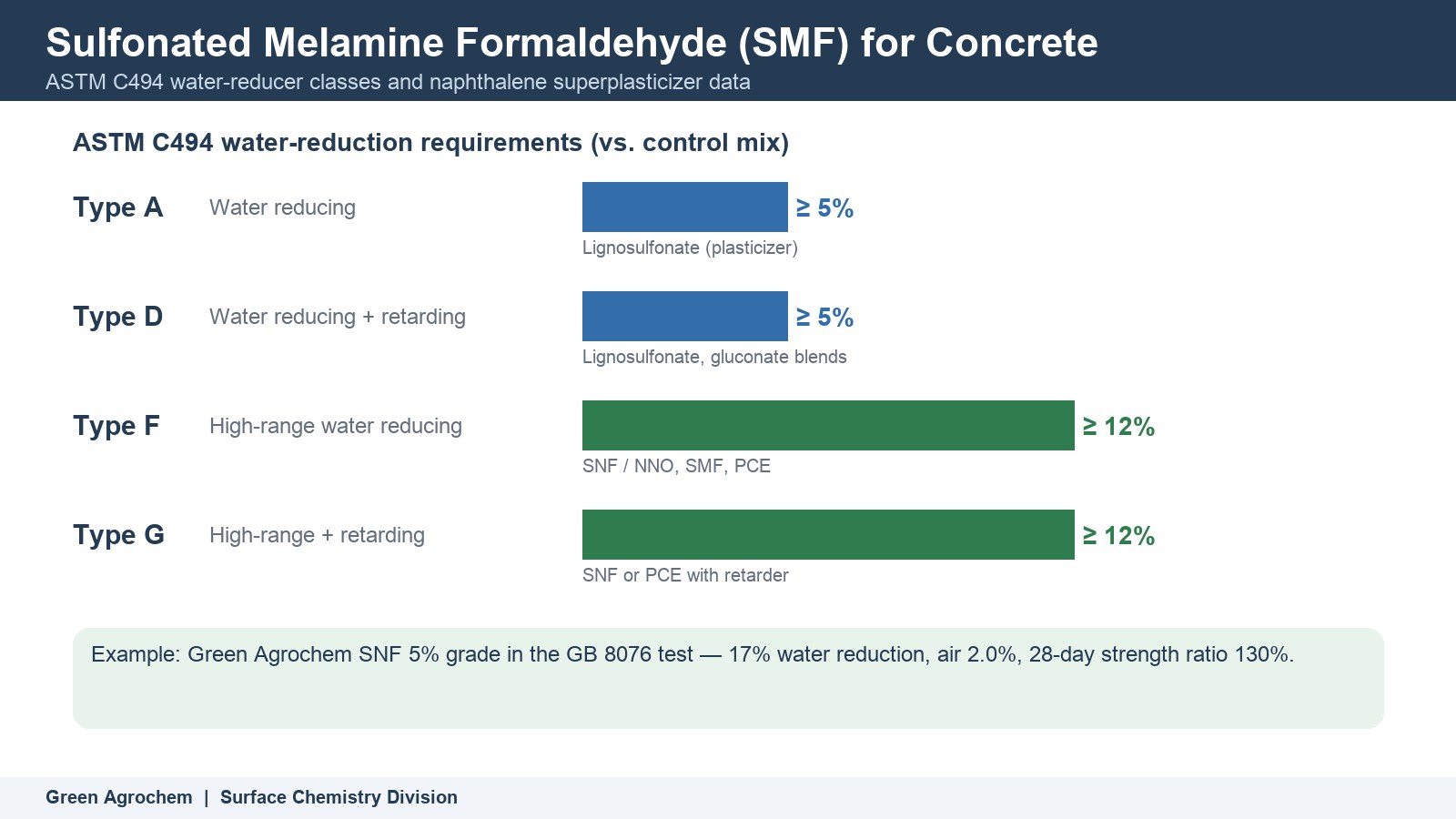
SMF stands for sulfonated melamine formaldehyde: a melamine-formaldehyde condensate that has been sulfonated so it dissolves in water and carries a negative charge. In concrete it is used as a high-range water reducer (superplasticizer), often for precast and light-coloured concrete. It is not the same as “Dispersant MF”, a naphthalene-based dye dispersant.
In concrete and mortar, SMF can adsorb on cementitious particles and promote dispersion. The practical outcome depends on cement chemistry, supplementary cementitious materials, aggregate, temperature, mixing sequence and the complete admixture package. No universal water-reduction, strength or setting-time result can be guaranteed from chemistry alone.
Where SMF may be evaluated
SMF grades may be considered in precast concrete, dry-mix mortar, grouts, gypsum or other cementitious systems when high fluidity at a controlled water content is required. Selection for white or light-coloured products should be based on an actual colour comparison and supplier data, not on a blanket “colourless” claim.
Suitability for self-compacting concrete, refractory products or rapid production cycles requires application-specific testing. These applications have different rheology, retention, setting, strength and durability requirements.
SMF, SNF, lignosulfonate and PCE
SMF, sulfonated naphthalene-formaldehyde condensate (SNF), lignosulfonate and polycarboxylate ether (PCE) admixtures are not direct drop-in equivalents. Their adsorption, water-reduction potential, slump retention, air interaction and cement compatibility can differ.
- SMF: assess early dispersion, workability retention, colour and setting response in the selected binder.
- SNF: compare solids basis, inorganic salt, fluidity and retention under the same mix conditions.
- Lignosulfonate: evaluate water reduction together with air and setting effects; see the lignosulfonate water-reducer guide.
- PCE: qualification should include sensitivity to clay, fines, temperature, addition sequence and other admixtures.
Recommended concrete qualification program
- Define the control mix: record cement sources, supplementary materials, aggregates, water, admixtures, temperature and mixing procedure.
- Use a recommended trial range: start from the supplier’s current guidance and bracket the dose in laboratory mixes. Do not treat an online percentage as a production dosage.
- Measure fresh properties: test consistency or slump/flow, retention at relevant times, air, density, bleeding, segregation and finishing behaviour.
- Measure setting and strength: compare setting response and compressive strength at project-relevant ages using the applicable standard.
- Check robustness: repeat with normal variations in material source, temperature, moisture and production mixing.
- Run a plant trial: confirm batching, transport, placement, finishing and curing before approval.
Compatibility and addition sequence
Test SMF with the complete admixture system, including accelerators, retarders, air entrainers, defoamers and supplementary cementitious materials. Simultaneous addition, delayed addition or pre-dilution may produce different results. Record the sequence during laboratory work so it can be reproduced in production.
Specifications and documentation
A purchase specification should state the product identity, supplied form, solids or moisture basis, pH, density where applicable, relevant salt or insoluble limits, packaging and shelf-life conditions, with test methods. Project acceptance must also include application performance because basic chemical limits do not establish concrete compatibility.
Request a current TDS, SDS and lot-specific COA. Requirements for formaldehyde, transport, worker exposure or regional chemical compliance must be assessed against the actual product and destination market; synthesis history alone does not demonstrate compliance.
Questions for suppliers
- What is the full chemical identity and intended cementitious application?
- Are reported values on an as-supplied or dry-solids basis?
- Which cement, temperature, mixing method and test standard support the application data?
- What recommended trial range should be used for the buyer’s binder system?
- How should the product be stored, diluted and introduced?
- What lot documentation and change-notification process are available?
For grade review, sample planning or a commercial quotation, contact info@greenagrochem.com with the mix type, cementitious materials, required standards, estimated quantity, packaging and destination.
Frequently Asked Questions
What is the full form of SMF in chemistry?
Sulfonated melamine formaldehyde, a water-soluble anionic condensate used as a concrete superplasticizer.
What is melamine sulfonate superplasticizer?
Another name for SMF: a sulfonated melamine formaldehyde condensate used as a high-range water reducer in concrete and mortar.
SMF or SNF?
Both are high-range water reducers. SMF is often chosen for light-coloured and early-strength precast work; SNF is more widely used and usually cheaper. Compare them in trial mixes.
Is SMF supplied as a liquid?
SMF is sold as powder and as liquid solutions; compare products on the same active-solids basis.
