
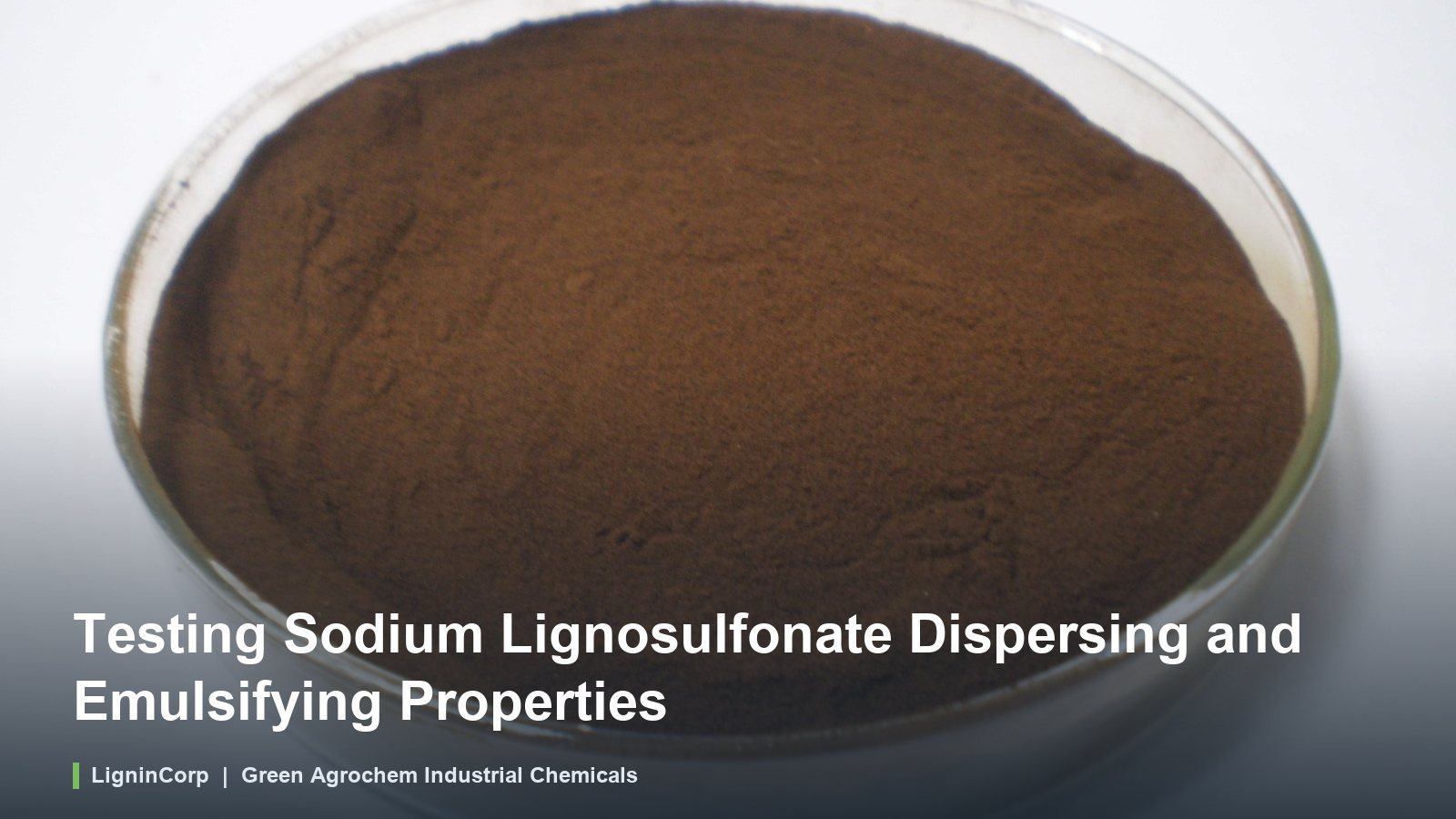
Sodium lignosulfonate can adsorb at solid–water and, in some formulations, oil–water interfaces. Its anionic groups support water compatibility and electrostatic interactions, while aromatic regions can contribute to adsorption on selected surfaces. These features explain why a grade may be screened as a dispersant or emulsion-supporting additive—but they do not prove that every sodium lignosulfonate is an effective stand-alone emulsifier.
This page focuses on how to measure and compare dispersing and emulsifying performance. For molecular identity and specification variables, see the separate structure–property buyer guide.
Mechanism: Adsorption, Charge and Interfacial Balance
Sulfonate and other ionizable groups can give the dissolved polymer an anionic character. When suitable segments adsorb on a particle, the remaining charged/hydrated portions can help reduce close particle–particle approach. The observed response may include lower viscosity, improved wetting or slower settling, depending on the system.
At an oil–water interface, performance depends on the balance between hydrophilic groups and aromatic/hydrophobic regions, as well as molecular distribution and impurities. A material that disperses mineral particles may not stabilize the selected emulsion, and a stable fresh emulsion may still fail during storage, heating, dilution or electrolyte exposure.
Variables That Change the Result
| Variable | Why it matters | Control during comparison |
|---|---|---|
| Particle or oil identity | Surface chemistry determines adsorption and wetting. | Use the customer’s actual raw material and surface treatment. |
| Solids/oil fraction | Changes surface area, crowding, viscosity and phase behaviour. | Record mass fractions and total batch composition. |
| pH and water quality | Affect ionization, electrolytes and competing adsorption. | Fix pH, hardness, conductivity and salt composition. |
| Grade composition | Molecular distribution, charge, salts, sugars and insolubles vary. | Use exact-grade TDS/COA and normalize on dry solids. |
| Mixing or milling energy | Can dominate droplet or particle-size development. | Fix equipment, speed, time, temperature and addition sequence. |
| Other additives | Surfactants, defoamers, electrolytes and polymers may interact. | Test the complete formulation, including order of addition. |
Dispersant Screening Protocol
- Prepare an untreated control using the defined particle, liquid phase, pH and solids.
- Screen several additions on a clearly stated active- or dry-solids basis.
- Keep mixing/milling energy and temperature constant.
- Measure initial viscosity or rheology, particle-size distribution, wetting and foam.
- Track settling, hard sediment, redispersibility and viscosity after storage or temperature cycling.
- Check downstream effects such as colour, filtration, coating quality, drying, firing or cement hydration.
Emulsion Screening Protocol
- Define oil identity, aqueous composition, phase ratio, pH and target emulsion type.
- Use controlled homogenization energy and addition sequence.
- Measure droplet-size distribution where available, not only visual appearance.
- Record creaming, coalescence, phase separation and viscosity over the required storage period.
- Challenge the system with relevant dilution, salts, temperature, freeze–thaw or shear conditions.
- Compare against the existing emulsifier system and evaluate whether a co-emulsifier is required.
How to Interpret Common Results
| Observation | Possible cause | Next check |
|---|---|---|
| Low initial viscosity but rapid settling | Good short-term dispersion with inadequate stabilization. | Particle-size distribution, adsorption, grade level and rheology modifier. |
| High foam | Interfacial activity or mixing sequence. | Air entrainment, defoamer compatibility and process energy. |
| Flocculation after salt addition | Electrolyte or hardness sensitivity. | Water quality, counter-ion, charge level and competing additives. |
| Emulsion separates during heating | Insufficient interfacial film or phase change. | Temperature profile, emulsifier package and oil composition. |
| Batch-to-batch viscosity shift | Solids, molecular distribution, salts or measurement variation. | COA, dry-solids correction and standardized test method. |
Evidence and Dosage Requirements
Do not describe polydispersity, branching, bio-based origin or water solubility as proof of superior dispersion or emulsion stability. Product specifications require the current exact-grade TDS/SDS/COA. A numerical addition may be shown as a supplier-recommended starting trial range only when the exact grade, document revision, application and calculation basis are identified. Performance figures require the formulation, control, conditions and test method.
Product and Division Routes
For industrial-grade material, review the LigninCorp sodium lignosulfonate product page and the industrial function overview. Formulation-focused buyers can use the group’s GreenAgrochem lignosulfonate dispersant guide. To request a sample or exact-grade documents, contact LigninCorp with substrate/oil identity, solids, pH, water quality, process conditions and acceptance tests.
