
In high-yield industrial manufacturing and heavy civil engineering, controlling the rheology and water demand of mineral slurries is critical for operational efficiency. Naphthalene Sulfonate Formaldehyde (NSF) condensates—frequently distributed as Sodium Naphthalene Sulfonate Formaldehyde—represent a foundational class of high-range water reducers (HRWR) and specialized dispersing agents.
1. Chemical Identification & Structural Properties
| Parameter | Specification / Technical Detail |
| Chemical Name | Naphthalene Sulfonate Formaldehyde Condensate |
| Common Acronyms | NSF, SNF, PNS (Polynaphthalene Sulfonate) |
| Surfactant Class | Anionic Polymer / Dispersant |
| Physical Form | Free-flowing light brown to dark brown powder / Highly concentrated amber liquid |
| Water Solubility | Fully soluble in aqueous systems |
| Primary Mechanism | Steric hindrance and powerful electrostatic repulsion |
2. Core Mechanism of Action: Electrostatic Dispersion
The high performance of NSF stems directly from its polymeric, multi-sulfonated architecture. When introduced into a dense aqueous suspension of mineral particles (such as cement grains, gypsum crystals, or raw clays), the hydrophobic polymer backbone adsorbs aggressively onto the particle surfaces.
This adsorption aligns the highly polar, negatively charged sulfonate groups outward into the aqueous phase. The resulting uniform negative surface charge causes neighboring particles to repel one another intensely. This electro-kinetic repulsion breaks up particle agglomerates, releasing trapped water and drastically lowering system viscosity without requiring excess water addition.
3. Key Industrial Application Matrix
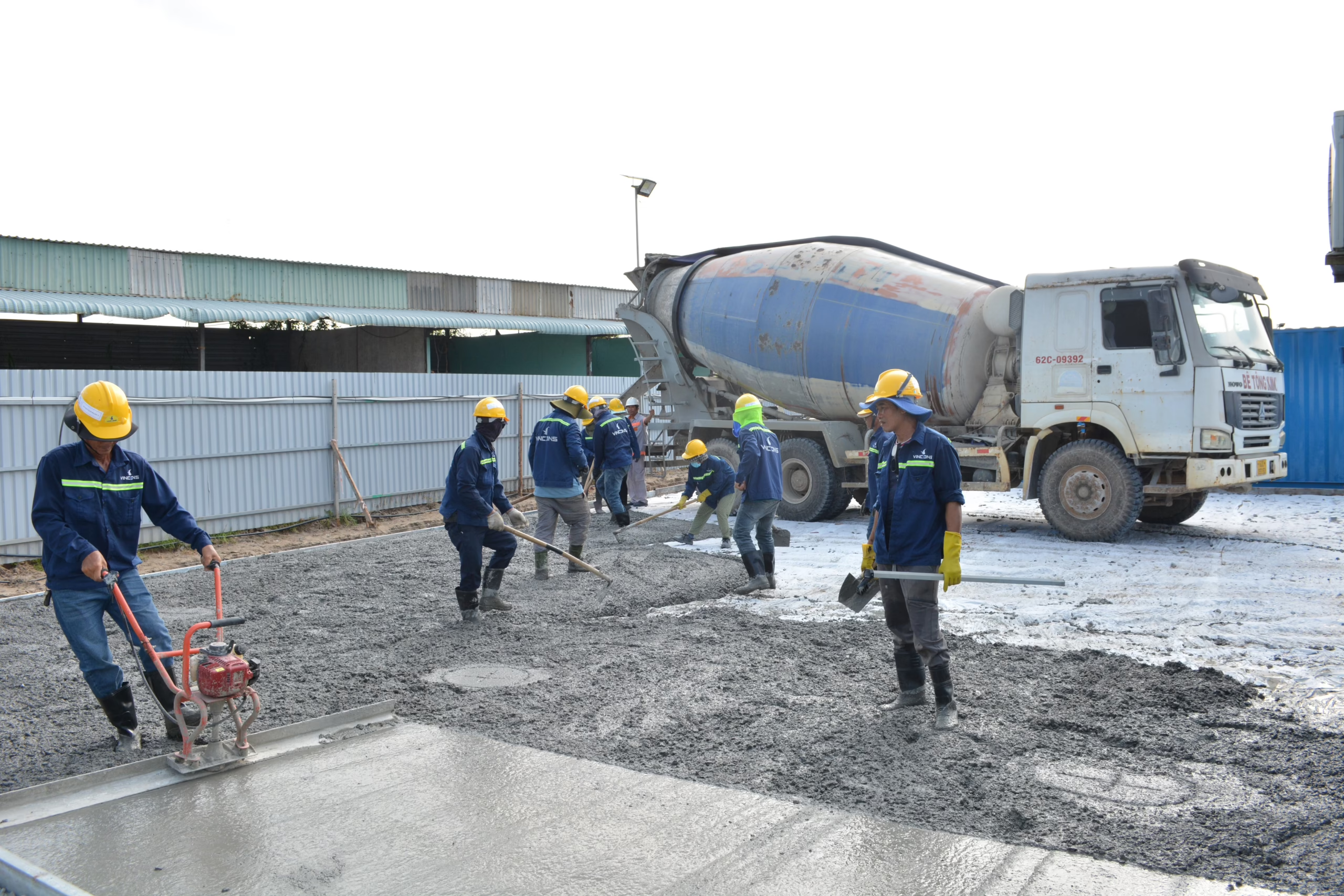
Construction Chemicals (High-Range Concrete Water Reducer)
NSF is a primary constituent in mid- to high-tier concrete admixture formulations. Functioning as a high-range water reducer (superplasticizer), it provides distinct engineering advantages:
- Water Reduction: Enables water reduction capabilities of 15% to 25%, significantly increasing the compressive strength and durability of cured concrete.
- Slump Enhancement: Drastically improves the slump and self-leveling flow of fresh concrete, allowing for seamless pumping and placement in heavily reinforced structures without segregation.
- Set Regulation: Maintains predictable hydration kinetics, making it ideal for ready-mix trucks navigating high-temperature urban traffic environments.
Gypsum & Wallboard Manufacturing
In automated gypsum board production lines, NSF is utilized as a high-efficiency fluidizer. By lowering the water-to-stucco ratio needed to achieve a pourable slurry, it reduces the thermal energy and time required in the drying kilns. This directly accelerates line speeds, lowers manufacturing costs, and yields a denser, structurally stronger core matrix.
Agrochemical Formulations
NSF serves as a premium dispersing agent in agricultural biotechnology. It is formulated into Wettable Powders (WP) and Water-Dispersible Granules (WDG) to ensure active crop protection particles remain uniformly suspended in spray tanks, preventing sedimentation and nozzle blockages during field applications.
Textile and Dye Auxiliaries
Within industrial dye houses, NSF acts as a leveling and dispersing agent for disperse and vat dyes. It prevents dye particle aggregation during high-temperature cycles, ensuring uniform color penetration and preventing structural shading defects across synthetic fabrics.
4. Performance Characteristics and System Advantages
- Broad pH and Thermal Stability: NSF retains its molecular structure and dispersing efficiency across wide pH ranges and elevated processing temperatures, making it highly reliable in harsh industrial chemical processes.
- Excellent Cost-to-Performance Ratio: Compared to newer polycarboxylate ether (PCE) alternatives, NSF delivers robust, predictable fluidization at a highly competitive economic benchmark, maximizing formulation margins.
- Zero Air Entrainment: Unlike some natural biopolymer dispersants, NSF does not introduce unwanted air micro-bubbles into cementitious or ceramic matrices, preserving the structural density of the finished product.
