
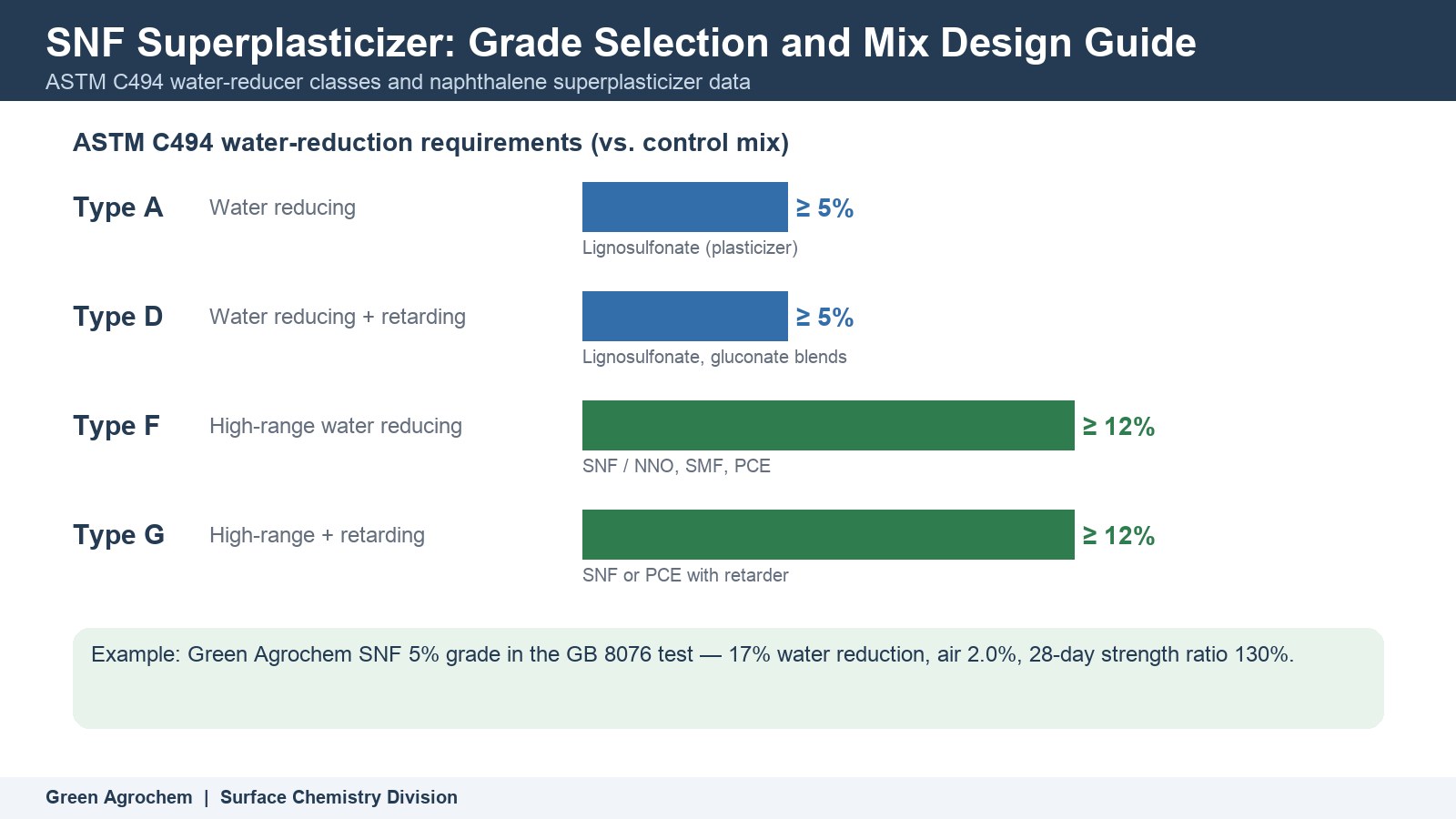
SNF superplasticizer—sodium naphthalene sulfonate formaldehyde condensate, also called PNS or NSF—is a high-range water-reducing component used in concrete-admixture formulations. Reliable selection depends on the exact product grade, cement system and verified mix performance, not on a universal dosage or strength claim.
This guide is for grade selection and mix-design planning. For current product specifications, documentation and samples, use the LigninCorp SNF product-family page.
How SNF Works in Cementitious Systems
SNF molecules adsorb on cement-particle surfaces and introduce negative charge. The resulting electrostatic repulsion helps separate flocculated particles and releases water trapped inside those clusters. Depending on the formulation objective, this can support higher workability at constant water or lower water content at a selected workability.
The response is not fixed. Cement mineralogy, sulfate balance, fineness, supplementary cementitious materials, aggregate grading, temperature, mixing energy and companion admixtures can all change the dosage-response curve.
Selecting the Sodium Sulfate Grade
| Grade route | Selection intent | Qualification focus |
|---|---|---|
| 5% sodium sulfate grade | Projects or formulations requiring tighter control of the sulfate contribution from SNF. | Confirm the grade limit, test method, cement compatibility and batch COA. |
| 18% sodium sulfate grade | Standard commercial formulations seeking a practical balance of specification and procurement economics. | Lock the exact grade in the purchasing specification and requalify before substitution. |
| 20% sodium sulfate grade | Approved formulations in which the higher-sulfate commercial grade is acceptable. | Verify total soluble-salt contribution and full concrete performance in the intended mix. |
The grade percentage is a product specification limit—not a dosage, purity claim or assured performance level. Never infer application performance from sulfate grade alone.
Recommended Mix-Design Trial
- Define the control mix and measurable acceptance criteria: workability and retention time, air content, setting window, stability, strength ages and any project-specific durability tests.
- Obtain the current grade-specific TDS, SDS and representative COA.
- Use the supplier document to set an initial screening range on a clearly defined basis—such as as-supplied product or dry solids per total cementitious material.
- Test several levels with the actual cement, SCMs, aggregates, water and companion admixtures.
- Plot the complete response rather than selecting the highest initial flow. Review retention, air, setting, bleeding/segregation and strength together.
- Confirm the chosen formulation in a controlled production batch and document allowable operating tolerance.
Common Trial Problems
Good Initial Flow, Poor Retention
Review cement compatibility, temperature, mixing sequence and the need for a separate retention strategy. Do not assume more SNF will solve the problem.
Unexpected Setting Change
Check the entire admixture package, cement source and sulfate balance. Repeat against an untreated control using the same temperature and mixing procedure.
Bleeding or Segregation
Reassess water content, paste volume, aggregate grading, air and dosage. High measured flow is not evidence of a stable mix.
Variable Plant Results
Confirm batching accuracy, moisture corrections, mixing time, addition sequence and the COA of each incoming SNF batch.
SNF Compared with Other Water Reducers
SNF is often evaluated where robust electrostatic dispersion, established processing and cost-performance are important. Lignosulfonate-based reducers may be considered for moderate water reduction and set-control needs, while polycarboxylate ether systems are commonly evaluated where stronger retention or different rheological control is required. The choice should be made by comparative testing against the project specification rather than by a generic ranking.
Information to Include in an RFQ
- Required SNF grade and sodium sulfate limit.
- Application, cement type and applicable standard.
- Target workability, retention, setting and strength criteria.
- Required TDS/SDS revision, COA limits and sample quantity.
- Annual volume, packaging, delivery schedule, Incoterm and destination port.
Request current documents or a sample through the LigninCorp technical enquiry route or email info@greenagrochem.com.
SNF Grades and Specifications
| Grade | Na2SO4 | Cement paste fluidity | Chloride | Solids | pH |
|---|---|---|---|---|---|
| SNF 3% (GAC-SNF-3) | < 3% | ≥ 220 mm | < 0.4% | ≥ 91% | 7 – 9 |
| SNF 5% (GAC-SNF-5) | 5% max | 220 mm min | 0.4% max | 91% min | 7 – 9 |
| SNF 10% (GAC-SNF-10) | 10% max | 220 mm min | 0.4% max | 91% min | 7 – 9 |
| SNF 18% (GAC-SNF-18) | 18% max | 210 mm min | 0.5% max | 91% min | 7 – 9 |
| SNF 20% (GAC-SNF-20) | 20% max | 210 mm min | 0.5% max | 91% min | 7 – 9 |
| SNF powder, high solids (GAC-SNF-P) | 10% max | — | < 200 ppm | 95% min | 6.5 – 8.5 (1:10) |
Concrete Test Data From the TDS
| Test (concrete) | Criterion | SNF 5% | SNF 18% / 20% |
|---|---|---|---|
| Water reduction | 14% min | 17% | 16% |
| Air content | 3.0% max | 2.0% | 2.0% |
| Water penetration ratio | 90% max | 80% | 85% |
| Compressive strength ratio, 1 d | 140% min | 165% | 160% |
| Compressive strength ratio, 3 d | 130% min | 155% | 155% |
| Compressive strength ratio, 7 d | 125% min | 135% | 135% |
| Compressive strength ratio, 28 d | 120% min | 130% | 125% |
| Shrinkage ratio, 28 d | 135% max | 87% | 89% |
Starting Dosage
Supplier-recommended starting trial range for SNF in concrete: 0.5 – 1.0% by weight of cementitious material, with 0.75% as a first trial level (grade TDS). Confirm the dose in trial mixes with your own cement and aggregates.
Grades and documents: SNF product family. Background on the chemistry: NSF explained.
Frequently Asked Questions
What is the full form of SNF admixture?
Sodium naphthalene formaldehyde (sodium naphthalene sulfonate formaldehyde condensate), also called PNS or NSF.
How much SNF superplasticizer is added to concrete?
Supplier-recommended starting trial range: 0.5 – 1.0% by weight of cementitious material, 0.75% as a first trial.
What is the difference between SNF 5% and SNF 20%?
The maximum sodium sulfate content. SNF 5% also has a higher cement paste fluidity specification (220 vs 210 mm).
What water reduction does SNF give?
In the TDS concrete tests, 17% (SNF 5%) and 16% (SNF 18% / 20%), against a 14% minimum criterion.
