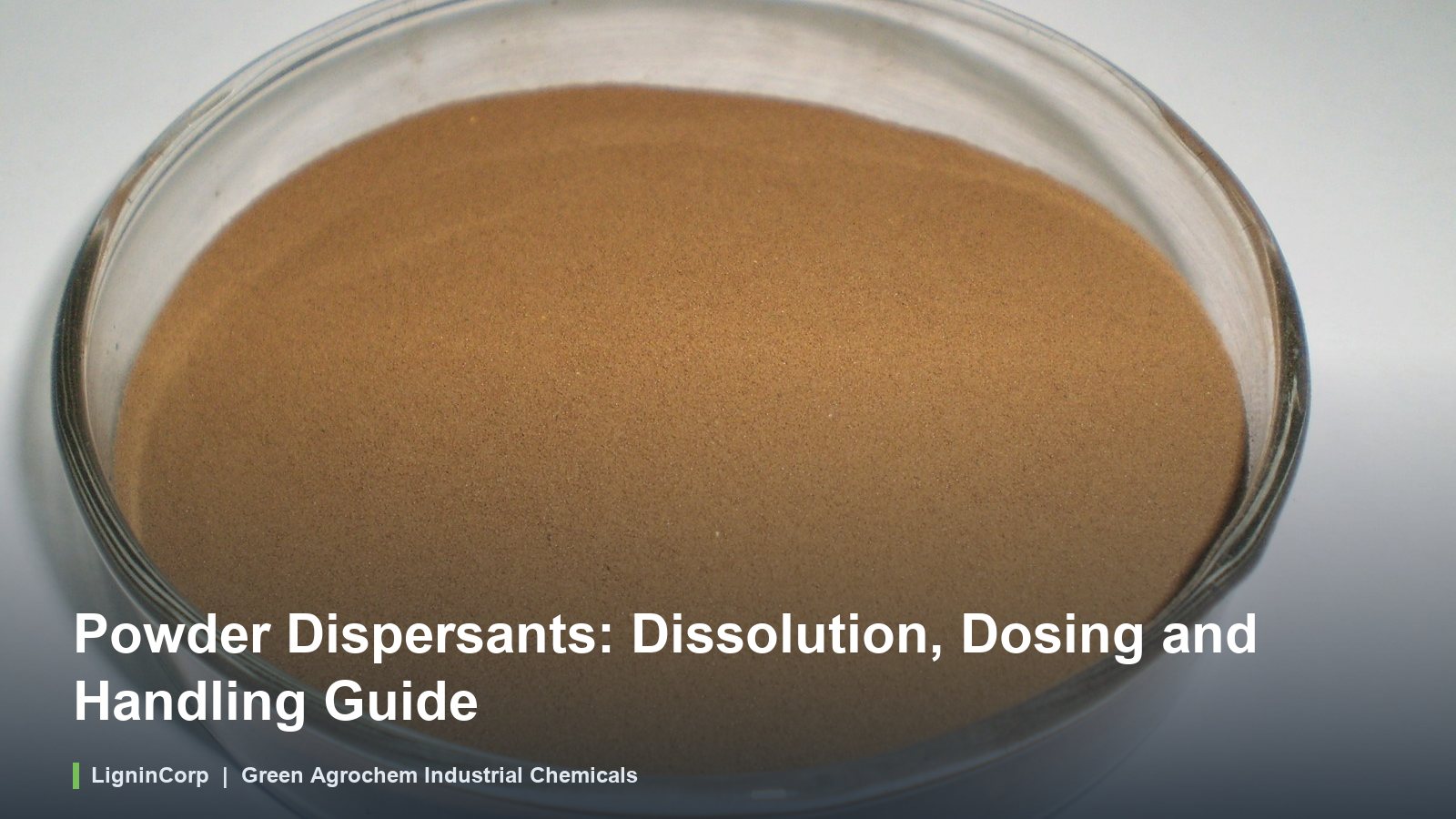
A powder dispersant is a dry-form additive selected to help incorporate and stabilize particles in a defined industrial process. “Powder” describes the supplied form, not one chemistry or a guaranteed performance level. Lignosulfonates, naphthalene-sulfonate condensates, polycarboxylates and other materials can all be supplied as powders, but their dissolution, compatibility and end-use behavior differ.
This guide focuses on powder handling, solution preparation, dosage basis and plant qualification. For general mechanism and chemistry selection, see the Industrial Dispersants Selection and Testing Guide.
Powder versus liquid: make a process decision
| Decision factor | Powder form | Liquid form |
|---|---|---|
| Delivered material | Less carrier water, but requires dry handling and often solution preparation. | Ready for pumping or dilution when compatible with the process. |
| Equipment | Needs controlled bag discharge, dust extraction, feeding and suitable mixing. | Needs tanks, pumps, meters, freeze or heat review and spill containment. |
| Dosage control | Can be dry-fed or dissolved; moisture and dissolution completeness affect the basis. | Requires confirmed solids or active content, density where volume-metered, and homogeneity. |
| Storage risk | Moisture pickup, caking, dust and segregation must be controlled. | Settling, microbial change, viscosity drift, freezing or evaporation may be relevant by grade. |
| Total cost | Include solution-make-down labor, energy, dust control and handling loss. | Include carrier freight, tank use, pumping, cleaning and storage losses. |
Confirm that the powder can be handled safely
Review the current product-specific SDS before designing unloading or feeding. Confirm bag or bulk format, dust controls, required personal protection, grounding or ignition precautions where applicable, spill collection and disposal requirements. Do not infer hazard classification from the generic word “dispersant.”
For routine receiving, verify product code, lot number, packaging condition, appearance and the COA parameters agreed in the purchase specification. Store the material under the supplier’s stated conditions and keep opened packaging protected from moisture and contamination.
Develop a controlled solution-preparation procedure
- Confirm whether the grade is intended for dry feeding, pre-dissolution or either route.
- Record water quality, temperature, solution concentration, vessel geometry and mixer type.
- Add material at a controlled rate that avoids floating rafts, dust release and dry lumps.
- Use enough circulation or agitation to wet and dissolve the powder without unnecessary air entrainment.
- Define the endpoint by appearance and an appropriate check such as filtration, solids, viscosity or residue—not by mixing time alone.
- Establish solution hold time, recirculation, temperature limits and cleaning requirements through stability testing.
A procedure developed for one grade should not be copied to another without confirmation. Particle size, moisture, salts, molecular distribution and processing history can change dissolution behavior.
State the dosage basis before comparing products
Powder addition can be reported as as-supplied product, dry matter or active component. These bases are not interchangeable. For a defined dry-matter comparison, calculate:
Dry-matter addition = as-supplied powder addition × dry-matter fraction.
Use the current exact-grade TDS or shipment COA for the applicable value and record whether it is a specification limit or batch result. Do not use a generic internet specification or transfer a value from another grade. Supplier guidance should be treated as a recommended starting trial range only when the exact product, source document, revision and calculation basis are identified.
Evaluate dissolution and application performance separately
A clear solution does not prove that a product will disperse the target particles, and a successful laboratory slurry does not prove that the powder will run reliably through plant feeding equipment. Qualification should cover both stages.
- Make-down checks: feed consistency, wetting, lump formation, dissolution endpoint, residue, foam and prepared-solution stability.
- Application checks: viscosity or flow at defined conditions, particle-size distribution, sedimentation, redispersibility, filtration and downstream product properties.
- Plant checks: bag emptying, dust, feeder accuracy, transfer, tank circulation, pump or nozzle performance, cleaning and batch repeatability.
Select a documented industrial grade
For a lignin-derived powder option, review the exact documentation for industrial Sodium Lignosulfonate. For cementitious or selected industrial systems requiring naphthalene-sulfonate condensate chemistry, compare the relevant powder SNF grades. The product code and current TDS, SDS and COA must accompany any specification comparison.
Wettable-powder, water-dispersible-granule, dye and pigment formulation work belongs to the group’s Surface & Interface Technology division; use the GreenAgrochem.net formulation guide for that application route.
Powder dispersant RFQ checklist
Include the target particle, liquid phase, formulation conditions, required function, preferred chemical family, dry-feed or make-down route, equipment, test criteria, required documentation, packaging, shipment size and delivery location. Ask the supplier to identify all quoted values as specification limits, typical data, COA results or recommended starting trial information.
Use the LigninCorp technical enquiry form or email info@greenagrochem.com for grade and process review.
