
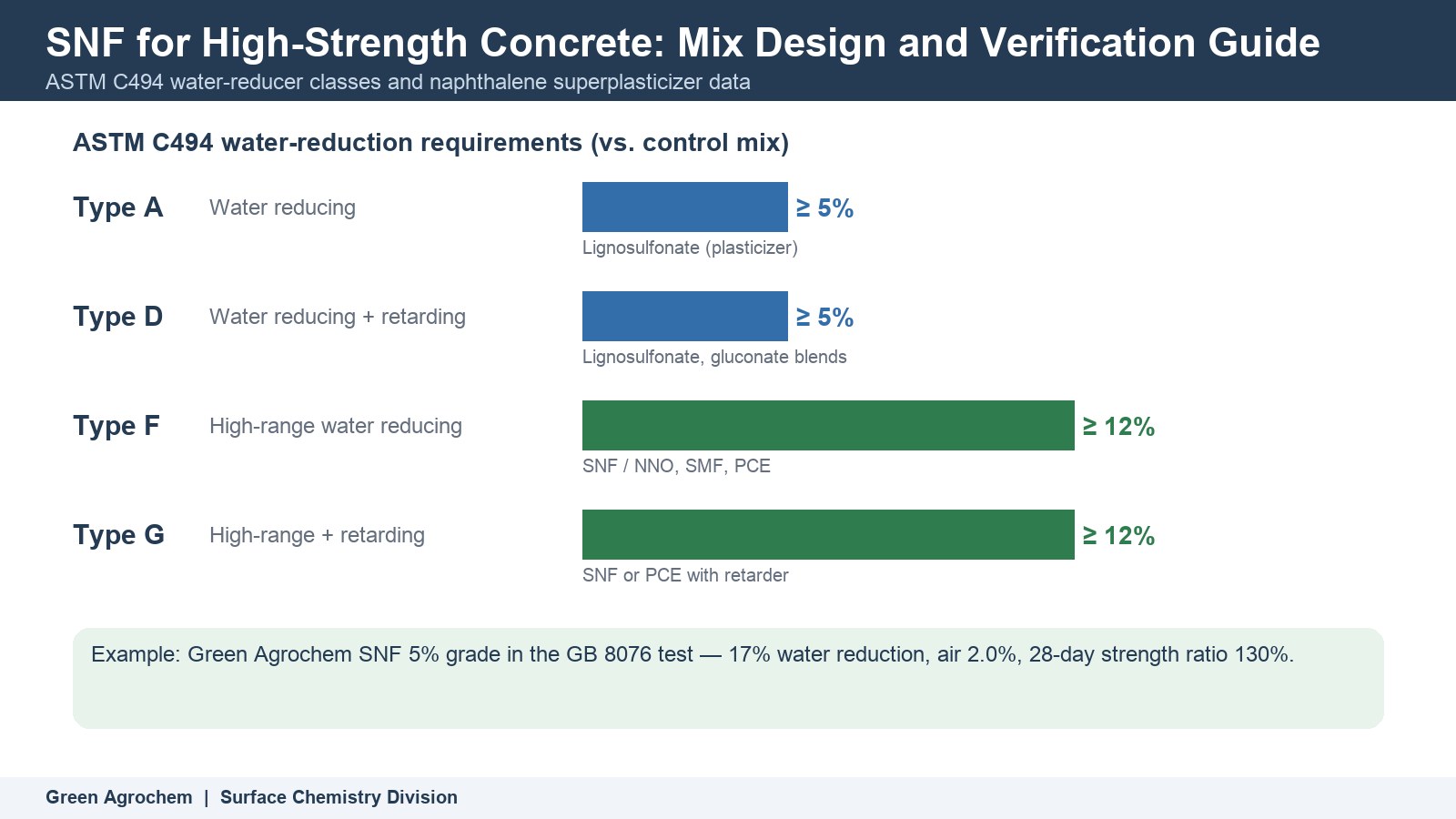
An SNF-based admixture is a concrete admixture whose active ingredient is SNF (sodium naphthalene formaldehyde, a naphthalene sulfonate superplasticizer). In high-strength concrete it is used to reach a low water-cement ratio while keeping the mix workable.
High-strength concrete is not created by adding a fixed amount of superplasticizer to a standard mix. It is developed as a coordinated system: cement and supplementary cementitious materials, aggregate packing, total water, admixture chemistry, mixing sequence, placing method and curing all influence the result. Sulphonated naphthalene formaldehyde (SNF) can support this process by dispersing cement particles and helping the producer reach the required workability at a controlled water-to-binder ratio.
This guide explains where SNF fits in high-strength concrete, how to evaluate it with project materials and which records a concrete producer should request before approving a grade. For product availability, see our SNF superplasticizer product page.
What SNF contributes to a high-strength mix
SNF is an anionic dispersant. After adsorption on cement particles, its sulfonate groups increase electrostatic repulsion and reduce flocculation. Water trapped inside cement agglomerates becomes more available for flow and wetting. In a properly designed mixture, the producer can use this dispersion to:
- adjust workability without solving every slump problem by adding water;
- support a lower water-to-binder ratio selected by the mix designer;
- improve mixing and placement consistency when batching and moisture control are stable;
- develop early-age handling strength or later-age design strength through a validated mix and curing regime.
SNF does not independently guarantee a strength class, permeability value or service life. Those outcomes must be demonstrated with the actual cementitious system, aggregates, production equipment and curing conditions.
Where SNF can be a practical choice
SNF remains relevant where the required workability window, local cement chemistry, project economics and production process suit naphthalene-based dispersants. Common evaluation contexts include precast units, structural concrete, pumped concrete with controlled delivery times, dense reinforcement and industrial elements. It may also be considered where a plant already has established SNF quality-control procedures.
For projects requiring a long slump-retention window, very low water-to-binder ratios or complex compatibility with multiple supplementary cementitious materials, SNF should be compared directly with other admixture technologies. The decision should be based on trial data and total delivered-concrete cost—not chemistry name alone.
Build the performance brief before selecting a grade
A useful supplier brief converts “high strength” into measurable acceptance criteria. Record at least:
- required strength ages and acceptance method;
- target slump, flow or rheology at discharge and placement;
- maximum transport, waiting and pumping time;
- cement source, supplementary cementitious materials and expected variability;
- aggregate grading, absorption and moisture-control method;
- placing, compaction, finishing and curing conditions;
- limits for air, bleeding, segregation, setting time and dimensional stability;
- exposure-related durability requirements defined by the project specification.
This brief prevents a high laboratory slump or a single compressive-strength result from being treated as proof of complete field suitability.
Dosage: use the current grade TDS as the trial basis
There is no responsible universal dosage for every SNF grade and concrete mixture. Product solids, sodium sulfate, molecular distribution and the form supplied can differ. Cement composition, fineness, sulfate balance, supplementary materials, temperature and mixing sequence also affect demand.
Use the supplier-recommended starting trial range stated in the current TDS for the exact offered grade. Confirm whether the dosage basis is total cementitious material, cement only, liquid product or dry solids. Then bracket that starting point in laboratory trials. Do not copy a percentage from another supplier, another solids content or an unrelated project.
At each trial point, record initial workability, workability over the required time, unit weight, air, temperature, bleeding, segregation, setting behavior and strength at the specified ages. The approved production dosage should come from this evidence and remain subject to adjustment when raw materials or temperature change.
A controlled trial-mix sequence
- Characterize the baseline. Confirm aggregate moisture, grading, cementitious-material certificates and the performance of the control mix.
- Hold variables constant. Compare admixture levels without changing water, aggregate proportions and mixing energy at the same time.
- Follow the declared basis. Weigh the product accurately and document whether it was introduced with mixing water or at another validated stage.
- Measure the full workability window. Test at the times that represent batching, transport, pumping and placement.
- Inspect stability. A fluid mix is not acceptable if it bleeds, segregates or traps unacceptable air.
- Cast and cure consistently. Compare specimens prepared, stored and tested under the same procedure.
- Scale up cautiously. Verify the selected formulation in plant and field equipment before routine production.
Compatibility checks that matter
Compatibility cannot be inferred from an SNF label. Changes in cement source, alkali and sulfate balance, limestone content, silica fume, slag, fly ash, clay-bearing fines or another admixture can alter adsorption and workability retention. A robust approval program therefore checks:
- cement and supplementary-material combinations expected during supply;
- sequence sensitivity and realistic mixer efficiency;
- hot- and cold-weather behavior where relevant;
- interaction with set-control, air-control or other admixtures;
- response to normal aggregate-moisture and grading variation.
See how SNF disperses cement for the underlying mechanism and SNF in cement systems for additional compatibility considerations.
Common failure modes and corrective checks
Rapid workability loss
Check cement compatibility, temperature, elapsed time, mixing sequence and product basis. Do not restore workability by uncontrolled water addition. Re-test the formulation against the required delivery window.
Bleeding or segregation
Review total paste volume, aggregate grading, moisture correction, admixture level and mixing uniformity. High flow is not evidence of a stable high-strength mix.
Unexpected setting behavior
Confirm batching accuracy, cement source, product identity, temperature and interaction with other admixtures. Investigate the cause before changing several variables simultaneously.
Strength below target
Audit actual water addition, specimen preparation, curing, air, consolidation, raw-material variation and test procedure. Admixture selection is only one part of the root-cause analysis.
Supplier documentation for technical approval
Before qualification, request the current TDS and SDS for the exact commercial grade, a representative COA, declared physical form and solids basis, storage requirements, shelf-life statement, packaging options and change-control process. Any standards claim should identify the specific grade, test basis and current supporting report; a general reference to a standard is not a project approval.
For commercial comparison, evaluate cost per accepted cubic metre, not price per kilogram alone. Include effective dose on the correct basis, rejected batches, workability retention, cycle time, storage, transport and technical support.
Procurement conclusion
SNF can be a useful component of high-strength concrete when its dispersion behavior matches the binder system and production window. The defensible route is to define performance, select the exact grade, begin from its current TDS recommendation, conduct controlled trials and approve the final mixture from recorded results. Contact info@greenagrochem.com with your cementitious system, target workability window, strength ages and required documentation so the appropriate grade can be screened for testing.
SNF Grades and Data Sheet Values
Our current SNF grades differ mainly in sodium sulfate content:
| Grade | Sodium sulfate (Na2SO4) | Chloride (Cl–) | Cement paste fluidity | Solids | pH |
|---|---|---|---|---|---|
| SNF-5 (GAC-SNF-5) | 5% max | 0.4% max | 220 mm min | 91% min | 7 – 9 |
| SNF-10 (GAC-SNF-10) | 10% max | 0.4% max | 220 mm min | 91% min | 7 – 9 |
| SNF-18 (GAC-SNF-18) | 18% max | 0.5% max | 210 mm min | 91% min | 7 – 9 |
| SNF-20 (GAC-SNF-20) | 20% max | 0.5% max | 210 mm min | 91% min | 7 – 9 |
| Powder Grade, high solids (GAC-SNF-P) | 10% max | Below 200 ppm | Not listed | 95% min | 6.5 – 8.5 (1:10) |
The current TDS gives a supplier-recommended starting trial range of 0.5–1.0% powder by weight of cementitious material, with 0.75% as the first trial point. Confirm the working dose by trial mixes with your own cement, aggregates and admixtures.
Concrete test data, packaging and TDS downloads are on the SNF product page.
Frequently Asked Questions
What is an SNF-based admixture?
A concrete admixture whose active ingredient is SNF, a naphthalene sulfonate superplasticizer, supplied as powder or made into a liquid.
What is the full form of SNF in admixtures?
Sodium naphthalene formaldehyde, short for sodium naphthalene sulfonate formaldehyde condensate.
Can SNF be used for high-strength concrete?
Yes, for many high-strength mixes. For very low water-binder ratios or long slump retention, PCE is often preferred; test both.
What dose of SNF is used in high-strength concrete?
Start trials from the TDS range of 0.5–1.0% by weight of cementitious material, with 0.75% as the first trial, then adjust for your target water-binder ratio.
