
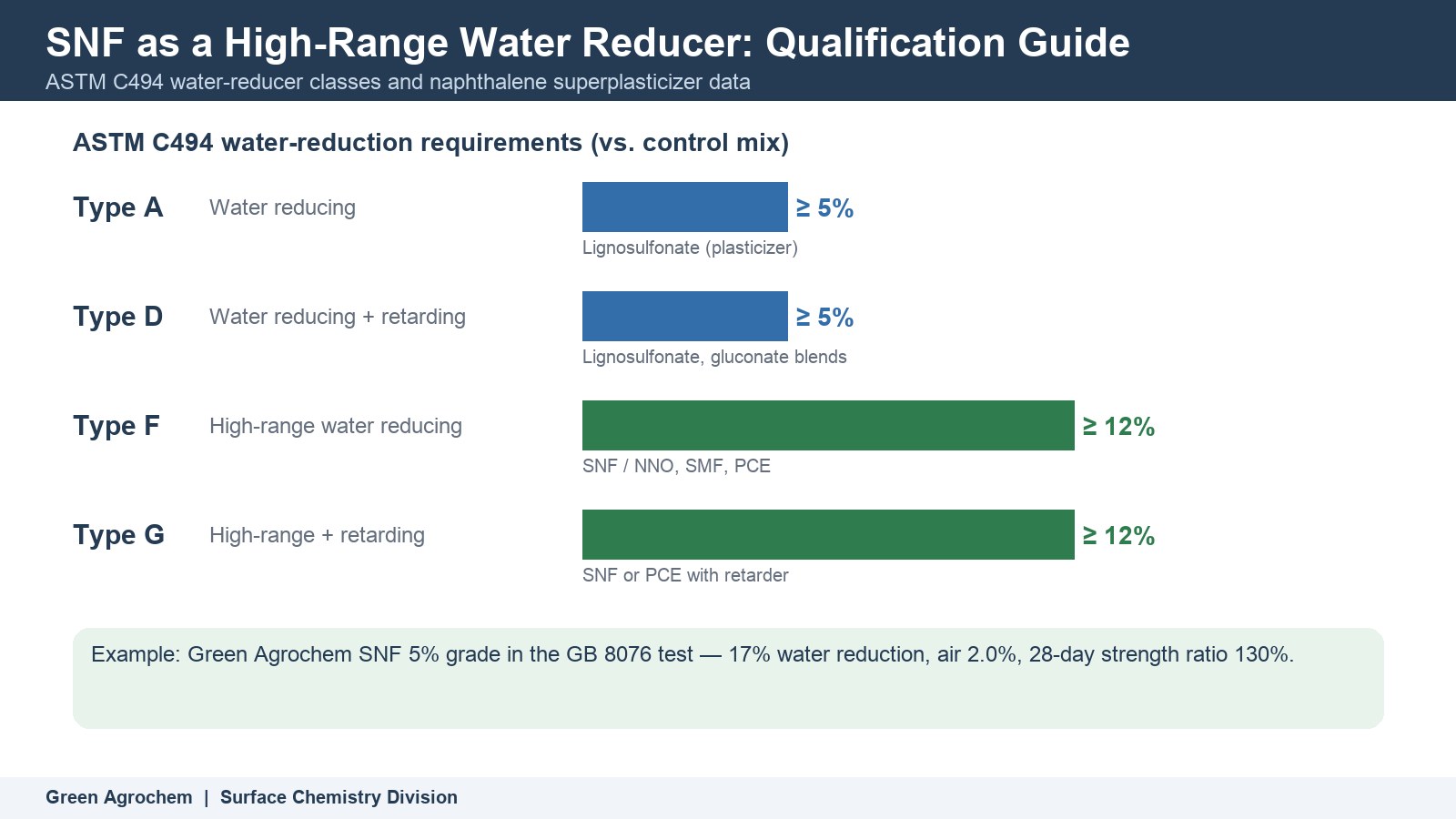
SNF is used as a high-range water reducer when its cement-dispersion performance is verified against a defined concrete specification. The designation describes an admixture function; it does not establish a universal water-reduction percentage, dosage, strength increase or standards compliance for every commercial grade.
This guide gives concrete producers and procurement teams a structured method for qualifying sulphonated naphthalene formaldehyde (SNF) as a high-range water-reducing admixture. Product formats are available on the SNF product page.
How the high-range water-reducing function is created
SNF molecules adsorb on cement-particle surfaces. Their anionic sulfonate groups increase electrostatic repulsion, reduce particle flocculation and release water held within agglomerates. A mix designer can use that dispersion in two principal ways:
- increase workability while holding total water approximately constant; or
- reduce water while maintaining a specified workability.
The measured response depends on cement chemistry, sulfate balance, fineness, supplementary cementitious materials, aggregate fines, temperature, sequence and elapsed time. The product name alone cannot predict the result.
Define the qualification route
Before testing, identify the applicable project specification and the function being claimed. A standards designation should be supported by a current test report for the exact grade, not inferred from another supplier’s data. Establish acceptance criteria for:
- water reduction at matched workability, using the specified method;
- initial and retained slump or flow;
- setting behavior;
- air content, unit weight, bleeding and segregation;
- compressive strength at the required ages;
- any exposure-specific durability property required by the project.
Water reduction is a test result, not a dosage. Report it with the control mix, material sources, temperature, addition basis and test method.
Use the exact-grade TDS for the starting trial
A generic online dosage is not an approval basis. Use the supplier-recommended starting trial range in the current TDS for the exact offered grade. State whether the value is based on cement or total cementitious material and whether it applies to supplied product or dry solids.
Test around that starting point with the actual cement, additions, aggregates, water and other admixtures. Approve the final production level only after laboratory and plant validation. Requalify after material-source or formulation changes that could affect response.
Example of the concrete test data a grade TDS should contain:
| Item | Age | Criterion | Result |
|---|---|---|---|
| Water reduction | — | 14% min | 16% |
| Air content | — | 3.0% max | 2.0% |
| Compressive strength ratio | 3 d | 130% min | 155% |
| Compressive strength ratio | 28 d | 120% min | 125% |
Controlled comparison with a reference mix
- Confirm aggregate moisture and calculate actual total water.
- Prepare a reference mix under a documented mixing and curing procedure.
- Prepare SNF trials while holding unrelated variables constant.
- Adjust only through the approved test plan; do not change water, sequence and dosage simultaneously.
- Measure fresh properties through the real transport and placement window.
- Inspect stability and setting before interpreting strength results.
- Test hardened specimens at the specified ages under consistent curing.
A successful laboratory comparison should be repeated in plant equipment because batch size, mixer energy, charging sequence and temperature can change performance.
Select between SNF grades
SNF products may differ in physical form, solids basis, sodium sulfate, moisture, pH and molecular distribution. These differences can affect storage, dissolution, dosing and cement response. Compare suppliers using current documents and representative batch data rather than grade names alone.
For example, lower-sulfate grades may be evaluated where the buyer’s formulation or acceptance limits make sulfate control important, while a different grade may provide adequate performance at a better delivered cost. The correct choice is the grade that passes the project’s tests consistently.
Use the SNF selection scorecard to compare documentation, consistency, performance and cost-in-use.
Compatibility and workability retention
SNF performance is sensitive to the binder system. Evaluate all cement and supplementary-material combinations expected during supply. Where other admixtures are used, test the complete package and its addition sequence. Do not assume physical blending or simultaneous addition is acceptable.
If the project needs an extended workability window, compare retained workability at realistic temperatures and times. Another admixture technology may be more appropriate when retention, extremely low water-to-binder ratios or particular raw-material interactions dominate the requirement.
Production risks to control
- Incorrect basis: confusing dry solids with as-supplied liquid or powder changes the effective dose.
- Moisture error: uncorrected aggregate water can mask admixture response and change strength.
- Overdosing: may contribute to excessive fluidity, segregation or altered setting; investigate against the exact grade and mix.
- Insufficient mixing: poor distribution can create batch variability.
- Uncontrolled retempering: jobsite water addition removes traceability and changes the approved mixture.
- Material drift: cement, SCM or fine-aggregate changes may require renewed compatibility testing.
Detailed batching controls are covered in Using SNF in Cement Mixing.
Supplier approval documents
Request the current TDS and SDS for the exact grade, representative COA, declared test methods, physical form and solids basis, storage requirements, shelf-life statement, packaging, batch traceability and change-control procedure. Ask for the relevant current report behind any standards claim.
Safety decisions must follow the current product SDS and applicable workplace requirements. Do not rely on generic claims such as “non-toxic,” “safe in all conditions” or a fixed impurity value copied from unrelated product literature.
Commercial comparison
Compare cost per accepted cubic metre rather than unit price alone. Include effective dose on the correct basis, freight and packaging, storage and dissolution where relevant, batch rejection, workability retention, production cycle and technical support. Cement savings, faster demoulding or longer service life should be counted only when the approved trial and project records demonstrate them.
Qualification conclusion
SNF can function as a high-range water reducer when the exact grade satisfies the applicable project test program. Define the function, begin from its current TDS trial recommendation, compare against a controlled reference, validate in plant conditions and maintain traceable production records.
Send your cementitious system, target workability window, applicable standard and required documents to info@greenagrochem.com for grade-screening support.
