
SNF should be treated as a controlled batching component, not as a correction for uncontrolled water or inconsistent raw materials. Sulphonated naphthalene formaldehyde (SNF) disperses cement particles and can help a concrete producer reach the specified workability at controlled water content. The result depends on product basis, aggregate moisture, addition sequence, mixer performance, temperature and elapsed time.
This guide focuses on how to introduce and control SNF during cement and concrete mixing. For product documentation and supply formats, see the SNF superplasticizer product page.
Define the dosage basis before batching
Do not transfer a percentage from another article or supplier. Start with the supplier-recommended starting trial range in the current TDS for the exact SNF grade. The batching instruction must state:
- whether the percentage is based on cement only or total cementitious material;
- whether the value refers to as-supplied liquid, powder or dry solids;
- the product identity and TDS revision;
- the permitted trial range and plant target established by testing.
Powder and liquid products cannot be substituted on equal mass without converting for solids content and confirming formulation equivalence. Any water carried by a liquid admixture should be included in the mix-water accounting when required by the approved procedure.
Correct aggregate moisture first
Variable sand and aggregate moisture can obscure the response to SNF. Measure moisture at the frequency appropriate to the plant and weather, then correct batch water and aggregate masses. Record the actual water entering the mixer from added water, aggregate moisture and liquid components. Uncontrolled water addition changes the water-to-binder ratio and invalidates comparisons between admixture trials.
Select and validate the addition sequence
There is no universal sequence suitable for every cement, mixer and SNF grade. Common plant trials compare addition with part of the mixing water against delayed introduction after the solids have been wetted. The selected sequence should provide consistent dispersion without local overdosing or inadequate mixing.
Document the approved sequence in operational terms: order of materials, water split, time or mixer revolutions before admixture addition, mixing duration after addition and any permitted rinse water. Avoid direct contact between concentrated admixtures unless their compatibility and sequence have been verified.
Laboratory qualification procedure
- Characterize materials. Record cement and supplementary-material sources, aggregate grading and moisture, water source, temperatures and all other admixtures.
- Prepare a control. Establish the mixture response without changing several variables simultaneously.
- Bracket the TDS starting point. Test levels around the exact-grade supplier recommendation using a clearly defined dosage basis.
- Compare sequences. Keep total water and material proportions constant while evaluating the approved sequence candidates.
- Measure over time. Record slump or flow at the intervals representing batching, transport, pumping and placement.
- Check stability and setting. Observe air, unit weight, bleeding, segregation and setting behavior.
- Verify hardened properties. Prepare and cure specimens consistently and test at the ages required by the project.
The selected result is a trial outcome for that material system—not a universal dosage or performance guarantee.
Scale-up from laboratory to plant
Plant mixers differ from laboratory mixers in energy, charging pattern, batch size and material temperature. Confirm the laboratory selection in production equipment before routine use. During scale-up, verify dispenser calibration, minimum weighment, line condition, discharge time and uniform distribution.
A plant trial should reproduce the real delivery and placement window. Record the load’s batch time, discharge time, temperature, actual water, SNF mass, initial and retained workability, air, unit weight and stability. Cast strength specimens only under the approved sampling and curing procedure.
Quality checks during routine production
- confirm the delivery batch and product label against the approved grade;
- inspect storage condition and product homogeneity as required by the TDS;
- verify dispenser calibration and daily zero checks;
- update aggregate-moisture corrections;
- prevent unauthorized water addition at the plant or jobsite;
- trend workability, air, unit weight, setting observations and strength;
- investigate shifts by raw-material lot, temperature and sequence.
Troubleshooting mixing problems
Low initial workability
Check actual water, aggregate moisture, product identity, dispenser output, cement source and mixing energy before increasing dosage. Confirm that the grade has not been calculated on the wrong solids basis.
Rapid slump loss
Review temperature, elapsed time, cement compatibility, water split and addition sequence. Test any proposed retarder or alternative admixture as a complete system; do not assume compatibility.
Bleeding or segregation
Check overdosage, excess water, aggregate grading, paste volume, air and mixing uniformity. Do not accept high flow when stability is outside the project criteria.
Delayed or variable setting
Audit batching accuracy, raw-material lots, temperature and interaction with other admixtures. Avoid changing dosage, water and sequence at the same time during the investigation.
Unexpected strength results
Review actual water-to-binder ratio, air, specimen preparation, curing and test procedure before attributing the result to SNF. A change in workability does not by itself prove a change in strength.
Jobsite controls
The approved concrete should arrive within the validated time and temperature window. If workability is outside specification, follow the project’s documented adjustment and rejection procedure. Unrecorded water or admixture addition destroys traceability and can change setting, stability and hardened properties.
For pumping or congested reinforcement, verify pump response, passing ability and finishability under field conditions. SNF does not automatically make a mixture self-compacting; that classification requires its own flow, passing and segregation-resistance checks.
Documentation required for approval
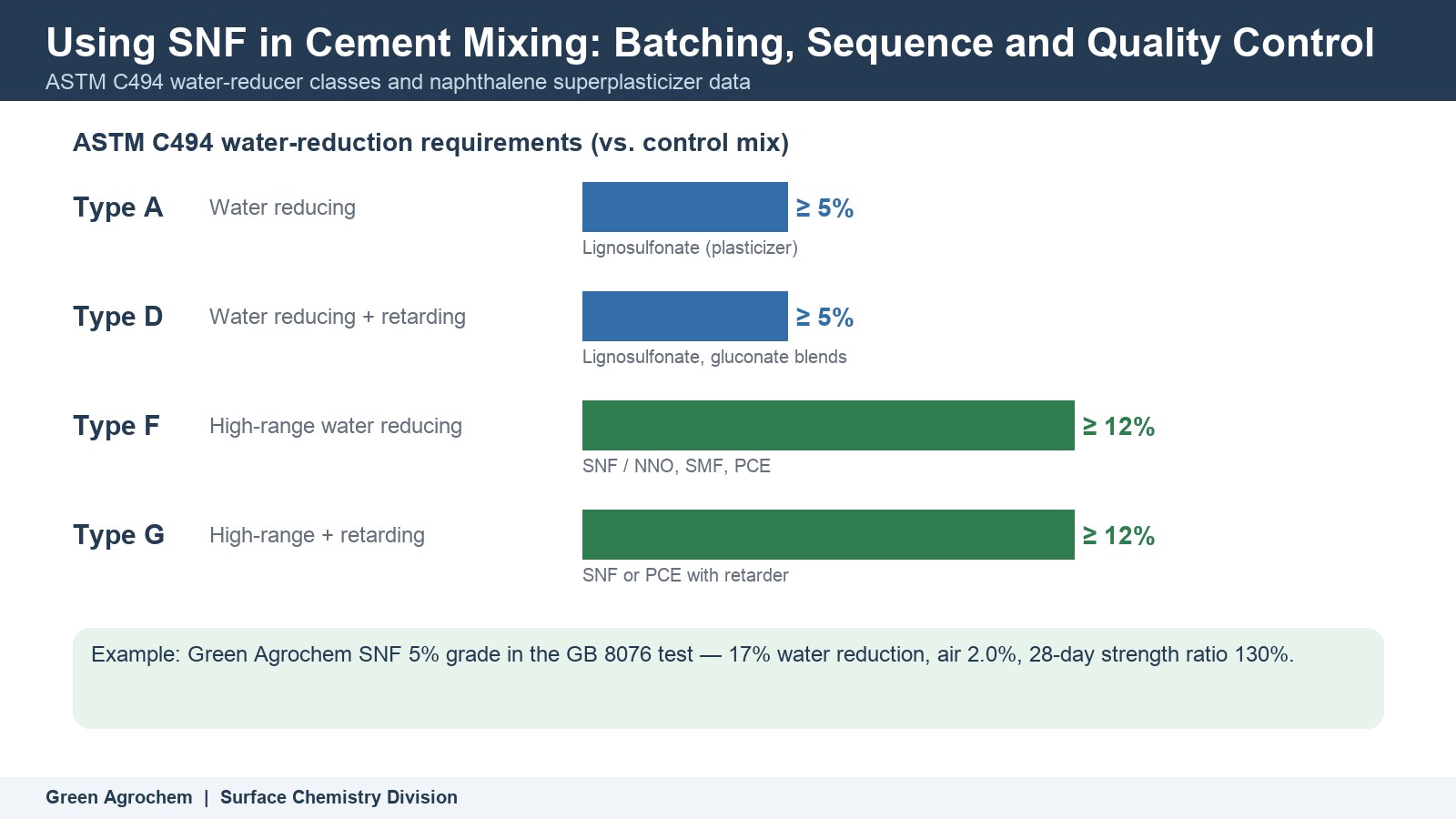
Maintain the current TDS and SDS for the exact grade, representative COA, approved mix and sequence, dispenser-calibration records, trial data, product batch traceability and change-control requirements. Any claimed compliance with an admixture standard should be supported by a current report for the supplied grade and relevant function.
For the underlying dispersion mechanism, see how SNF works. For the broader value proposition and its limits, see benefits of SNF in construction. High-strength mixes should follow the separate high-strength concrete verification guide.
Operational conclusion
Successful SNF use begins with a verified product basis and ends with traceable plant and field records. Correct moisture, validate the addition sequence, qualify the current exact grade through controlled trials and monitor routine production. Send your binder system, supply form, mixer type and required workability window to info@greenagrochem.com for grade-screening support.
