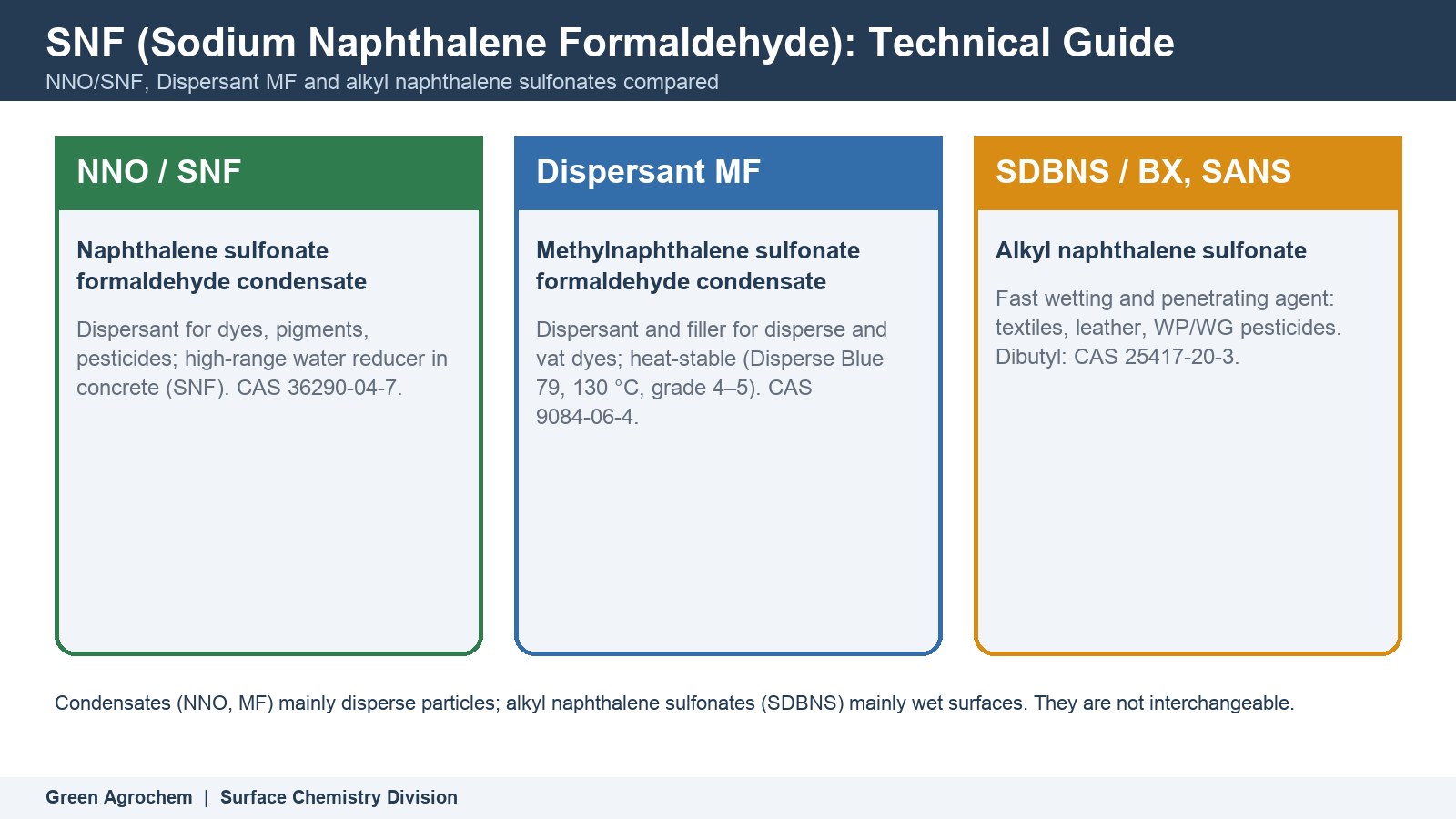
Sodium Naphthalene Formaldehyde (SNF), also called sulfonated naphthalene-formaldehyde condensate or PNS, is an anionic polymer used primarily as a dispersant and high-range water-reducing component in cementitious systems. This page provides a technical overview; commercial specifications, samples and quotations are handled through LigninCorp Industrial Chemicals.
What SNF Does in Cement Systems
SNF adsorbs on cement-particle surfaces and increases electrostatic repulsion. This helps break up flocculated particles and releases water trapped within the flocs. Depending on the cement, supplementary cementitious materials, temperature and admixture package, the same mechanism can improve flow at constant water content or permit water reduction at a selected workability.
Performance is formulation-dependent. SNF should not be described as guaranteeing a fixed water-reduction percentage, strength gain, setting time or slump-retention period in every concrete. Those outcomes must be established by laboratory and plant trials with the actual cement and aggregates.
Typical Applications
- Ready-mix concrete requiring improved workability or controlled water reduction.
- Precast and prestressed concrete where early-strength development and production cycle are evaluated through trials.
- Pumped concrete and dense reinforcement layouts where flow and cohesion must be balanced.
- Cement grouts, dry-mix formulations and selected oil-well cement systems after compatibility testing.
- Non-cement particle-dispersion systems only when a product grade has been qualified for that application.
Grade and Specification Points
| Item | Why buyers check it |
|---|---|
| Appearance and form | Powder or liquid form affects storage, dosing and transport. |
| Solids or moisture | Required for accurate active-dose comparison. |
| Sodium sulfate | Grade selection may depend on formulation and project requirements. |
| pH and water insolubles | Useful routine indicators for consistency and compatibility screening. |
| Chloride and alkali contribution | Must be reviewed against concrete specifications and local standards. |
| Batch documentation | Request a current TDS, SDS and lot-specific COA before approval. |
Recommended Trial Procedure
Use the supplier’s current TDS dosage range as a recommended screening range, not as a guaranteed universal dose. Compare candidates on an equal active-solids basis and include an untreated control. Begin with paste or mortar screening, then confirm the selected range in concrete.
- Record cement source, SCM content, aggregate grading, water temperature and mixing sequence.
- Measure initial workability, air content and setting behavior at several trial dosages.
- Check slump loss at the actual transport and placement intervals.
- Confirm segregation, bleeding, pumpability and finishing behavior.
- Test early and specified-age strength and any durability properties required by the project.
- Repeat when a major raw material, temperature or batching condition changes.
SNF Compared with Other Water Reducers
SNF, lignosulfonates and polycarboxylate ethers are not interchangeable solely on a price-per-ton basis. Lignosulfonates are commonly considered for conventional plasticizing and set-control systems; SNF is often evaluated where stronger electrostatic dispersion is required; PCE products may provide higher water reduction or tailored slump retention. The appropriate choice depends on total formulation cost, cement compatibility, production controls and project performance criteria.
Safety and Compliance
Do not infer safety, regulatory status or suitability from the chemical name alone. Review the current SDS, local chemical regulations and project specifications. Use appropriate dust control and personal protective equipment for powder handling. Final concrete-admixture compliance remains the responsibility of the formulator and producer in the destination market.
Industrial Product Route
For current SNF grades, specification review, sample requests and commercial supply, visit Sodium Naphthalene Formaldehyde (SNF) at LigninCorp. Include the target application, cement type, required standard, estimated consumption, packaging and destination when requesting technical support.
Related technical guides: SNF dispersion mechanism, grade selection and quality control, and cement compatibility troubleshooting.
