
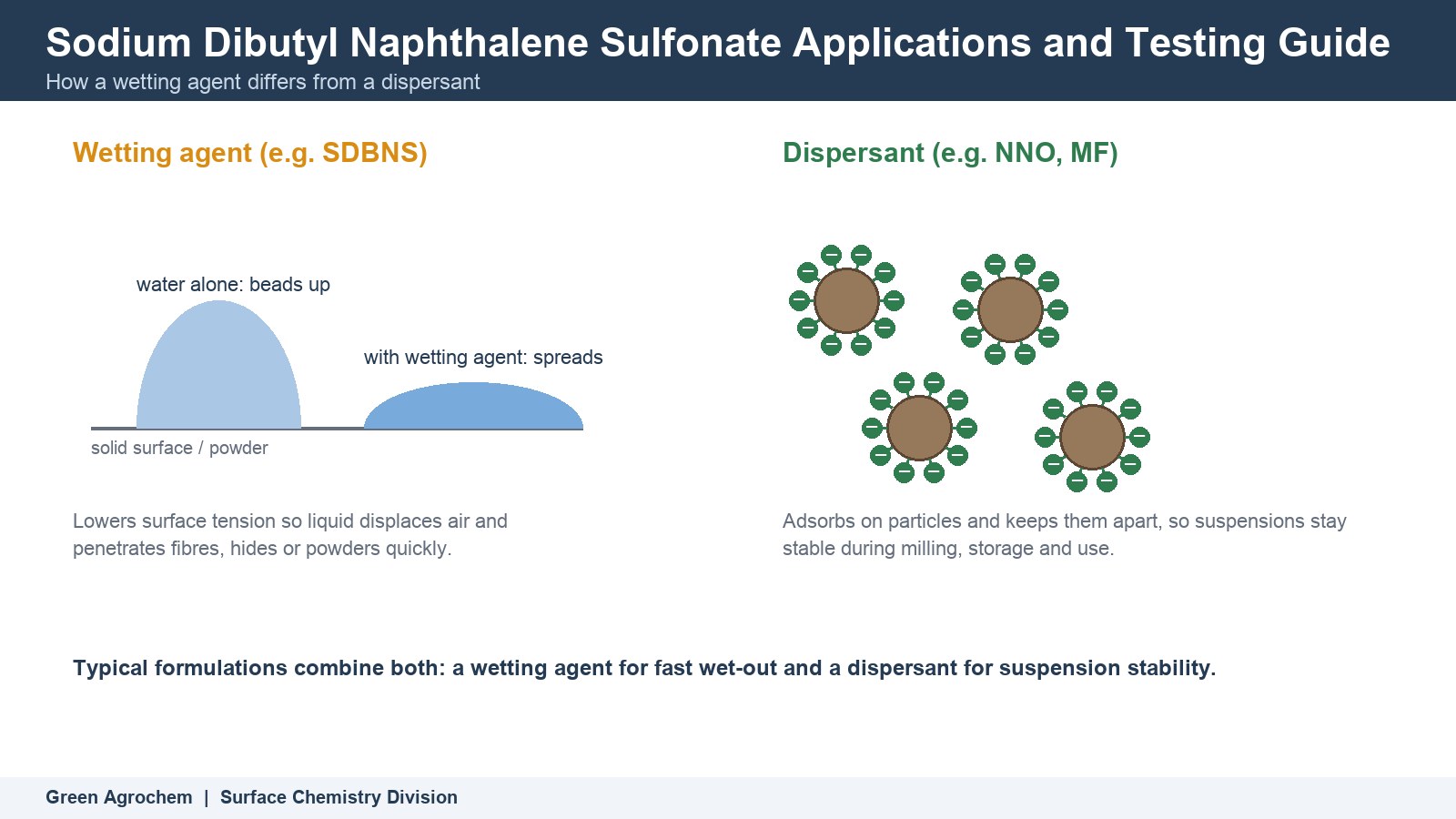
Sodium dibutyl naphthalene sulfonate (SDBNS) is generally selected for rapid wetting and penetration in aqueous process formulations. Because these are surface and interface functions, this application topic belongs to GreenAgrochem.net.
Start with the current Sodium Dibutyl Naphthalene Sulfonate Wetting Agent page. Then qualify the exact commercial grade for the intended formulation rather than assuming that one material performs every wetting, dispersing, emulsifying, penetrating, levelling or solubilizing role.
Application Selection Matrix
| Application | Defensible screening role | Key measurements and limits |
|---|---|---|
| Textile pretreatment and dyeing | Wet-out and penetration; possible process-aid support | Wetting time, bath foam, electrolyte/pH compatibility, shade, levelness and fastness |
| Agrochemical formulations | Powder/carrier wetting and possible emulsification support | Wetting, suspensibility or emulsion stability, particle size, foam, storage, packaging and regulatory suitability |
| Industrial cleaning | Surface wetting and penetration into compatible soils | Detergency against a control, foam, rinse, corrosion and substrate compatibility |
| Paints, coatings and inks | Initial pigment wetting; dispersion support only if testing confirms it | Viscosity/rheology, milling demand, particle size, colour, gloss, foam, storage and film properties |
| Rubber, latex and emulsion polymerization | Wetting/emulsification screening in compatible systems | Particle size, coagulum, conversion, viscosity, electrolyte stability and final polymer properties |
| Pulp, paper and deinking | Wet-out or process-aid screening | Ink removal, flotation/washing response, foam, drainage, brightness and effluent effects |
| Electroplating and metal finishing | Wetting/penetration screening | Bath compatibility, foam, deposit appearance, pits, residue, corrosion and drag-out |
| Ceramic slips and mineral systems | Initial wetting; dispersion only when verified | Rheology versus shear, solids loading, settling, milling, drying and firing response |
Applications Requiring Additional Caution
The former page also assigned SDBNS functions in EOR, drilling muds, scale/sludge control, concrete, mortar, tile adhesive, waterproofing, photographic chemicals and solvent-based coatings. These are not automatically established by the product name. Oilfield use requires salinity, temperature, pressure, rock/fluid or mud-system tests. Concrete and dry-mix projects require construction-grade identity, dosage basis, workability, setting, air, strength and compatibility tests. Route concrete-grade SNF procurement through LigninCorp rather than assuming SDBNS is an SNF superplasticizer.
Former Performance Statements: Evidence Status
| Former statement | Status | Correct treatment |
|---|---|---|
| Works across pH 4–12 | Unverified broad range without an exact grade, concentration, temperature, exposure time, method or retained-function result. | Not a specification or universal operating window. Confirm with the current TDS and formulation stability testing. |
| High electrolyte/hard-water tolerance and alkaline stability | System-dependent, with no electrolyte identity, hardness, concentration or test conditions. | Test in the actual process water and complete formulation. |
| Prevents flocculation, improves gloss/flow/storage, colour yield/fastness, bioavailability, polymer quality, brightness, bonding or workability | Application outcomes without controls or disclosed methods. | Use as trial objectives only; publish numbers or conclusions only with the tested system, control, conditions and source. |
Select the Correct Technical Route
- Technical-grade specification and document guide
- Emulsification-aid qualification guide
- Price, packaging and RFQ guide
Minimum Trial Record
Record the exact grade and lot, active/as-supplied basis, formulation, water quality, pH, temperature, addition sequence, shear, control, dosage ladder, test methods and acceptance criteria. Confirm the current TDS, SDS and COA before scale-up. Safety, transport and environmental treatment must come from grade- and jurisdiction-specific documents.
For documents, a sample or quotation, contact info@greenagrochem.com.
