
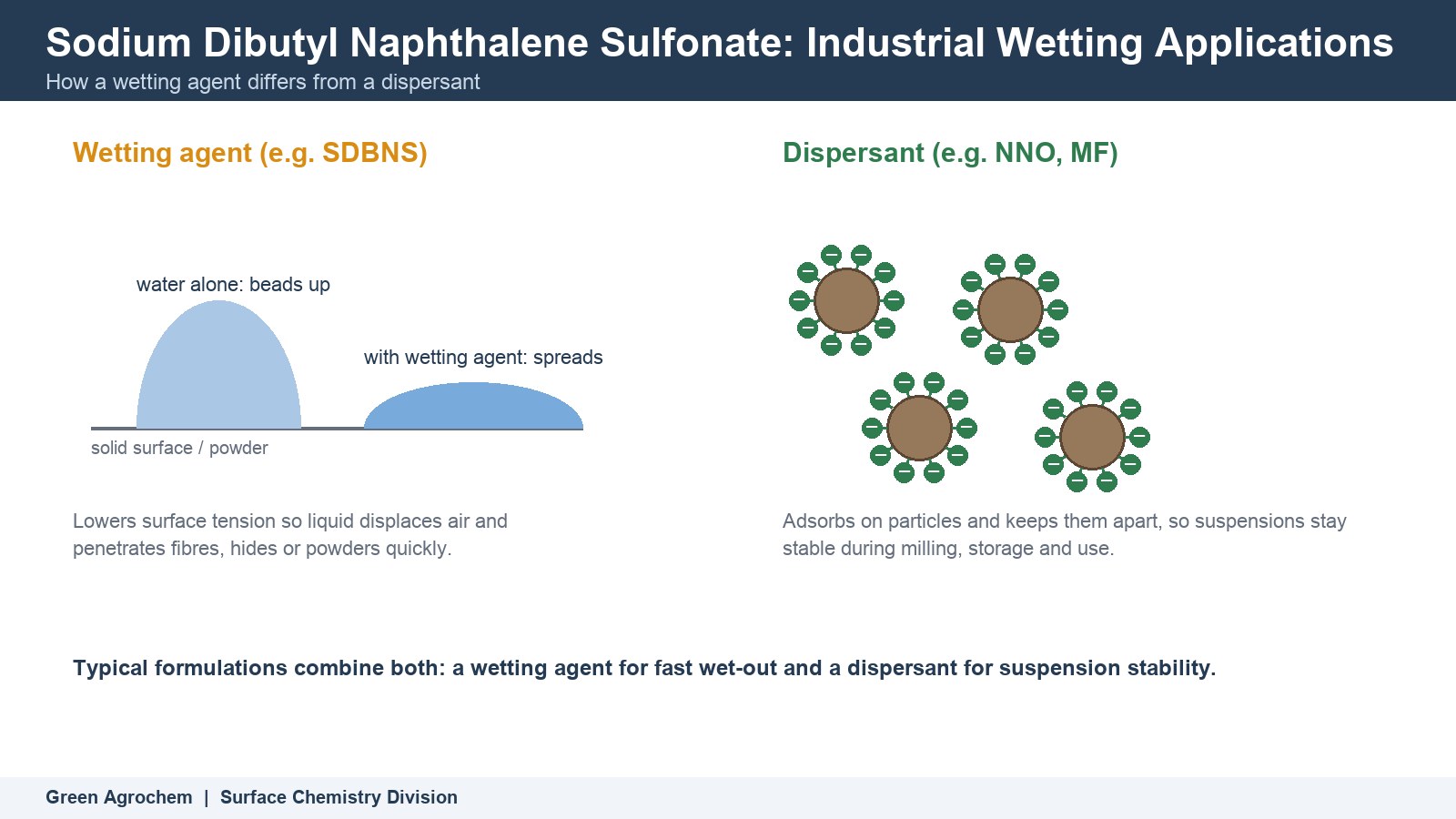
Sodium dibutyl naphthalene sulfonate used for textile, leather, cleaning and other process formulations is principally a wetting and penetration surfactant. These uses belong to GreenAgrochem.net, the Surface & Interface Technology Division.
Use the current Sodium Dibutyl Naphthalene Sulfonate product and qualification page to select a grade, request documents and design application trials.
Industrial Functions
| System | Possible function | Qualification priorities |
|---|---|---|
| Textile preparation and dyeing | Rapid wetting and penetration; possible dispersion support | Fibre and dye type, bath pH, electrolyte, temperature, foam, colour and fastness |
| Leather processing | Wet-out and penetration support | Hide condition, bath chemistry, uptake uniformity, foam and downstream finish |
| Paper and deinking | Wetting or process-aid screening | Furnish, ink system, flotation/washing process, foam, drainage and effluent impact |
| Industrial cleaning | Surface wetting and possible emulsification support | Soil, substrate, builders, pH, temperature, contact time, rinse and material compatibility |
| Metalworking or process fluids | Wetting/emulsification support in compatible formulas | Corrosion, emulsion stability, foam, microbial control, residue and equipment compatibility |
Claims That Require Grade-Specific Evidence
| Former statement | Evidence/status | Correct treatment |
|---|---|---|
| Strong hard-water tolerance and reliable performance under industrial conditions | System-dependent; no water hardness, electrolyte, concentration, method or result was stated. | Test with the actual process water and full formulation. |
| Low toxicity and rapid biodegradation with a reduced ecological footprint | Unsupported universal safety and environmental claims. | Use the exact-grade SDS and relevant biodegradation/ecotoxicity report; do not infer environmental superiority. |
| Solid form is flammable | Cannot be assigned to every commercial grade without classification data. | Use the current SDS for flammability, dust, handling, storage, first aid and transport classification. |
| Large water discharges reduce oxygen or alter pH | Generic environmental statement without grade, concentration or study. | Prevent uncontrolled discharge and follow site permits, SDS and local waste rules; use product-specific evidence for hazard claims. |
| Improves penetration, process efficiency, colour, softness, lubrication or wear | Application outcomes without controls or test conditions. | Define each as a trial objective and report measured results in the complete system. |
Grade Selection and Trial Workflow
- Confirm chemical identity, product code, active matter, physical form and current TDS/SDS/COA.
- Define the primary function and measurable acceptance target; do not use “versatile surfactant” as a specification.
- Obtain a supplier-supported starting trial range with a clear active/as-supplied and formulation-component basis.
- Run a control and dosage ladder using actual water, substrate, temperature, pH, electrolyte, shear and addition sequence.
- Measure wetting/penetration, foam, stability, compatibility and end-use quality; include accelerated and ambient storage where relevant.
- Confirm packaging, shelf life, regulatory documentation and scale-up behaviour before commercial adoption.
Relationship to Other Naphthalene Sulfonates
This wetting agent is not automatically interchangeable with Dispersant NNO, Dispersant MF, monomeric sodium naphthalene sulfonate or concrete-grade SNF. Compare exact identities and application data rather than selecting by the shared “naphthalene sulfonate” wording.
For a sample, current documents or quotation, contact info@greenagrochem.com.
Division note: Concrete-grade SNF and construction-chemical procurement remain with LigninCorp.
