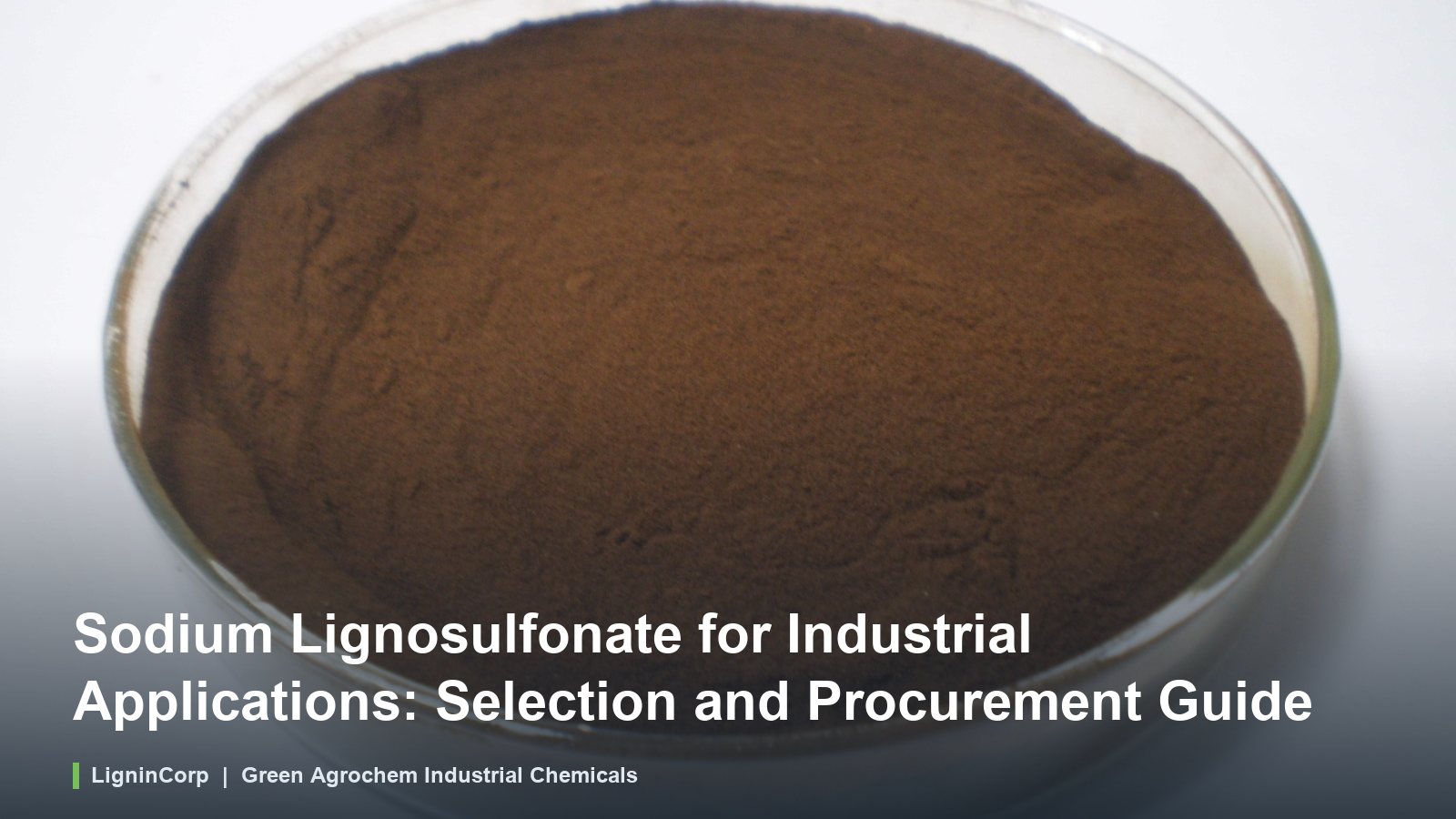
Sodium lignosulfonate is a water-soluble lignin derivative used as a dispersing, binding and process-control component in selected industrial formulations. Its commercial value does not come from one universal specification or a single claimed performance figure. Buyers need to match the supplied grade to the chemistry, solids level, water quality, process conditions and acceptance tests of the intended system.
This procurement guide explains how industrial users can screen sodium lignosulfonate for concrete and mortar, ceramics, mineral processing, dust-control formulations, drilling-related systems and other water-based applications. For neutral chemistry and cross-industry background, see the Sodium Lignosulfonate Applications and Selection Guide. Buyers seeking a commercial grade can review the LigninCorp sodium lignosulfonate product page.
What industrial buyers are actually purchasing
Sodium lignosulfonate is produced from lignin-containing process streams and contains a distribution of sulfonated aromatic macromolecules rather than one discrete pure molecule. A single molecular formula therefore does not adequately define a commercial grade. Counter-ion identity, molecular-weight distribution, sulfonation level, residual sugars, inorganic salts, moisture or solids, colour and insoluble matter can all influence behaviour.
For procurement, the correct question is not simply “Is this sodium lignosulfonate?” It is “Does this identified grade meet the specification and performance criteria of our formulation?” The answer should be supported by the current technical data sheet, safety data sheet and a batch-specific certificate of analysis, followed by application testing.
Functional mechanism and application boundaries
Sulfonate and other polar groups support water solubility and adsorption onto many particle surfaces. Adsorption can alter interparticle forces and help separate agglomerates, while the polymeric structure can contribute binding or film-forming behaviour after water removal. The balance between dispersion and binding depends on the substrate, dosage basis, pH, ionic strength, competing additives and drying or curing conditions.
- Concrete and mortar: selected grades may support workability and water-reduction objectives, but cement chemistry, supplementary cementitious materials, temperature, mixing sequence, air system and set-time requirements must be tested. Sodium lignosulfonate should not automatically be described as interchangeable with a modern high-range water reducer.
- Ceramics and mineral slurries: adsorption may assist viscosity and flow control. Buyers should test solids loading, particle-size distribution, electrolyte sensitivity, casting or pressing behaviour, drying and fired-product quality.
- Granulation, briquetting and industrial binding: binding performance depends on substrate moisture, particle surface, compaction, drying and required green and final strength. A laboratory result should be confirmed on the actual production line.
- Dust-control systems: lignosulfonate solutions may contribute surface binding and crust formation on suitable unpaved materials. Soil gradation, traffic, rainfall, drainage, application equipment and local environmental requirements control field performance.
- Drilling and other process fluids: compatibility with salinity, hardness, temperature, pH, weighting solids and the rest of the additive package must be established. One industrial grade should not be assumed suitable for every oilfield function.
Grade variables to specify
| Variable | Why it matters to the buyer | Recommended verification |
|---|---|---|
| Physical form and solids or moisture | Affects storage, handling, transport economics and dosage conversion | Current TDS and batch COA with the calculation basis stated |
| pH and solution behaviour | Can influence compatibility, stability and process response | Supplier method plus testing in the buyer’s process water |
| Inorganic salts and insoluble matter | May affect deposits, corrosion review, appearance and sensitive formulations | Defined limits, test methods and batch results |
| Reducing substances or residual sugars | May influence setting, colour, biological stability or downstream reactions | Application-specific limit and documented method where relevant |
| Colour and odour | Important in light-coloured or appearance-sensitive products | Approved reference sample and incoming inspection criteria |
| Particle-size or molecular distribution | Can change dissolution, adsorption, dispersion and binding response | Use only when the supplier controls and documents the relevant method |
Specification values are grade-specific. They must not be copied from another supplier or presented as universal sodium lignosulfonate properties. If a parameter is commercially important, place its unit, test method, limit or typical-status language and revision in the purchase specification.
Recommended qualification workflow
- Define the function and acceptance criteria. Record the required dispersion, viscosity, binding, workability or process outcome and the test used to judge it.
- Confirm the exact grade. Review the current TDS, SDS, representative COA, country-of-origin information and any application-specific declarations before sampling.
- Establish a controlled baseline. Test the untreated formulation and the current additive under the same raw materials, water, temperature, mixing energy and sequence.
- Screen a supplier-recommended starting range. A numeric addition range should be used only when supported for the exact grade and expressed on a clear basis, such as as-supplied product, dry solids or formulation weight. It is a trial range, not a universal production dosage.
- Check interactions and failure modes. Evaluate setting, air, foam, colour, sedimentation, corrosion review, filtration, drying, final strength or other properties relevant to the process.
- Run a plant trial. Scale-up should confirm mixing, metering, storage, throughput and final-product performance before routine purchasing.
- Fix the commercial specification. Agree the grade name, controlled parameters, methods, packaging, traceability, change notification and acceptance procedure.
Dosage and performance evidence
There is no defensible universal dosage for every sodium lignosulfonate application. Addition level depends on active or solids basis, substrate surface area, formulation composition, water chemistry, equipment and the required response. Adding the word “recommended” does not validate an unsupported percentage.
When LigninCorp provides a starting range, it should identify the exact grade and technical-document revision, define the calculation basis and require laboratory and plant validation. Water reduction, strength, flow retention, service life and cost savings are performance results—not dosage specifications—and should be published numerically only with the relevant materials, controls, conditions and test method.
Safety, handling and regulatory review
Biobased origin does not by itself establish that a commercial grade is non-toxic, biodegradable, food suitable or environmentally harmless. Review the current SDS, composition and impurity information, workplace exposure controls, transport classification and local end-use requirements for the actual product. Dust control, drilling, construction and other field uses may also require site-specific environmental and discharge assessment.
Documents and RFQ information
A useful request for quotation should state the application, formulation or substrate, desired function, current additive, process-water quality, pH and temperature, addition basis, test method, annual demand, packaging preference, destination and required compliance documents. Ask the supplier to identify the proposed grade rather than quoting a generic product name.
- Current TDS and SDS with revision dates
- Representative and shipment-specific COA
- Declared test methods and specification tolerances
- Sample identification and batch traceability
- Packaging, storage and shelf-life documentation for the supplied form
- Change-notification and complaint-handling procedure
Talk to LigninCorp about grade selection
For a technical and commercial review, send the application, target function, formulation conditions, test criteria and destination to info@greenagrochem.com. LigninCorp can then recommend a candidate grade and an evidence-based trial plan instead of treating one specification or dosage as suitable for every industrial system.
