
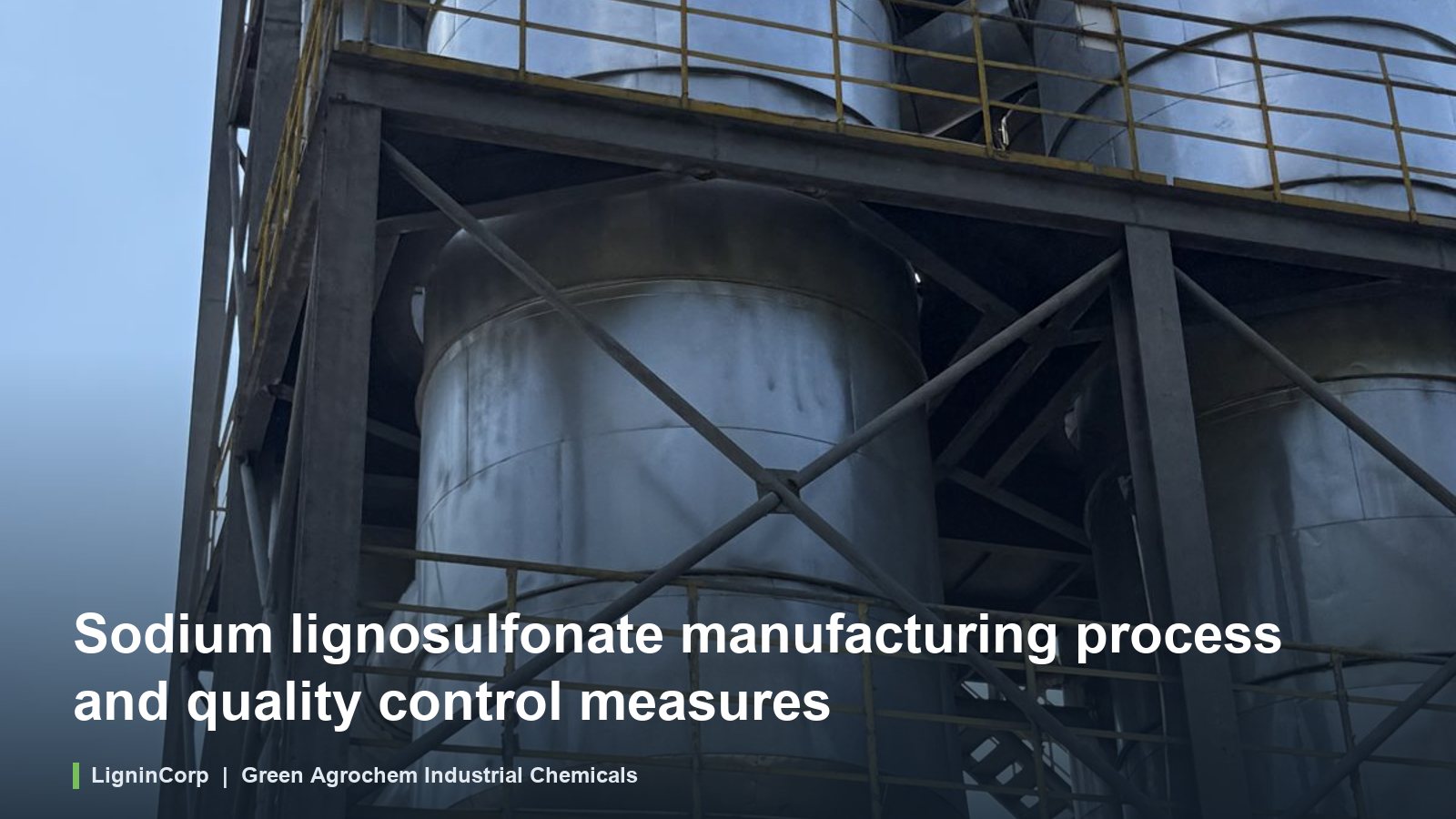
Sodium lignosulfonate is made from the spent liquor of sulfite wood pulping. Quality control checks every batch against the grade TDS before release, and buyers check it again on arrival. This page summarises the process and sets out both sets of checks.
Manufacturing Process in Brief
- Sulfite pulping dissolves lignin from wood as lignosulfonate.
- The spent liquor is converted to the sodium salt and purified to the grade, including optional desugaring and filtration.
- The liquor is concentrated by evaporation (liquid grades, 45% min solids) and spray-dried to powder (95% min dry matter).
Full process: sodium lignosulfonate manufacturing process.
Batch Quality Control: What Is Tested
| Parameter | Typical method | Grade One limit |
|---|---|---|
| Appearance | Visual | Yellow-brown powder |
| pH (10% solution) | pH meter | 7.0 – 9.5 |
| Dry matter / moisture | Gravimetric, oven-dry / loss on drying at 105 °C | 95% min / 5% max |
| Water-insoluble matter | Filtration, gravimetric | 1.5% max |
| Lignosulphonate content | UV spectrophotometry | 55% min (dry basis) |
| Reducing sugar | Fehling titration | 7% max |
| Sulphate | Gravimetric as BaSO₄ | 2 – 5% |
| Calcium & magnesium | Complexometric (EDTA) titration | 0.5% max |
| Water reducing capacity | Mortar flow test | 8% min |
Incoming Inspection for Buyers
- Check the packing list, labels and batch numbers against the COA.
- Take a representative sample from several bags or from the top and bottom of a tank.
- Retest the items that matter for your use, for example pH, dry matter and insoluble matter, and reducing sugar for concrete.
- Compare results with the COA and the agreed specification; use the same test methods to avoid disputes.
- Keep a retained sample from each batch until the batch has been used.
How to read a COA: sodium lignosulfonate certificate of analysis.
Frequently Asked Questions
How is sodium lignosulfonate quality controlled?
Each batch is tested against its TDS for appearance, pH, dry matter, insoluble matter, lignosulphonate content, reducing sugar, sulphate and calcium and magnesium, and released with a COA.
How is lignosulphonate content measured?
By UV spectrophotometry, as stated on our COA template.
What should buyers check on arrival?
Batch numbers against the COA, then retest the key parameters on a representative sample using the same methods.
Is sodium lignosulfonate made by mixing sodium hydroxide and sulfuric acid?
No. It is made from lignin in the spent liquor of sulfite wood pulping.
