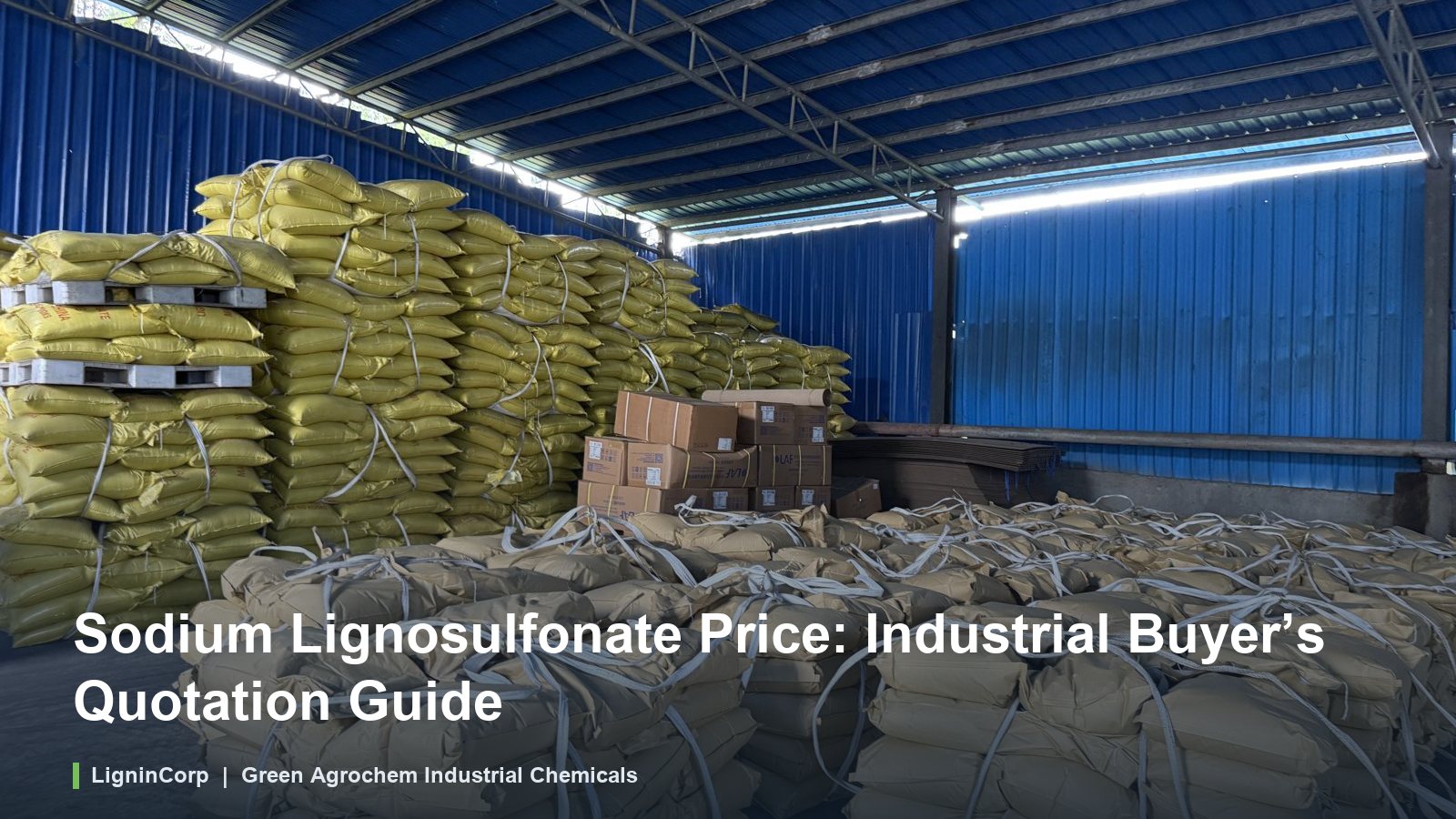
A meaningful sodium lignosulfonate price is a grade-specific, delivery-specific quotation—not a universal market number. Two offers with the same price per metric ton may represent different solids content, moisture, sodium content, reducing sugars, insolubles, packaging, Incoterms or freight. Industrial buyers should compare the total delivered cost of material that actually meets the application specification.
This guide explains what changes the quotation, how to compare powder and liquid offers, and what information to include in an RFQ. For a current quotation, contact info@greenagrochem.com.
What determines sodium lignosulfonate price?
| Cost factor | Why it changes the offer | What the buyer should specify |
|---|---|---|
| Grade and application | Concrete, ceramics, granulation, mineral dispersion and other processes require different impurity and performance controls | End use, formulation and pass/fail test |
| Physical form | Powder requires drying but is usually more freight-efficient; liquid avoids drying but transports water | Powder or liquid, solids basis and handling limits |
| Specification | Moisture, pH, insolubles, reducing sugars, ash, bulk density and particle size affect processing and consistency | Required limits from the current TDS or internal specification |
| Order size | Sample, pallet, container and repeat-contract quantities have different packing and production economics | Trial quantity, regular volume and annual forecast |
| Packaging | Small bags, big bags, pallets, drums, IBCs and bulk delivery have different material and handling costs | Pack size, palletization, labels and destination requirements |
| Incoterm and destination | EXW, FOB, CFR, CIF and DDP quotes include different portions of freight, insurance, customs and local delivery | Named port or full delivery postcode plus preferred Incoterm |
| Documents and compliance | Market-specific documentation, testing and registration can add time or cost | TDS, SDS, COA, origin documents and application-specific requirements |
Why online price ranges are often misleading
Published price ranges quickly become outdated and frequently omit the commercial basis. They may mix powder and liquid, technical and refined grades, small retail packs and container quantities, or factory-gate and delivered prices. Currency, fuel, container availability, route congestion and seasonal freight changes can move the delivered cost without changing the product itself.
For that reason, this page does not publish a fixed global price or an unsupported annual forecast. A dated quotation with a defined validity period is more useful than a broad number without specification or delivery terms.
Compare offers on an equivalent basis
Normalize every quotation before choosing a supplier:
- Confirm the same grade and specification. Do not compare a general technical grade with a processed low-sugar or application-controlled grade.
- Convert to dry-solids cost when relevant. For liquids, account for the quoted solids fraction and the cost of transporting water.
- Use one Incoterm and destination. Convert all offers to the same port or delivered location.
- Add packaging and local costs. Include pallets, import charges, terminal handling, customs clearance, inland freight and disposal or return costs.
- Account for usable performance. A lower unit price is not cheaper if a higher recommended trial dosage, filtration loss, foam control or batch variation increases process cost.
Quotation-normalization worksheet
Use one currency, unit of mass, named destination and Incoterm for every offer. Record the exchange-rate date and do not compare a tax-inclusive quotation with a tax-exclusive quotation without adjustment.
| Comparison output | Calculation | Required inputs |
|---|---|---|
| Delivered as-supplied cost per metric ton | Total delivered cost ÷ delivered net product mass | Product value, packaging, freight, insurance, import/terminal charges, inland delivery and net mass |
| Delivered dry-solids equivalent | Delivered as-supplied cost per metric ton ÷ solids mass fraction | Delivered cost plus verified solids fraction expressed as a decimal; for example, use 0.50 for 50% solids |
| Material cost per production batch | Delivered unit cost × qualified as-supplied addition mass | Application-trial dosage on a clearly defined basis and the batch or treated-material mass |
| Adjusted application cost | Material cost + dissolution, filtration, foam control, storage, handling and documented process losses | Site-specific labour, energy, equipment and loss data |
These formulas normalize commercial offers; they do not predict performance. Keep powder moisture and liquid solids on the correct basis, and only use an application dosage established for the exact grade in the buyer’s formulation.
Practical landed-cost model
Comparable landed cost = product value + export packing + international freight + insurance + import and terminal charges + inland delivery + application-related handling or treatment.
For liquid material, buyers may also calculate a dry-solids equivalent. The result remains a commercial comparison tool, not a substitute for formulation trials.
Powder versus liquid: the price trade-off
Powder is often preferred for export because it offers higher active material per shipment, longer storage flexibility and straightforward bag handling. Liquid may be attractive near the production source or where automated tank dosing removes powder-handling costs. The correct choice depends on distance, solids content, local storage, dissolution capacity, energy and labour—not the quoted price per ton alone.
Performance can matter more than the lowest quotation
Sodium lignosulfonate is a heterogeneous lignin-derived material. Molecular-weight distribution, charge density, residual sugars, salts and insolubles may influence dispersion, retardation, binding, viscosity and colour. Before a commercial order, test a supplier-recommended trial range using the actual raw materials, water chemistry, mixing sequence, temperature and process conditions.
Useful comparison tests may include viscosity or flow, sedimentation, setting behaviour, green strength, abrasion or dust generation, filtration, foaming, colour and storage stability. Select only the tests relevant to the intended application.
Information to include in a quotation request
- Company, destination country and delivery port or postcode
- Application and required product form
- Required specification or reference TDS
- Trial quantity, first order and expected regular volume
- Packaging and pallet requirements
- Preferred Incoterm and requested delivery window
- Required TDS, SDS, representative COA and origin or compliance documents
- Any limits for colour, odour, sugars, insolubles, moisture or particle size
Buyer checklist before placing an order
- Approve a representative sample against a written test method.
- Ensure the commercial specification matches the tested sample.
- Confirm batch-release documents and complaint procedures.
- Review shelf life, storage conditions and packaging integrity.
- Record the quotation currency, Incoterm, validity period and lead time.
See the industrial sodium lignosulfonate product page for grade and supply enquiries, or use the powder grade-selection and RFQ guide when planning an export order. Technical background and specification comparisons are available through the Lignosulfonate Knowledge Hub.
