The properties that matter in purchasing and formulation are the ones on the TDS and SDS: appearance, solubility, pH, dry matter, lignosulphonate content, insoluble matter and sugars. This page lists those values for our powder and liquid grades and explains what each one means in use.
Sodium Lignosulfonate Property Table
| Property | Value | Source |
|---|---|---|
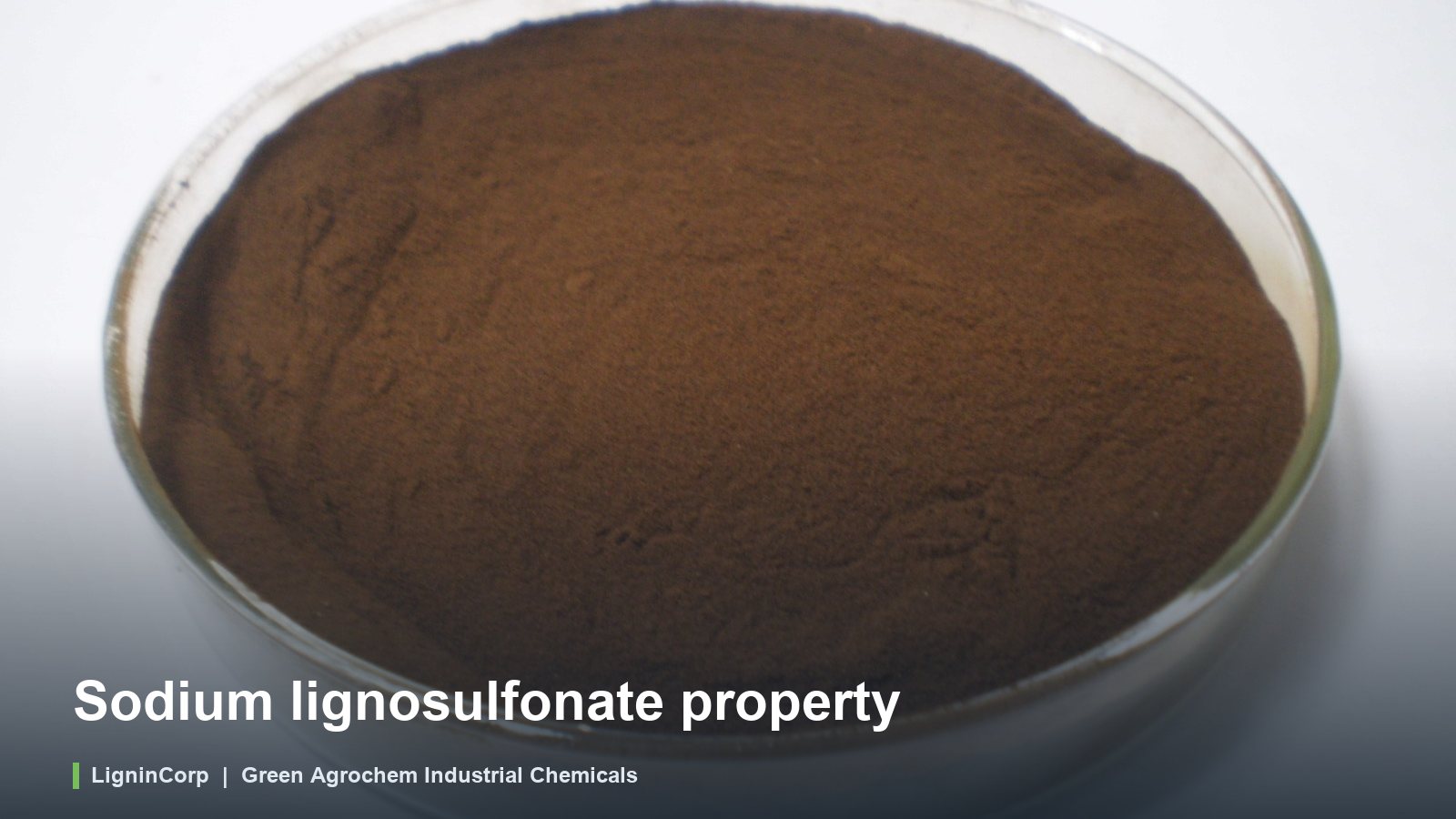
| Appearance | Powder: yellow-brown to brown. Liquid: dark brown to black | TDS |
| Odor | Slight, characteristic | SDS section 9 |
| Solubility | Readily soluble in cold and hot water | SDS section 9 |
| Ionic character | Anionic polymer with sulfonic and carboxylic groups | TDS |
| pH | Grade One 7.0 – 9.5 (10% solution); Grade Two 9.0 – 13.0; Grade Three 4 – 6; liquid 7.0 – 11.0 | TDS |
| Dry matter | Powder 95% min; liquid 45% min solids | TDS |
| Density (liquid) | 1.20 – 1.32 g/ml | Liquid TDS |
| Lignosulphonate content | 55% min (Grade One), 60% min (Grades Two and Three), 65% min (Construction), 70% min (Dispersant), dry basis | TDS |
| Water-insoluble matter | 0.5 – 2% max by grade; liquid 1.0% max | TDS |
| Reducing sugar | 7% max (powder grades) | TDS |
| Stability | Stable in closed containers at room temperature; keep away from strong oxidizers, acids and bases | SDS section 10 |
| Combustion products | Carbon oxides and sulfur oxides | SDS section 10 |
What These Properties Mean in Use
- High solubility: powder dissolves quickly for dosing; the liquid grade needs no dissolving at all.
- Anionic charge: it adsorbs on particles and gives them a negative charge, so they repel each other. This is why it is used as a dispersant. Research has also tested lignosulfonates in some flocculation processes, but that is not how our grades are sold or used.
- Reducing sugar: sugars slow cement hydration, so higher-sugar grades retard concrete more.
- pH: pick a grade whose pH suits your system; Grade Three is acidic, Grade Two strongly alkaline.
- Insoluble matter: lower values mean clearer solutions and less risk of blocking nozzles and filters.
Liquid Grade: Density and Viscosity
The liquid grade (GAC-NaLS-L) has a density of 1.20 – 1.32 g/ml at 45% min solids. The TDS does not give a viscosity value. Viscosity rises with solids content and falls as temperature rises, so if your pump or dosing system needs a figure, ask for a batch measurement. Storage and handling of the liquid are covered in liquid vs powder sodium lignosulfonate.
For the molecular structure behind these properties, see sodium lignosulfonate structure and properties and sodium lignosulfonate structure on lignosulfonate.com.
Frequently Asked Questions
Is sodium lignosulfonate soluble in water?
Yes. The SDS describes it as readily soluble in cold and hot water.
What is the pH of sodium lignosulfonate?
It depends on the grade: 7.0 – 9.5 for Grade One (10% solution), 9.0 – 13.0 for Grade Two, 4 – 6 for Grade Three and 7.0 – 11.0 for the liquid grade.
What is the density of liquid sodium lignosulfonate?
1.20 – 1.32 g/ml for the liquid grade GAC-NaLS-L at 45% min solids.
Is sodium lignosulfonate a flocculant?
Not in normal use. It is sold and used as an anionic dispersant that keeps particles apart. Research has tested lignosulfonates in some flocculation processes, but that is a specialist case.
