
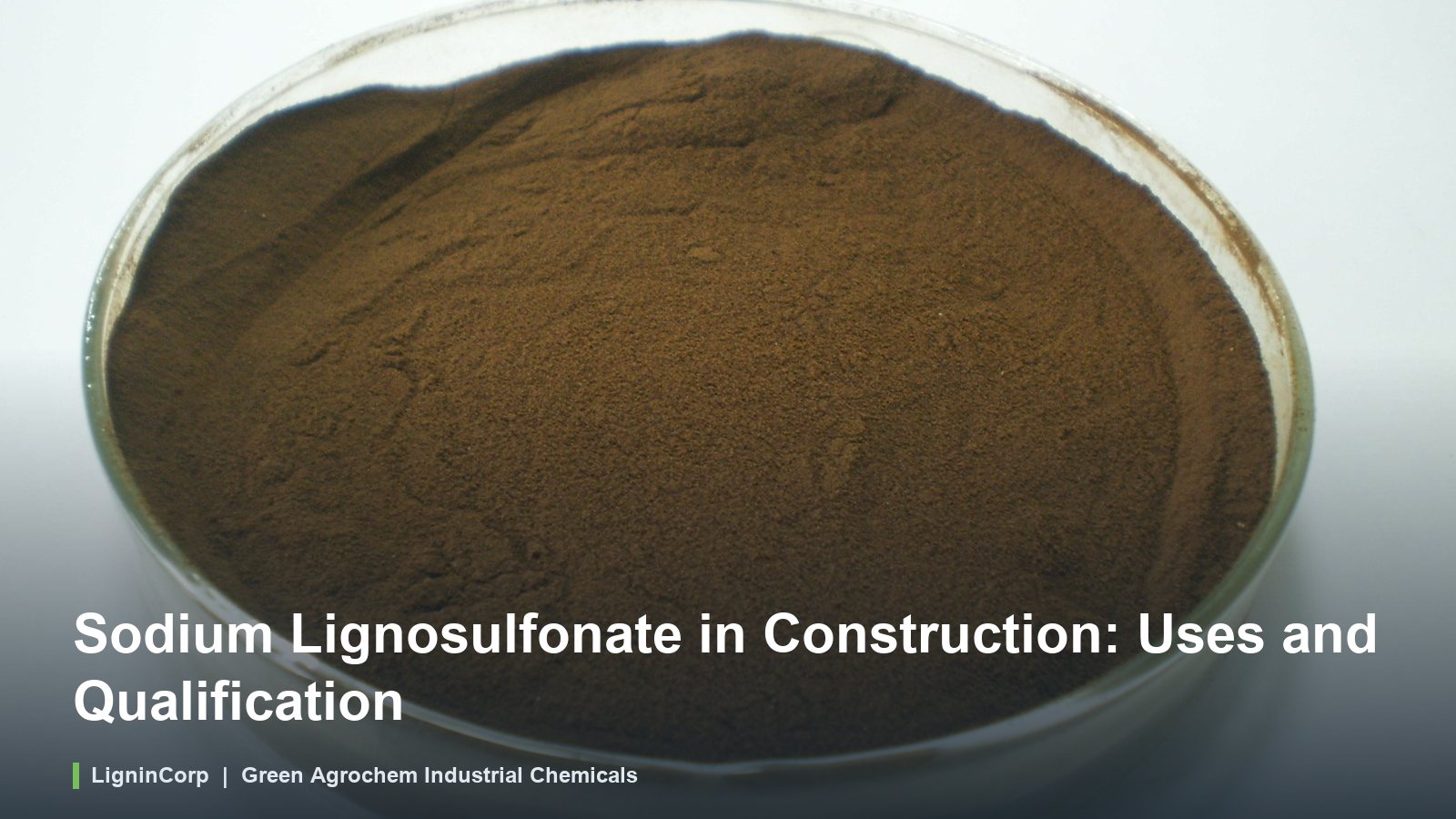
Sodium lignosulfonate in construction is used primarily for its dispersing, plasticizing and binding behaviour in cementitious and mineral systems. It is not a universal fireproofing, waterproofing or insulation material. Suitability depends on the product grade, formulation, substrate and required construction standard.
For current construction grades, documentation and samples, review LigninCorp Sodium Lignosulfonate Construction Grade.
Concrete and cementitious admixtures
In concrete and mortar, sodium lignosulfonate can adsorb on cement particles and improve dispersion. Depending on the cement and dosage, this may increase workability at constant water or support conventional water reduction at a selected consistency. Some grades also influence setting and air, so a supplier dosage is only a recommended starting range for trials.
Evaluate initial and retained workability, air content, setting, bleeding, segregation, finishing and strength using the actual cement, supplementary materials and aggregates. See the detailed sodium lignosulfonate concrete guide.
Dry-mix mortar and mineral formulations
Powder lignosulfonate may be screened in selected dry-mix systems where particle dispersion or water-demand control is needed. It must be tested with cellulose ethers, starch ethers, redispersible polymer powders, defoamers, retarders and other formulation components. Check wet density, flow, open time, adhesion where applicable, air and package-storage stability.
Gypsum and ceramic-related construction materials
Selected lignosulfonate grades can be evaluated as dispersing or processing aids in mineral slurries. The response depends on ionic composition, solids loading, pH and other additives. Do not transfer a concrete dosage directly to gypsum or ceramic systems; establish a separate laboratory screening curve.
Pelletizing, briquetting and dust management
Lignosulfonates are also used as binders or dust-control agents in some mineral-processing and construction-material operations. These are separate formulation applications, not evidence that the chemical forms a waterproof membrane or a certified fire-resistant coating. Test green strength, cured strength, moisture response, abrasion and process compatibility for the intended material.
Specification points for buyers
- Product form and moisture: needed for storage, dosing and active-material comparison.
- pH and reducing sugars: relevant to consistency and possible setting effects.
- Water insolubles: important for dissolution, filtration and dosing equipment.
- Chloride and alkali contribution: review against the project and destination standard.
- Bulk density and particle handling: relevant to powder feeding and packaging.
- Lot documentation: request a current TDS, SDS and batch-specific COA.
Recommended qualification procedure
- Define the required function and measurable acceptance criteria.
- Prepare an untreated control using actual project raw materials.
- Screen several active-solids-normalized dosages.
- Measure application-specific fresh and hardened properties.
- Check compatibility with the complete additive package.
- Confirm the selected formulation in a controlled production trial.
Claims that require separate evidence
Sodium lignosulfonate should not be marketed as automatically making a construction material fire-resistant, waterproof, mould-resistant, insulating or maintenance-free. Such performance depends on a complete tested system and the relevant certification. Product approval should be based on the intended formulation and applicable test methods.
Industrial supply route
For specification matching, samples and quotations, use the construction-grade product page or contact LigninCorp with the application, formulation, required standard, volume, packaging and destination.
