Sodium Naphthalene Formaldehyde (SNF/PNS) is used as a dispersing component in high-range water-reducing concrete admixtures. This page focuses on grade selection, incoming quality control and concrete qualification. For current industrial grades, samples and quotations, use the LigninCorp SNF product page.
Do Not Select SNF by Grade Name Alone
Labels such as “high purity,” “standard” or “economy” are not universal specifications. Two suppliers may use the same grade name for materials with different sodium sulfate, moisture, molecular-weight distribution or concrete response. Procurement specifications should therefore state measurable limits and an agreed concrete performance test rather than relying only on an A/B/C label.
Key Certificate-of-Analysis Items
| Item | Why it matters | How to use it |
|---|---|---|
| Appearance | Quick identity and contamination check. | Define acceptable powder or liquid appearance. |
| Moisture / solids | Affects active dosage and delivered-value comparison. | Normalize trial dosages to active solids. |
| Sodium sulfate | May influence grade choice and project limits. | Set the limit required by the formulation, not a generic market label. |
| pH | Routine consistency indicator. | Investigate meaningful shifts between lots. |
| Water insolubles | Relevant to dissolution, filtration and dosing. | Agree a suitable maximum for plant equipment. |
| Chloride | Concrete specifications may restrict chloride contribution. | Review together with the full admixture dose and local standard. |
Supplier Qualification Documents
- Current technical data sheet with test methods and product form.
- Safety data sheet for the destination market.
- Lot-specific certificate of analysis.
- Statement of manufacturing consistency and change control where required.
- Packaging, shelf-life and storage instructions.
- Representative pre-shipment sample and agreed retention-sample procedure.
Recommended Concrete Qualification Program
Where the current TDS for the exact SNF grade provides a dosage range, treat it only as a supplier-recommended starting trial range on the stated calculation basis. It does not guarantee a particular water reduction, slump retention or strength result. Evaluate the actual cement, SCMs, aggregates and companion admixtures.
- Screen an untreated control and several active-solids-normalized SNF dosages.
- Measure initial slump/flow, air, unit weight and water demand.
- Repeat workability measurements at the required delivery and placement intervals.
- Check segregation, bleeding, setting time, pumpability and finishability.
- Test early and specified-age strength.
- Complete exposure-specific durability tests required by the project.
- Run compatibility checks with air entrainers, retarders, accelerators and other water reducers.
- Confirm the selected formulation in a controlled production batch.
Choosing Between SNF, Lignosulfonate and PCE
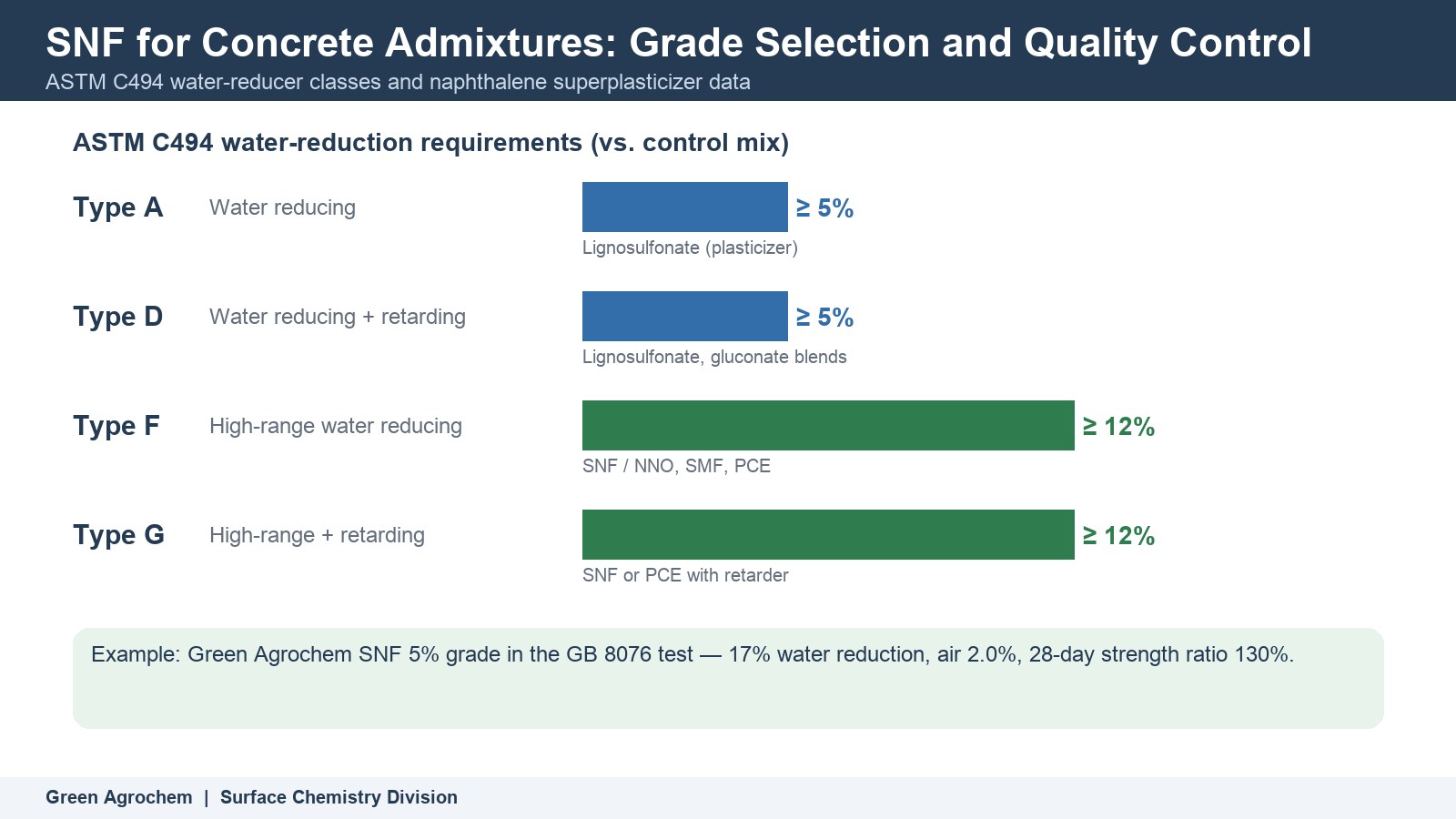
SNF is commonly screened when robust electrostatic dispersion and established cost-performance are priorities. Lignosulfonates may be considered for conventional plasticizing and set-control systems. PCE technology may be preferred where higher water reduction or tailored retention is required. Final selection should be based on verified concrete performance, total formulation cost and local compliance—not generic percentage tables.
Claims Requiring Test Evidence
Do not assume that SNF automatically produces self-compacting concrete, prevents corrosion, guarantees freeze-thaw durability, reduces cement content or delivers a fixed strength increase. Those results depend on the entire mix design, production control, curing and exposure. Any cement reduction must be approved through structural and durability testing under the applicable standard.
For the underlying dispersion process, see how SNF superplasticizer works. If a trial gives inconsistent results between cement sources, use the SNF cement compatibility and troubleshooting guide.
Industrial Procurement Route
For specification matching, provide the cement type, target standard, desired concrete performance, estimated consumption, packaging and destination to LigninCorp Sodium Naphthalene Formaldehyde (SNF). Request a current TDS, SDS, COA and sample before plant approval.
