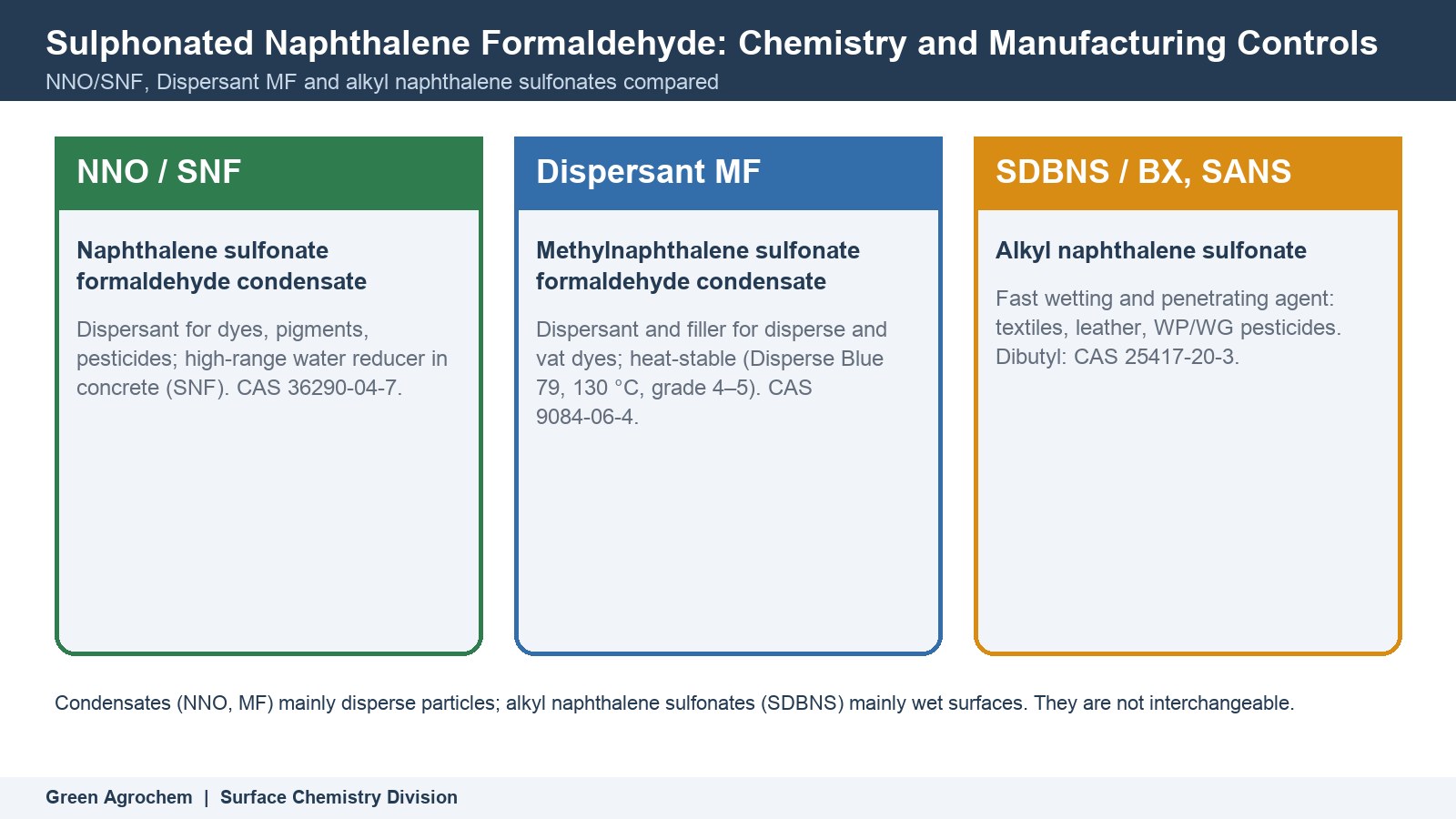
Sulphonated naphthalene formaldehyde (SNF) is a family of water-soluble anionic condensates, not one universal composition. Commercial behavior depends on the feedstock route, reaction control, neutralization, molecular-size distribution, residual inorganic salts and final powder or liquid processing.
This page explains product identity and manufacturing quality controls. For concrete selection and application testing, use the SNF technical guide. For a commercial construction grade, see the SNF product page.
Names used for SNF
Industry documents may use sulphonated or sulfonated naphthalene formaldehyde, sodium naphthalene formaldehyde, naphthalene sulfonate formaldehyde condensate, NSF, PNS or SNF. Naming alone is insufficient for equivalence. Confirm the commercial grade, supplied form, manufacturer and matching TDS/SDS identity.
Monomeric sodium naphthalene sulfonate is chemically distinct from the formaldehyde condensate. Dispersant NNO may also be sold under overlapping naphthalene-sulfonate terminology but can target different formulation requirements. Buyers should not substitute these products by name or CAS reference alone.
Functional structure
SNF contains aromatic naphthalene units bearing sulfonate functionality and connected through condensation-derived linkages. In aqueous mineral systems, the anionic groups support adsorption and surface charge development. Molecular-size distribution and accompanying salts can influence adsorption, dispersion, solubility and interaction with the liquid phase.
The mechanism in cement is predominantly associated with adsorption and electrostatic dispersion. It should not be described as a guaranteed steric-dispersion system equivalent to polycarboxylate ether. Actual response varies with cement mineralogy, sulfate balance, supplementary materials, water and other admixtures.
Manufacturing stages that require control
Sulfonation
Naphthalene feedstock is sulfonated under controlled conditions. Reaction severity and isomer distribution can affect the intermediates available for subsequent condensation. Quality control should focus on defined process limits and reproducibility rather than a generic reaction description.
Condensation
The sulfonated intermediate is condensed with formaldehyde. Feed ratio, addition profile, acidity, temperature history and reaction endpoint influence the condensate distribution. These are manufacturer-controlled variables; a buyer should evaluate the resulting commercial-grade specification and performance rather than infer quality from a simplified formula.
Neutralization and finishing
Neutralization produces the supplied salt form. The product may then be standardized as a liquid or concentrated and dried to powder. Filtration, concentration, drying and blending can affect solids, moisture, pH, solubility, caking tendency, bulk handling and batch consistency.
What to control in a purchase specification
The relevant parameters depend on the grade and application. A controlled specification may include:
- commercial grade, salt form and powder or liquid form;
- solids or moisture on a defined test basis;
- pH with stated concentration and method;
- inorganic salt or sulfate parameter where technically relevant;
- water-insoluble matter and solution appearance;
- bulk density or viscosity where needed for handling;
- application-performance reference test agreed by buyer and supplier;
- batch identity, manufacture date and change-notification requirements.
Publish numerical limits only from the current TDS, SDS, purchase specification or COA for the exact grade. Preserve units, methods and whether a value is a guaranteed limit, accepted range or typical result.
Batch qualification
- Confirm the lot and grade on the label, COA and delivery documents.
- Review specified physical and chemical tests against agreed limits.
- Compare solution behavior and an application test with an approved reference.
- Investigate trends even when individual results remain within specification.
- Retain samples according to the buyer’s risk and claims procedure.
A generic certificate or catalogue value is not a substitute for the shipment COA. Conversely, a COA does not replace compatibility testing in the buyer’s actual cement or formulation.
Performance and dosage boundaries
Water reduction, strength, setting, retention and dispersion efficiency are system test results, not intrinsic fixed percentages. Report numerical performance only with materials, control, addition basis, conditions and test method.
A dosage number may be used only as the supplier-recommended starting trial range in the current TDS for the exact grade. State whether it is based on cement, total cementitious material, formulation solids, dry product or as-supplied material. Final use level requires laboratory and plant validation.
Safety, compliance and sustainability
Use the current SDS for the supplied grade and form to determine classification, handling, storage, transport and protective measures. Do not assume “non-toxic,” “non-corrosive,” chloride status, standard compliance or environmental benefit from the product family name. Any regulatory or sustainability statement needs product- and market-specific evidence.
Technical inquiry
Send the intended application, required salt and supply form, target specification, test method, annual demand, shipment size and destination to info@greenagrochem.com. Ask that the quotation, sample, TDS, SDS and COA all identify the same commercial grade.
