
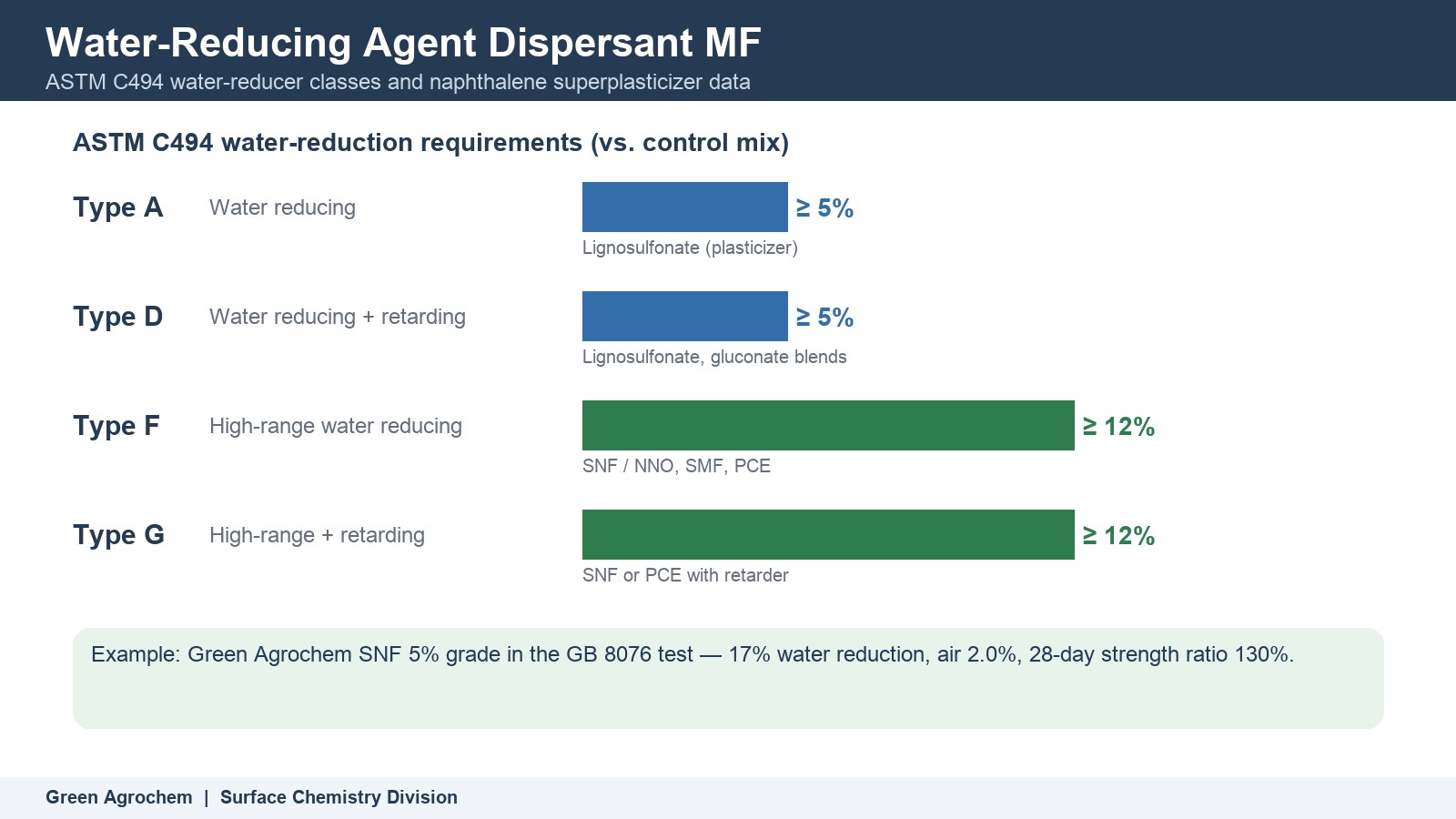
Dispersant MF (Methylnaphthalene Sulfonate Formaldehyde Condensate) is an industrial-grade, high-range water-reducing (HRWR) admixture. Operating as a powerful anionic surfactant, it prevents cement particle agglomeration, allowing concrete manufacturers to reduce the water-to-cement (w/c) ratio by 10% to 25%. This significantly accelerates early-strength development, increases ultimate compressive strength by over 20%, and improves the rheology of the mix for ready-mix and precast operations.
Chemical Mechanism: The Physics of Concrete Dispersion
In standard concrete mixtures, the hydration process causes cement grains to naturally clump together (flocculate). This traps water inside the clumps, resulting in a stiff, low-slump mix that is difficult to pump. If contractors add excess water to make the concrete workable, the cured concrete matrix becomes porous and structurally weak.
Dispersant MF resolves this structural challenge through electrostatic repulsion:
- Adsorption: The hydrophobic naphthalene-based backbone of the polymer tightly adsorbs onto the surface of the cement grains.
- Repulsion: The hydrophilic sulfonate groups impart a strong negative electrical charge to each cement particle.
- Fluidity: Because identically charged particles forcefully repel one another, the cement grains are physically pushed apart. The trapped water is released back into the mix, transforming a stiff paste into a highly fluid, workable concrete without compromising the structural hydration process.
Core Engineering & Performance Benefits
Meeting stringent international building standards, Dispersant MF provides compounding advantages for heavy construction and infrastructure projects:
1. Maximum Water Reduction & Strength Gain
By facilitating a 10% to 25% water reduction, Dispersant MF creates a highly dense, low-porosity concrete matrix. This increases the ultimate compressive strength of the cured concrete by 20% to 26%, allowing structures to withstand extreme weathering and heavy load stresses.
2. Early-Strength Acceleration
Unlike standard lignosulfonates that can retard setting times, Dispersant MF acts as an “early-strength” additive. It accelerates the initial hardening phase of the concrete. This rapid strength gain is critical for fast-tracking construction schedules and expediting formwork removal, making it highly valuable for precast concrete factories.
3. Superior Rheology and Workability
Transforms standard mixes into highly fluid concrete capable of being pumped across long distances and poured into intricate, heavily reinforced molds without the risk of blockages or voids.
Authoritative Application Guidelines & Dosage
To prevent mix failure and ensure optimal dispersion, ready-mix plant operators should adhere to the following batching parameters:
- Standard Dosage: 0.5% to 2.0% by weight of cementitious materials (BWOC).
- Mixing Protocol: The highly soluble dark brown powder should be fully dissolved in the mixing water prior to introduction, or added gradually during the wet-mixing phase to ensure 100% uniform dispersion.
- Environmental Stability: Unlike lesser admixtures, Dispersant MF remains highly stable and fully effective in acidic, alkaline, and hard water (high mineral content) environments.
- Storage & Handling: Because the powder is highly hygroscopic (absorbs moisture from the air), it must be stored in tightly sealed bags in a dry, well-ventilated warehouse to prevent caking and efficacy loss.
