There is no defensible “best SNF supplier in China” without a defined grade, application, test method, shipment basis and supplier audit. The right supplier is the one whose exact commercial grade passes your technical trials, documentation review, quality audit and delivered-cost assessment consistently.
This guide provides a practical process for evaluating Chinese suppliers of sulphonated naphthalene formaldehyde (SNF). To review available grades, visit the SNF product page.
1. Define the product before comparing suppliers
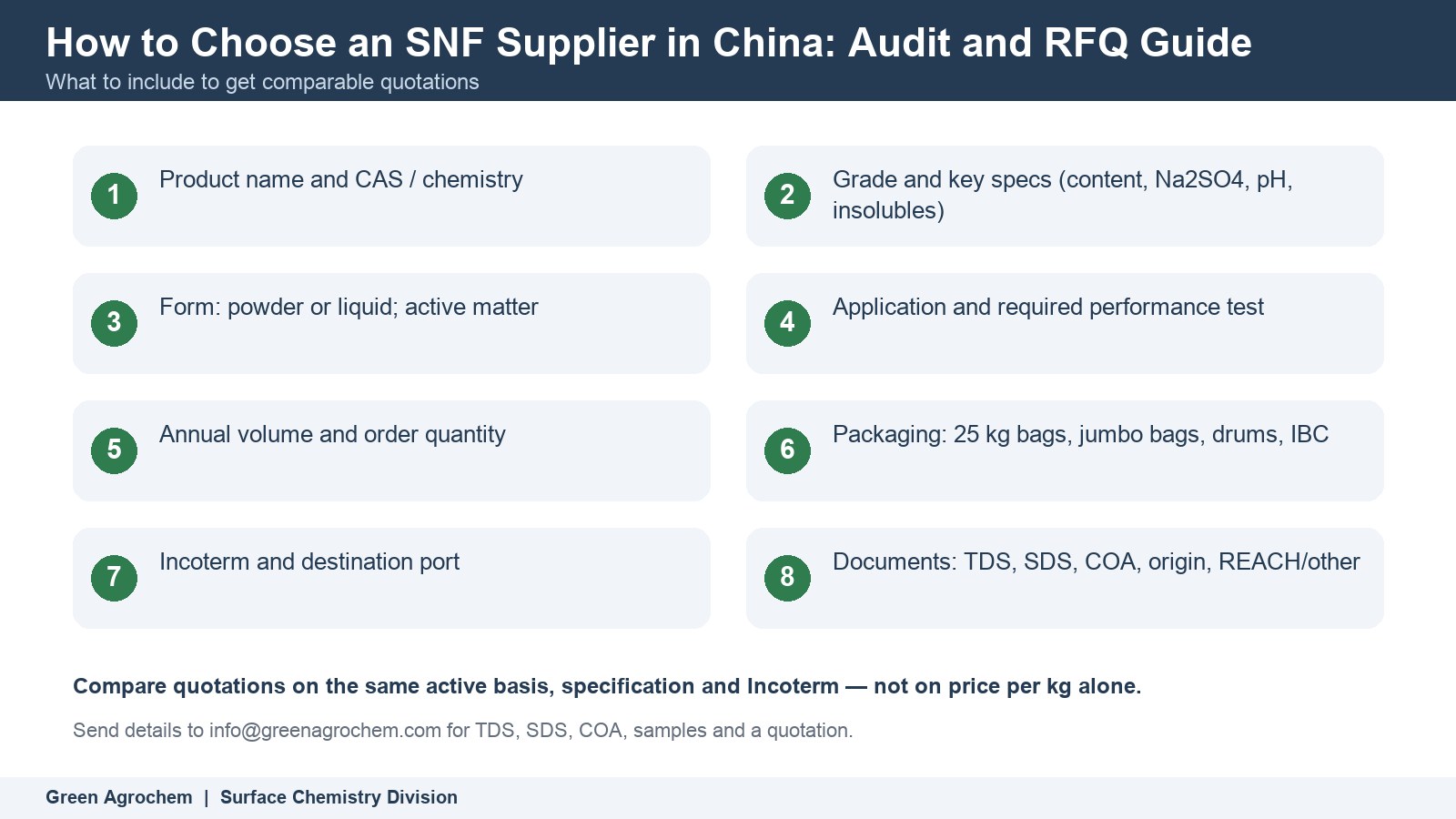
Names such as SNF, NSF, naphthalene superplasticizer and polynaphthalene sulfonate may be used inconsistently. State the required chemistry, powder or liquid form, application and technical controls in the RFQ. Do not select from a product name or color alone.
Ask each supplier to identify one exact commercial grade and provide matching documents. A quotation, sample, TDS and COA must refer to the same grade.
2. Review grade-specific technical documents
- current TDS with document revision;
- current SDS for the supplied form and destination market;
- representative COA with test methods;
- product specification identifying limits, ranges and typical values;
- storage, packaging and shelf-life statement;
- supporting report for any claimed standard classification.
Values for sodium sulfate, moisture, solids, pH, chloride or insolubles are grade specifications—not proof that one supplier is universally better. Verify units, basis and methods, then connect each requirement to your formulation or purchase specification.
3. Audit manufacturing and quality control
A supplier assessment should examine how consistency is controlled rather than relying on certificates alone. Review:
- manufacturing site and whether production is owned, subcontracted or traded;
- raw-material qualification and supplier-change controls;
- in-process controls and final batch-release tests;
- laboratory equipment, calibration and retained-sample system;
- lot numbering, traceability and complaint investigation;
- handling of nonconforming material;
- notification process for formulation, method or site changes;
- production capacity evidence and continuity planning.
Where an on-site audit is impractical, use a live video audit, document review and third-party inspection appropriate to the order risk.
4. Qualify the sample in the actual application
A generic supplier test cannot replace buyer validation. For concrete, use the actual cement, supplementary materials, aggregates, water, other admixtures, temperature and mixing sequence. Establish a controlled reference and measure initial and retained workability, air, unit weight, stability, setting and strength at specified ages.
Begin only from the supplier-recommended starting trial range in the current TDS for the exact grade. Confirm whether the basis is cement or total cementitious material and whether the percentage refers to as-supplied product or dry solids. Do not copy a universal online dosage.
For a structured comparison, use the SNF selection scorecard.
5. Confirm sample-to-shipment consistency
Approval of a hand-picked sample is not approval of future production. Before a large order, consider a pilot shipment and compare its identity, COA and application performance with the approved sample. Define pre-shipment sampling, independent testing or retained-sample terms where the commercial risk justifies them.
Include an agreed process for out-of-specification results, claims, replacement and investigation.
6. Evaluate export and logistics capability
Review packaging suitability, moisture protection, palletization, container loading, dangerous-goods classification where applicable, export documents, lead-time definition and route experience. Ask who is responsible for inland transport, customs documents, insurance and destination charges under the selected Incoterm.
For powder, inspect package integrity and moisture control. For liquid, review container compatibility, leakage prevention, temperature requirements and water freight. Packaging sizes must be confirmed in the current quotation rather than copied from an old webpage.
7. Compare quotations on the same basis
An undated price per tonne is not useful. Require each offer to state:
- exact grade and supply form;
- quantity and packaging;
- currency and quotation validity;
- Incoterm, named place, origin and destination;
- production lead time and shipment assumptions;
- payment terms and inspection terms;
- included documents and sample costs.
Normalize liquid and powder offers to a common solids or active basis where technically appropriate. Calculate landed and cost-in-use effects, including dose, freight, dissolution, storage, rejected batches and technical support.
8. Use a weighted supplier scorecard
Set the weights before reviewing final quotations. A procurement team may score technical performance, batch consistency, documentation, manufacturing controls, logistics reliability, service and total landed cost. The weights should reflect project risk; they are not universal.
Record the evidence behind every score. A polished website, marketplace badge or low price should not outweigh failed application tests or weak traceability.
9. Verify commercial identity and communication
Confirm the legal entity receiving payment, business registration, bank-account ownership, manufacturing relationship and authorized contact. Use controlled email domains and verify any last-minute payment-instruction change through a separate channel.
Agree on response times, technical contact, complaint escalation and document language before ordering.
10. What buyers should not accept
- “best quality” without a measurable purchase specification;
- universal water-reduction or strength percentages without test conditions;
- fixed dosage not linked to the current exact-grade TDS;
- absolute claims such as non-toxic, non-corrosive or eco-friendly without applicable evidence;
- standards logos without a current grade-specific report;
- a sample or COA labeled differently from the quotation;
- undated prices or hidden freight and destination charges.
RFQ checklist
Send your application, binder or formulation system, required supply form, specification, test methods, annual demand, shipment size, packaging, destination and Incoterm to info@greenagrochem.com. Request a quotation, current documents and sample under one exact grade identity.
SNF Grades and Data Sheet Values
Our current SNF grades differ mainly in sodium sulfate content:
| Grade | Sodium sulfate (Na2SO4) | Chloride (Cl–) | Cement paste fluidity | Solids | pH |
|---|---|---|---|---|---|
| SNF-5 (GAC-SNF-5) | 5% max | 0.4% max | 220 mm min | 91% min | 7 – 9 |
| SNF-10 (GAC-SNF-10) | 10% max | 0.4% max | 220 mm min | 91% min | 7 – 9 |
| SNF-18 (GAC-SNF-18) | 18% max | 0.5% max | 210 mm min | 91% min | 7 – 9 |
| SNF-20 (GAC-SNF-20) | 20% max | 0.5% max | 210 mm min | 91% min | 7 – 9 |
| Powder Grade, high solids (GAC-SNF-P) | 10% max | Below 200 ppm | Not listed | 95% min | 6.5 – 8.5 (1:10) |
The current TDS gives a supplier-recommended starting trial range of 0.5–1.0% powder by weight of cementitious material, with 0.75% as the first trial point. Confirm the working dose by trial mixes with your own cement, aggregates and admixtures.
Concrete test data, packaging and TDS downloads are on the SNF product page.
Frequently Asked Questions
How do I choose an SNF supplier in China?
Define the grade, compare TDS and COAs on the same test methods, audit production and laboratory capability, test a pre-shipment sample in your cement, and compare quotations on the same basis.
Which documents should an SNF supplier provide?
Grade-specific TDS and SDS, recent batch COAs, packaging and labelling details, and export documents.
What CAS number is used for SNF?
Our SNF superplasticizer grades are supplied under CAS 36290-04-7; check the SDS of each supplier.
