
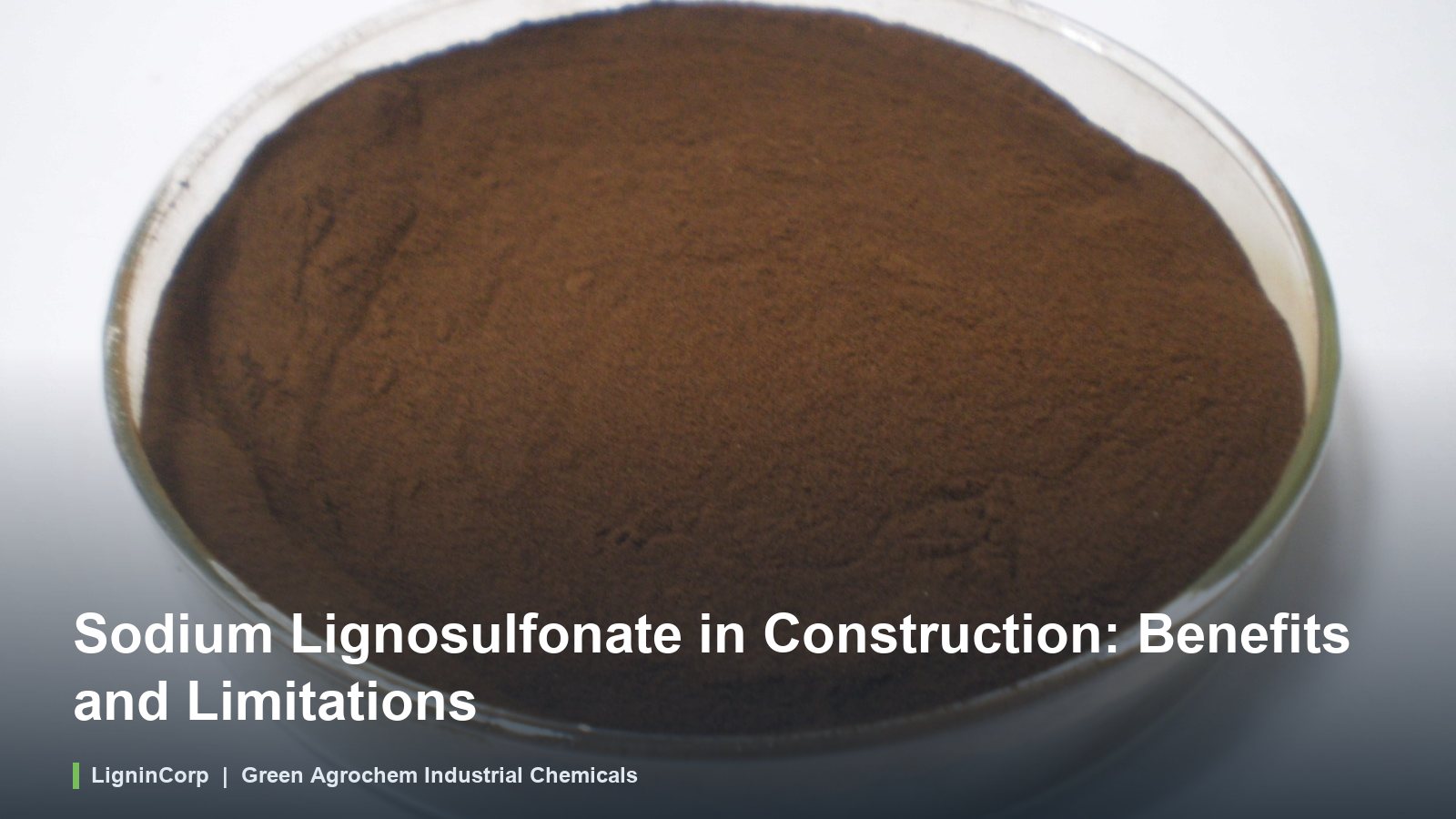
The useful benefits of sodium lignosulfonate in construction materials come mainly from particle dispersion, conventional plasticizing and, in selected formulations, binding or set-control effects. These benefits are conditional: the same product can perform differently with another cement, mineral filler or additive package.
This page separates plausible formulation benefits from claims that require a separately tested system. For commercial construction grades, see LigninCorp Sodium Lignosulfonate Construction Grade.
Potential benefit: improved particle dispersion
Sodium lignosulfonate can adsorb on mineral and cement particles and increase electrostatic repulsion. Better dispersion may lower apparent water demand or improve flow at the same water content. The result depends on solids loading, ionic composition, pH, mixing energy and competing additives.
Potential benefit: workability at controlled water
In a compatible cement system, dispersion can support easier placement or conventional water reduction at a selected consistency. The achievable change is not a fixed percentage. Measure initial and retained workability, air, setting, bleeding and strength using the actual project materials.
Potential benefit: set-time adjustment
Some lignosulfonate grades can delay setting. This may be useful in warm weather, long transport or certain manufactured products, but it can also slow finishing or early-strength development. Reducing-sugar content, cement chemistry, temperature and dosage all influence the response.
Potential benefit: formulation and process efficiency
Where the product is compatible, improved dispersion may help a producer reach a target flow with a more manageable mixing or dosing process. Liquid forms can simplify automated metering; powder forms can suit factory dry mixes. Total cost should include delivered active solids, storage, handling and verified performance—not price per tonne alone.
Potential benefit: binding in selected mineral systems
Lignosulfonates are used as binders in some briquetting, pelletizing and mineral-processing applications. A binder result cannot be assumed for every construction material. Evaluate green strength, cured strength, abrasion, moisture response and interaction with the substrate.
What sodium lignosulfonate does not automatically provide
The ingredient alone does not establish fire resistance, waterproofing, thermal insulation, corrosion protection, mould resistance or a durable architectural finish. Those claims require a complete formulated system tested to the relevant construction standard. “Bio-based” content also does not by itself prove a lower environmental impact; a defined life-cycle comparison is needed.
Recommended benefit-verification plan
- Define one target benefit and its measurable acceptance criterion.
- Prepare an untreated control with the actual project materials.
- Screen several supplier-recommended dosages on an active-solids basis.
- Measure relevant fresh, processing and hardened properties.
- Check the complete additive package for interactions.
- Confirm the result at production scale before changing the specification.
Choosing the appropriate grade
Review solids or moisture, pH, reducing sugars, water insolubles, chloride contribution and storage requirements. Request a current TDS, SDS, lot-specific COA and representative sample. For concrete-specific tests, use the sodium lignosulfonate concrete guide; for broader applications, see uses in construction and qualification.
Request technical and commercial support
Send the formulation type, raw materials, target performance, applicable standard, annual quantity, packaging and destination through the construction-grade product route or contact LigninCorp.
