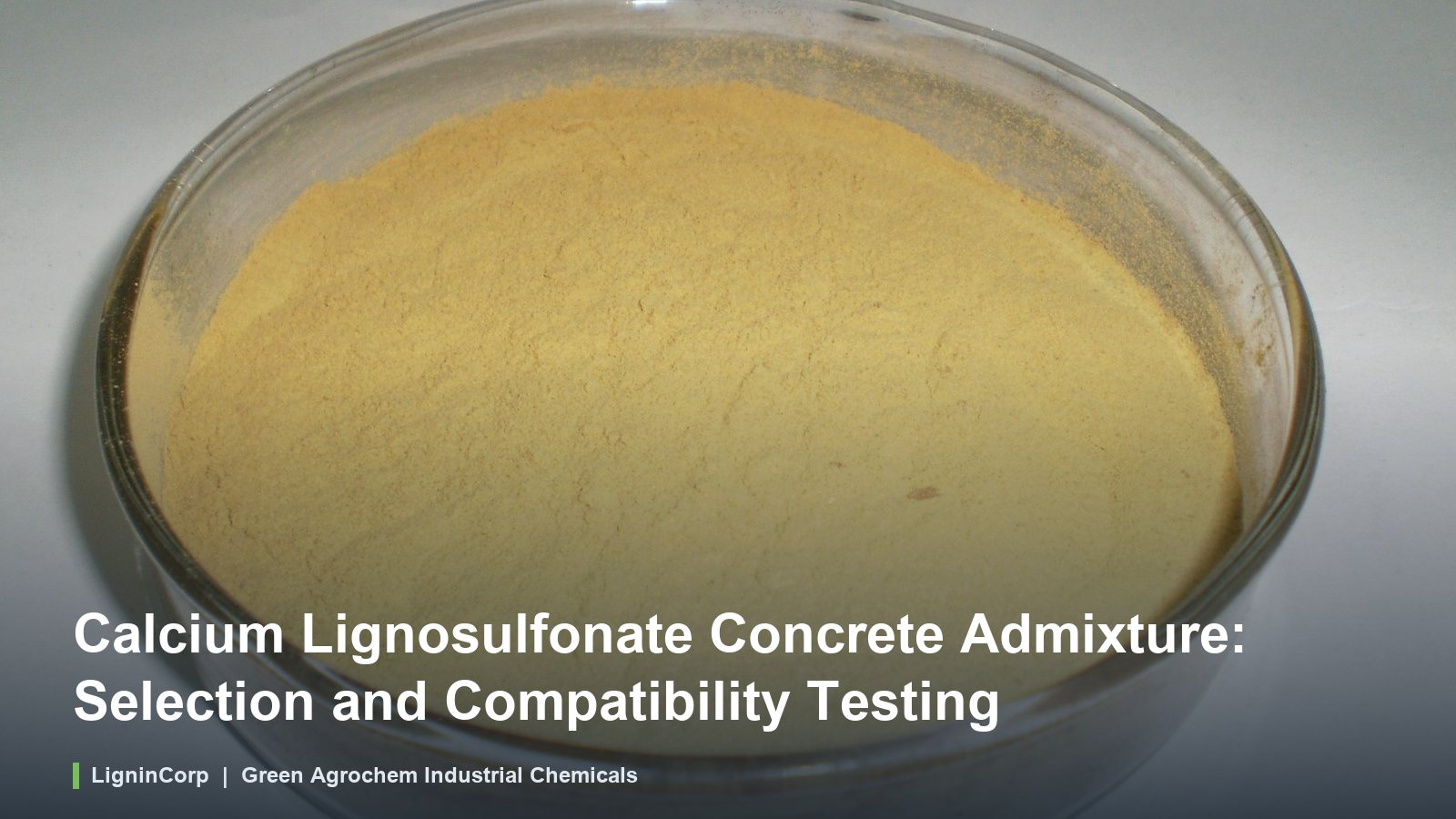
Calcium lignosulfonate can be evaluated as a conventional water-reducing, plasticizing and set-modifying component in concrete and mortar. Its practical performance depends on the exact grade, cementitious materials, addition basis, temperature, mixing sequence and interaction with other admixtures. It should therefore be qualified as part of the complete mix—not selected from the product name alone.
This page focuses on technical selection and validation. Buyers seeking a commercial grade can review the calcium lignosulfonate construction-grade product route.
Functions to Evaluate Separately
| Function | What may be observed | What must be measured |
|---|---|---|
| Particle dispersion | Improved workability at constant water or reduced water at a selected consistency. | Slump/flow over time, water content, segregation and bleeding. |
| Set modification | Longer working or finishing window in some systems. | Initial/final setting, temperature sensitivity and construction schedule. |
| Air response | Air content may change with grade, mixing and other admixtures. | Fresh-air content and, where required, the hardened air-void system. |
| Hardened performance | Strength and transport properties reflect the complete mix design. | Specified-age strength and project-specific durability tests. |
None of these outcomes is automatic. Improved workability does not by itself prove water reduction, strength improvement or durability compliance.
Why Calcium Grade Is Not Interchangeable by Name
“Calcium lignosulfonate” describes a family of materials rather than a single universal concrete-admixture specification. Molecular distribution, sulfonation, residual sugars, ash and inorganic salts, moisture or solution solids, pH, water insolubles and chloride can vary with feedstock and processing. These variables can change adsorption, setting, air response, colour and storage behaviour.
Compare candidate grades on a defined basis. Powder and liquid offers should be converted to dry active solids, and the water carried by a liquid product should be included in the batch-water calculation.
Documents and Incoming Quality Checks
- current exact-grade TDS and SDS;
- representative and lot-specific COA;
- declared test methods for moisture/solids, pH, insolubles and controlled impurities;
- dosage basis—total cementitious material, as-supplied product or dry solids;
- storage, shelf-life, packaging and change-control information.
A numerical addition level may be published only when supported by the current technical document for the exact grade. Present it as a supplier-recommended starting trial range, identify the basis and document revision, and validate it in the customer’s actual materials. Do not convert a literature result or another supplier’s specification into a LigninCorp dosage.
Concrete Compatibility Trial
- Fix the control mix: record cement and SCM sources, aggregate moisture, target consistency, temperature and other admixtures.
- Normalize additions: compare the control and several screened levels on an equal dry-solids basis.
- Test fresh properties: measure slump or flow initially and over the required time, air, unit weight, bleeding, segregation and setting.
- Review operations: observe mixing, pumping, placement, consolidation, finishing and form-removal timing.
- Test hardened concrete: assess early and specified-age strength plus durability properties required by the project exposure.
- Confirm at scale: run a controlled plant batch before routine production and define acceptance limits for incoming lots.
Compatibility with Other Admixtures
Do not assume compatibility with air entrainers, accelerators, separate retarders, SNF or PCE superplasticizers. Test the actual combination, order of addition and mixing time. If slump loss, excessive retardation, unexpected air or separation occurs, review dosage basis and sequence before changing multiple components at once.
Important Limitations
Calcium lignosulfonate is not a universal high-range water reducer, waterproofing agent, corrosion inhibitor or durability guarantee. Bio-based origin alone does not establish non-toxicity, regulatory acceptance, carbon benefit or environmental superiority. Use the current SDS for handling and conduct project-specific compliance and life-cycle reviews where required.
Buyer Information for a Useful Recommendation
Provide cement/SCM identity, concrete or mortar application, target slump/flow, required retention and setting window, air requirement, temperature range, current admixtures, test standard, annual volume and packaging preference. Review the concrete admixtures application hub and the ready-mix trial and control guide. For documentation, samples or a quotation, contact LigninCorp.
