
In ready-mix concrete, calcium lignosulfonate does two jobs: it lowers the water needed for the target slump, and its set delay helps concrete stay workable between batching and placing. This page covers dosage, slump retention, hot-weather use and how to qualify it in a plant.
Dosage
| Parameter | Construction Grade (GAC-CaLS-Construction), TDS Rev. 2.0 |
|---|---|
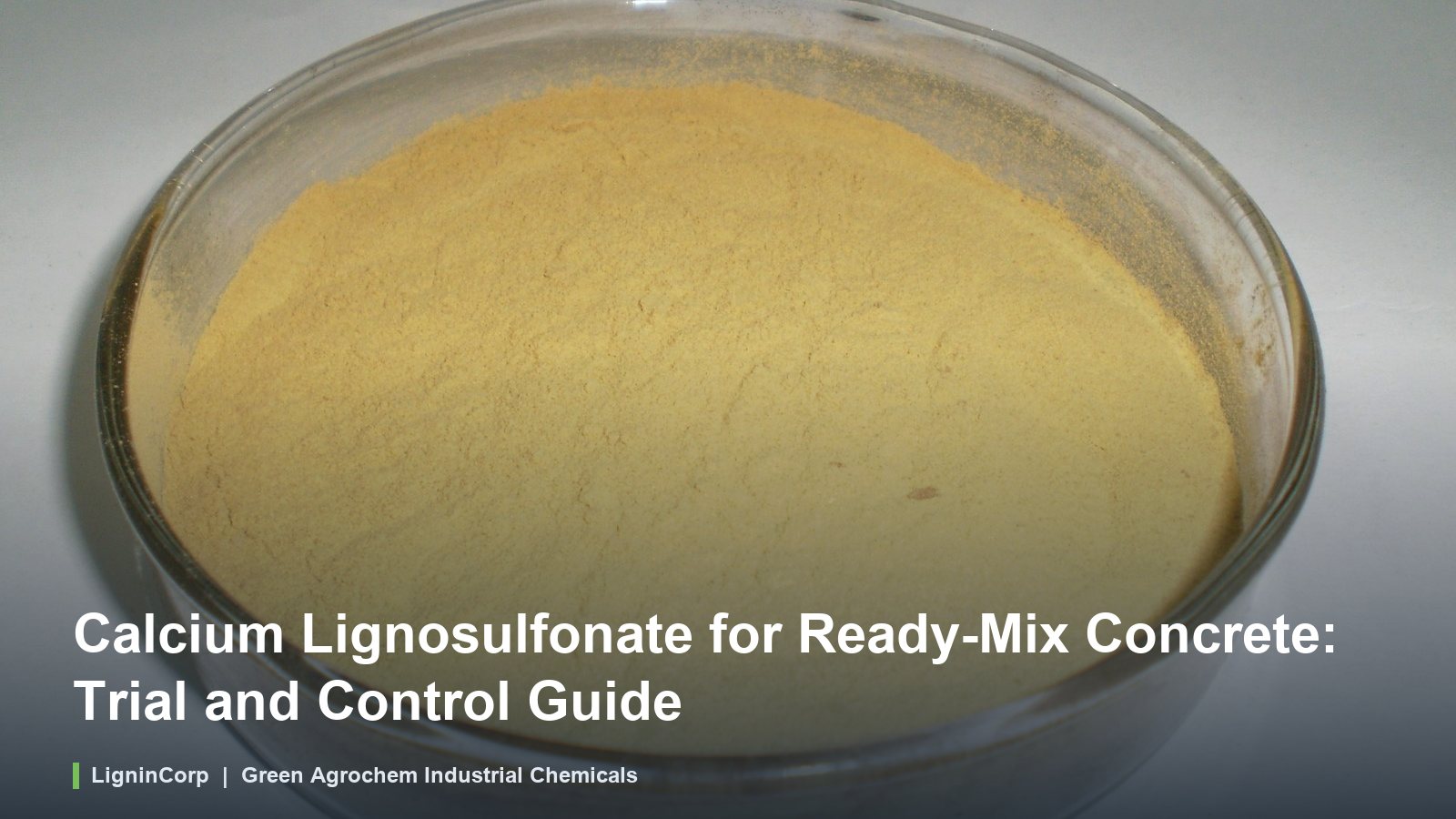
| Form | Light brown powder |
| Bulk density | 0.8 g/cm³ |
| Moisture | 5% max |
| pH (5% solution) | 4–6 |
| Recommended dosage | 0.20–0.30% by weight of cement; higher dosages may retard set beyond specified limits |
| Water-demand reduction | Up to 12% |
| Packaging | 25 kg woven bags with PE liner; 500 kg or 600 kg jumbo bags |
| Shelf life | 12 months |
Typical values from the current TDS. Each lot ships with a COA.
Slump Retention and Haul Time
Ready-mix concrete loses slump during the haul. The retarding effect of lignosulfonate slows that loss. Test it the way the truck sees it:
| Time after batching | Measure |
|---|---|
| 0 min | Slump, air, temperature |
| 30 min | Slump |
| 60 min | Slump |
| 90 min (long haul) | Slump, air |
Hot Weather
- Higher temperatures speed slump loss and setting; the delay from lignosulfonate offsets part of this.
- Re-check set time at the summer concrete temperature, since the dose that works in spring may not be enough.
- Follow hot-weather practice for curing and placing (for example ACI 305 in the US).
Plant Qualification Steps
- Define target slump, retention time, air range and strength.
- Run lab trials at two or three doses against the control.
- Confirm set time by ASTM C403 at expected concrete temperatures.
- Run a plant batch and test slump at delivery times.
- Repeat after a change of cement, fly ash or slag source, or season.
Compatibility
Check the combination with air entrainers and any high-range reducer used in the same mix. See admixture compatibility testing and blending with SNF and PCE.
Frequently Asked Questions
Why use calcium lignosulfonate in ready-mix concrete?
To cut water at the target slump and to extend working time on long hauls or in hot weather. The construction grade TDS lists ready-mix concrete as a typical application.
What dosage is used?
The GAC-CaLS-Construction TDS recommends 0.20–0.30% by weight of cement. Higher doses may retard set beyond specified limits.
Does it help slump retention?
Its retarding effect slows slump loss, but the amount varies with cement and temperature. Measure slump at the delivery times you expect.
Which standard covers ready-mix concrete?
ASTM C94 in the US and EN 206 in Europe set the delivery and conformity rules. The admixture itself is tested to ASTM C494 or EN 934-2.
Samples and Documents
Send the cement type, mix design, target slump or setting time, and the test standard you work to, to info@greenagrochem.com or use the contact form.
Related: set retarder · water reducing agent · all construction uses
