Liquid calcium lignosulfonate is an aqueous commercial form of a calcium-counter-ion lignosulfonate grade. Its main operational advantage is pumpable delivery, but a liquid is not automatically ready for direct substitution or use. Solids, density, viscosity, pH, insolubles, storage temperature and application response must be confirmed for the exact grade.
This page focuses on receiving, tank storage, circulation and dosing control. For grade specifications and application selection, read the Liquid Calcium Lignosulfonate specification and application guide. Current product-family information is available on the LigninCorp calcium lignosulfonate product page.
Information Required Before Delivery
| Item | Why it matters | Required evidence |
|---|---|---|
| Exact grade and lot | Prevents mixing or receiving the wrong material. | Quotation, order, TDS/SDS, COA, delivery note and container label must reconcile. |
| Solids and density | Used for dry-solids normalization, inventory and dosing conversion. | Current exact-grade document with units, temperature/method and limit versus typical status. |
| Viscosity/temperature behaviour | Affects pump sizing, unloading time, pressure drop and meter accuracy. | Supplier data for the relevant solids and temperature plus site trial where needed. |
| Insolubles and filtration | Can influence strainers, nozzles, small lines and process residue. | Defined method and application/equipment review. |
| Storage conditions and shelf life | Controls temperature, circulation, ageing and inventory policy. | Current TDS/SDS or separate exact-grade storage statement. |
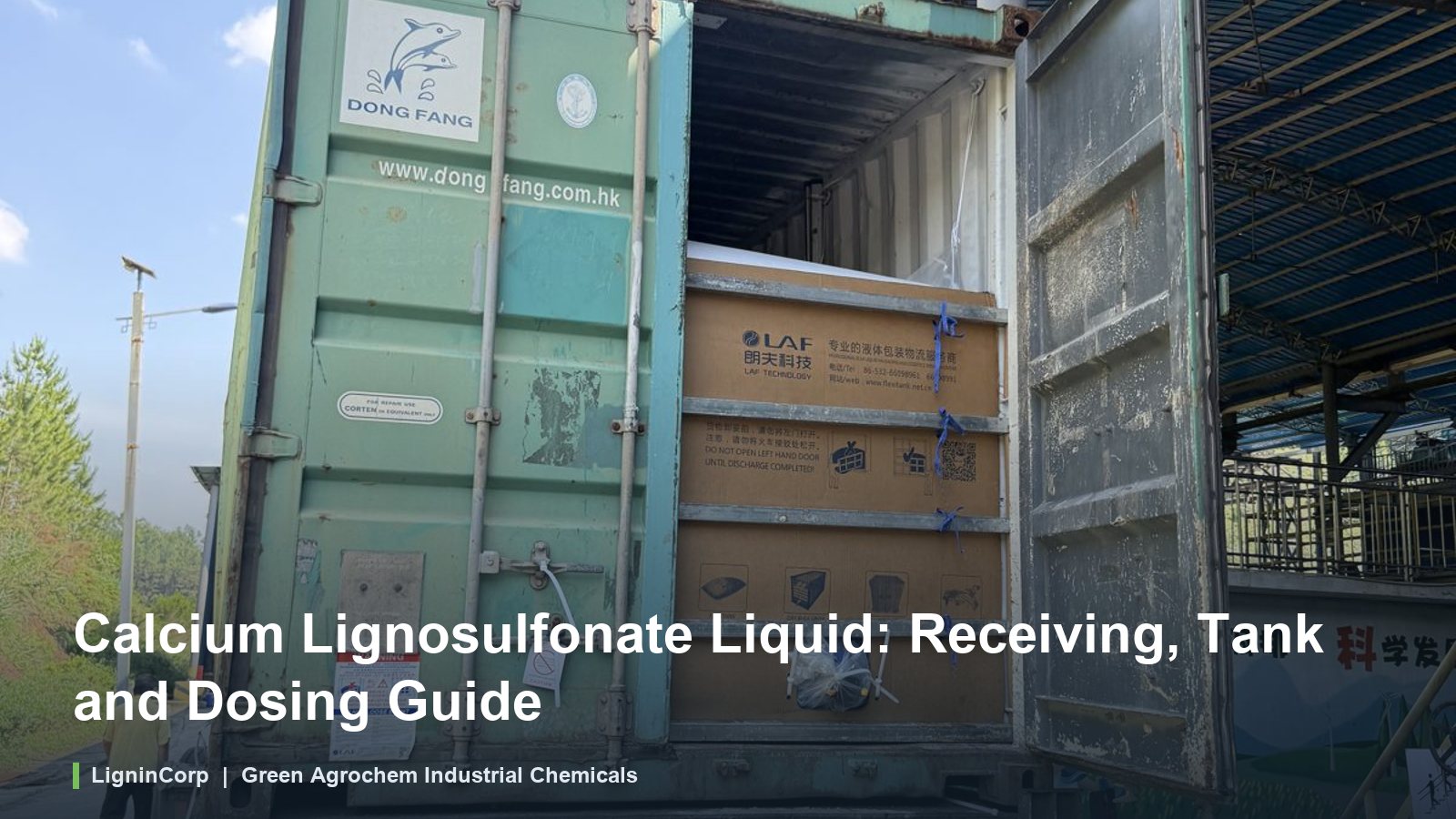
| Container and connection | Determines unloading interface, containment and contamination control. | Approved packaging/transport plan and site receiving procedure. |
Receiving and Sampling
- Verify carrier, seal, product, grade, lot, quantity and delivery documents before connecting.
- Inspect drum, IBC, tanker or other packaging for leakage, damage, swelling, contamination or incorrect labelling.
- Confirm the receiving tank has the correct identity, available capacity and compatible previous contents.
- Sample using the agreed safe procedure, representative location and clean compatible equipment.
- Quarantine the lot until required incoming tests and COA review are complete.
- Retain a labelled sample according to the quality agreement and investigation period.
Tank, Pump and Line Design Review
Confirm wetted-material compatibility using the current SDS, supplier information and site engineering review. Tank volume should allow operating heel, expansion, circulation and safe delivery acceptance. Secondary containment, venting, level protection, overfill prevention, drainage isolation and spill response should follow local requirements.
Pump selection depends on viscosity at the lowest expected operating temperature, flow requirement, suction conditions and solids/residue risk. Avoid dead legs and cross-connections that can cause contamination. Where settling, concentration gradients or long residence time are credible risks, define a validated recirculation or mixing plan rather than applying continuous agitation by habit.
Dosing and Dry-Solids Normalization
Meter calibration must use the actual product density and operating temperature when volume is converted to mass. If a powder or another liquid grade is replaced, compare on verified dry solids first, then confirm application response. Equal dry mass does not prove equal molecular distribution, counter-ion profile or process performance.
A numerical addition level may be used only when the current supplier technical document for the exact grade states its revision and calculation basis. Present it as a supplier-recommended starting trial range, not as a universal production dosage, and optimize with the actual raw materials, water, temperature, addition sequence and test method.
Routine Operating Checks
| Check | Possible warning sign | Response |
|---|---|---|
| Appearance and homogeneity | Layering, unexpected sediment, gel, contamination or colour change. | Hold material; compare retained sample and investigate before use. |
| Tank level versus receipts/use | Inventory mismatch or unexplained loss. | Check meter calibration, leaks, line contents and transaction records. |
| Pump pressure/flow | Reduced flow, pressure rise or unstable meter reading. | Review temperature, strainer, line blockage, air ingress and pump condition. |
| Application response | Viscosity, setting, dispersion, binding or stability drift. | Hold affected lots, verify dosage basis and compare incoming/application results. |
| Storage age | Material exceeds approved inventory window. | Do not extend shelf life without documented exact-grade evaluation. |
Corrections to the Former Page
| Former statement | Status | Correct treatment |
|---|---|---|
| Liquid is a concentrated solution of calcium lignosulfonate in water. | Incomplete identity description. | Confirm exact grade, solids, analytical profile and solution condition from current documents. |
| Highly water-soluble and easy to prepare. | Unqualified solubility and handling claim. | Review insolubles, water quality, temperature, residue and equipment requirements. |
| Ready to use and needs no mixing or preparation. | Unsupported universal operating claim. | Confirm whether dilution, circulation, filtration or solids correction is required for the actual process. |
| Compatible with various ingredients and additives. | Unsupported universal compatibility claim. | Run complete-formulation compatibility and performance testing. |
| Prevents settling or agglomeration. | Unverified performance promise. | Measure viscosity, particle size, settling, hard sediment and redispersibility against a control. |
Powder, General Liquid or Application Grade?
Use the calcium lignosulfonate powder handling guide when on-site dissolution and dry logistics are being considered. For road and yard surface binding, evaluate the purpose-built calcium lignosulfonate dust-control liquid and confirm it in a field section. Other industrial systems require their own grade and acceptance program.
Documents and Technical Review
Request the current exact-grade TDS and SDS, representative COA, packaging information and storage statement through the technical document centre. To review unloading, tank compatibility, pump selection, solids conversion or a process trial, contact LigninCorp or email info@greenagrochem.com.
Liquid Calcium Grades
| Grade (code) | Solids | Lignosulphonate (dry basis) | pH | Reducing sugar | Density |
|---|---|---|---|---|---|
| General (GAC-CaLS-L) | 45% min | 45% min | around 5.0 | around 4% | 1.265 g/ml |
| Acidic (CaLS-L-Acidic) | 45% min | 55% min | 4.0 – 6.0 | around 12% | 1.268 g/ml |
| Dust Control (GAC-CaLS-DC-Liquid) | 45 – 55% | 45% min (liquid basis) | 4.0 – 7.0 | — | 1.20 – 1.28 g/cm³ |
| Feed Grade (GAC-CaLS-FEED) | 45% min | 55% min | 4.0 – 6.0 | around 15% | 1.268 g/ml |
Dosing Example
A plant needs 50 kg of dry calcium lignosulfonate per batch. At 45% solids that is 50 ÷ 0.45 = 111 kg of liquid, or about 88 L at 1.265 g/ml. The liquid brings about 61 kg of water into the batch.
Frequently Asked Questions
How should liquid calcium lignosulfonate be stored?
In closed tanks, protected from freezing, and circulated before use. Shelf life is 12 months in sealed containers (TDS).
What is the density of liquid calcium lignosulfonate?
The general grade TDS gives 1.265 g/ml; use the batch value for volume dosing.
How do I convert a dry dose to liquid?
Divide by the solids fraction: at 45% solids, 1 kg dry equals about 2.22 kg of liquid.
