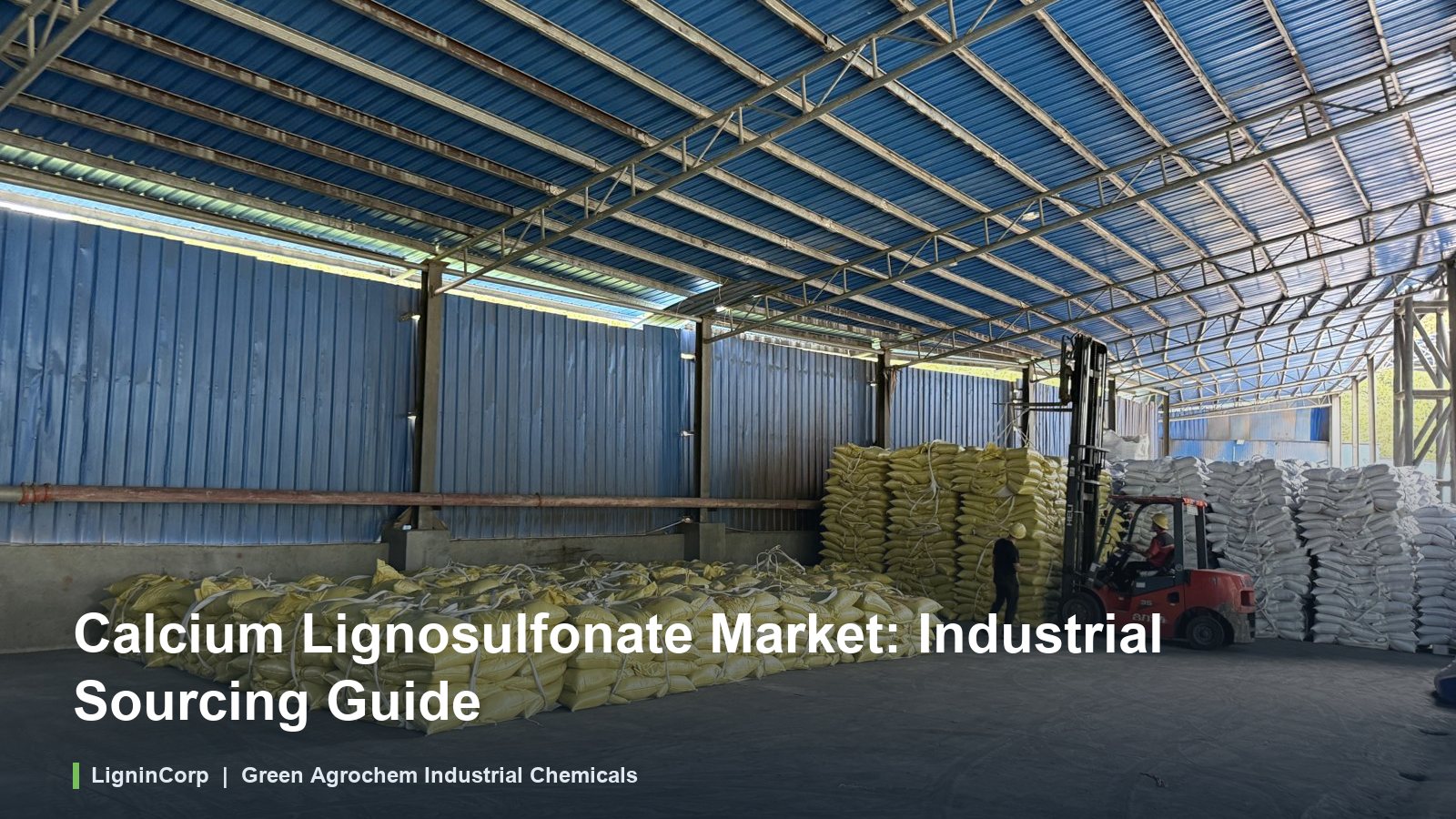
The calcium lignosulfonate market is best understood as a group of regional supply chains serving concrete, mineral processing, ceramics, granulation, dust control and other industrial applications. Commercial offers are not automatically interchangeable: feedstock, manufacturing route, purification, product form and release specification can influence both delivered cost and application performance.
This page gives industrial buyers an evergreen framework for evaluating market offers. For current grade data, packaging and sample requests, see Calcium Lignosulfonate. Use the industrial calcium lignosulfonate powder buying guide to compare current powder grades and prepare an RFQ.
Where industrial demand comes from
- Cementitious systems: conventional water reduction, plasticizing or set modification after mix-specific testing.
- Mineral and ceramic processing: slurry dispersion, viscosity control and selected binding operations.
- Granulation and agglomeration: binding of mineral fines, briquettes and selected industrial granules.
- Dust control: treatment of compatible unpaved surfaces where climate, traffic and runoff conditions have been assessed.
- Other formulations: require grade-specific compatibility and performance evidence rather than transfer of results from another industry.
Feed and agricultural demand belongs to specialist regulatory and application channels. Industrial purchasing decisions should not assume that an industrial grade is approved for feed, fertilizer or crop use.
How the supply chain is structured
Supply may originate from integrated pulp producers, lignosulfonate refiners, converters, compounders or distributors. These business types offer different strengths. An integrated producer may control the source liquor, while a specialist converter may offer purification, blending, ion adjustment or application support. A distributor may improve regional stock and logistics but should still provide traceability to the manufacturing site.
What drives quotation differences?
| Commercial factor | Why it changes the comparison |
|---|---|
| Powder, granule or liquid form | Changes active-solids freight, handling equipment, storage and dissolution cost. |
| Purity and controlled properties | Tighter limits or additional processing may affect price and application consistency. |
| Packaging and shipment size | Bags, big bags, drums, IBCs and bulk shipments have different handling and freight economics. |
| Origin and delivery terms | Freight, duties, insurance, port handling and Incoterms affect landed cost. |
| Volume and supply commitment | Forecast accuracy, campaign planning and contract duration influence commercial terms. |
| Technical support and documentation | Application trials, traceability, change control and complaint handling have procurement value. |
Compare offers on active and usable value
For liquids, compare price on active solids and include transport of water. For dry forms, include dissolution equipment, labor, energy and make-down losses. The lowest price per tonne may not be the lowest cost-in-use if a grade requires more material, creates deposits, dissolves slowly or causes inconsistent final properties.
Specification and documentation checklist
- Current TDS and SDS for the exact quoted grade.
- Representative and lot-specific COA with stated test methods.
- Moisture or liquid solids, pH, solubility or insolubles, ash and reducing sugars where relevant.
- Calcium and other ion information where the formulation imposes limits.
- Packaging, shelf life, storage, country of origin and manufacturing site.
- Batch traceability, retained-sample policy and advance change notification.
Market claims need dated evidence
Market size, growth rate, regional share and forecast claims change over time and depend on how analysts define product grade and end use. Buyers should request the publication date, geographic scope, methodology and source before relying on such numbers. This page intentionally does not present an unsupported global market value or CAGR.
Qualification before contracting
Use supplier guidance as a recommended trial range and compare grades on an active-solids basis. Screen more than one dosage using the actual formulation, water chemistry and process conditions. Define acceptance criteria before testing, then confirm the preferred material in a controlled plant trial and more than one production lot when supply continuity is important.
Supply-risk controls
Dual-source planning should compare functional performance as well as paper specifications. Agree on notification for changes in feedstock, manufacturing site, process or specification. Review seasonal logistics, minimum order, lead time, safety stock and alternative packaging before a disruption occurs.
For a comparable quotation, send the application, required specification, annual volume, shipment size and delivery location to info@greenagrochem.com. Concrete buyers may also review Calcium Lignosulfonate for Building Materials.
