
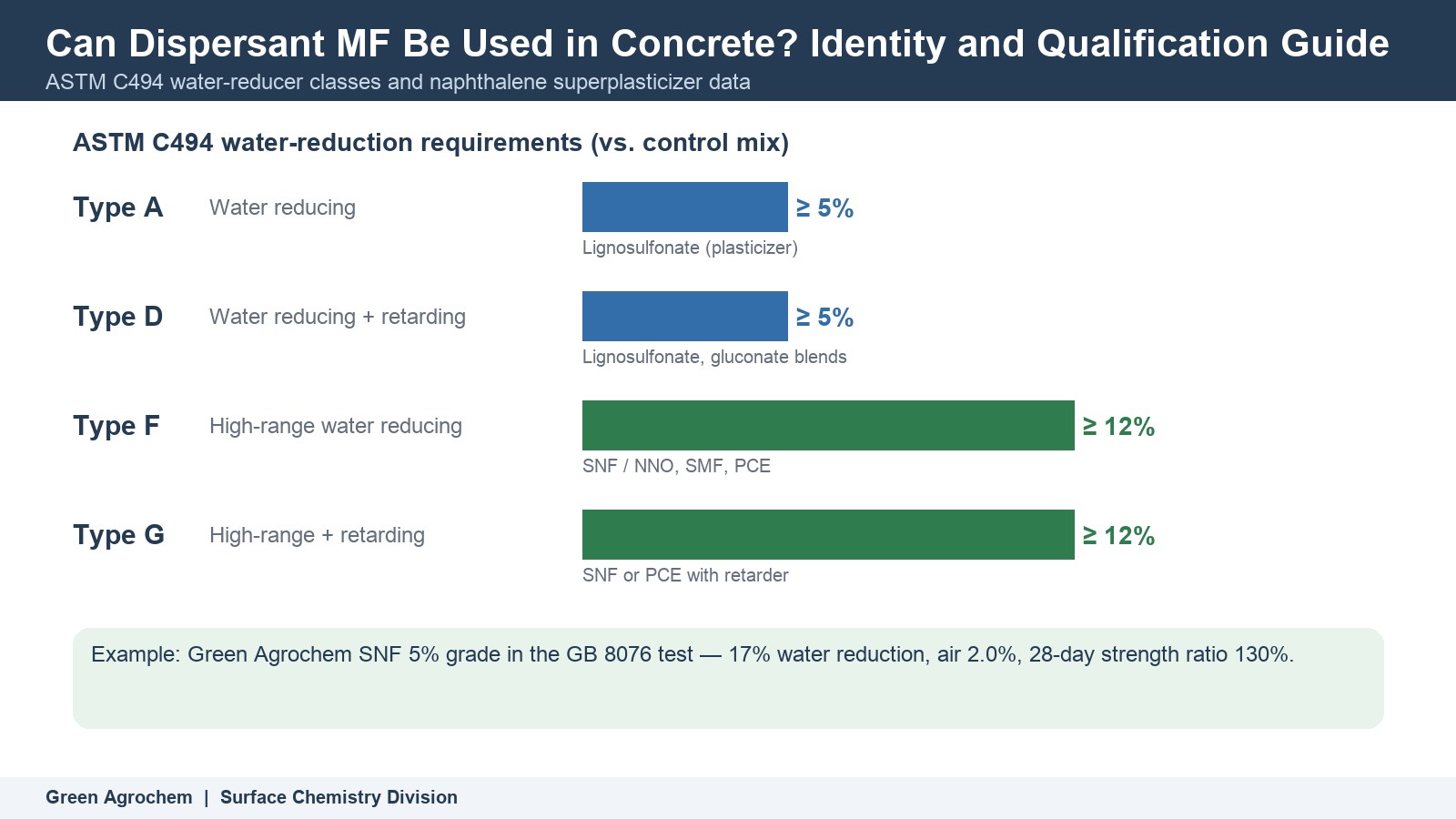
“Dispersant MF” should not be approved for concrete from the trade name alone. In many dye and pigment markets, MF refers to a methylnaphthalene-sulfonate/formaldehyde condensate dispersant. In construction, similar abbreviations may be confused with melamine-formaldehyde sulfonate or with SNF, the sodium naphthalene sulfonate formaldehyde family commonly sold as a concrete superplasticizer. These are not interchangeable identities.
This page answers a narrower and more useful question: can a specific MF-labelled product be qualified for a concrete formulation? The answer depends on verified chemistry, exact-grade documentation and concrete testing.
Resolve the Product Identity First
| Label encountered | Possible meaning | Required confirmation |
|---|---|---|
| Dispersant MF | Often a methyl/methylnaphthalene sulfonate formaldehyde condensate used in dye or pigment processing. | Manufacturer, grade code, chemical description, CAS information, TDS and SDS. |
| Melamine-based superplasticizer | A sulfonated melamine-formaldehyde condensate used in some cementitious systems. | Do not infer from the letters “MF”; obtain the exact polymer identity. |
| SNF/PNS | Sodium/polynaphthalene sulfonate formaldehyde concrete admixture family. | Confirm sulfate grade, solids/moisture, chloride, pH and construction documentation. |
If the supplier cannot resolve the identity, do not substitute the product into concrete. Similar colour, solubility or anionic character is not proof of equivalence.
Why Dye-Grade MF Is Not Automatically a Concrete Admixture
A formulation dispersant may be optimized for dye heat stability, grinding, shade development or electrolyte tolerance. A concrete admixture must be evaluated for cement adsorption, water reduction at equal consistency, slump retention, setting, air, bleeding, strength development and project-specific durability. Impurity controls and regulatory documentation may also differ.
The concrete producer remains responsible for verifying that the material meets the applicable project specification and local admixture standard. A supplier’s statement that a product is “dispersing” does not establish construction suitability.
Documentation Gate Before Laboratory Testing
- exact chemical family, manufacturer and grade code;
- current TDS, SDS and representative or lot-specific COA;
- solids or moisture, pH, sulfate/salts, chloride and insolubles with test methods;
- declared intended use and relevant construction compliance documents;
- dosage basis—total cementitious material and as-supplied versus dry solids;
- storage, shelf life, packaging and change-control policy.
Concrete Qualification Workflow
- Use an approved control mix: fix cement/SCM sources, aggregate moisture, water, temperature and other admixtures.
- Normalize candidate additions: compare active or dry solids, not only powder or solution mass.
- Measure fresh concrete: workability at initial and later times, air, unit weight, bleeding, segregation and setting.
- Observe production behaviour: mixing, pumping, placement, finishing and cleaning.
- Test hardened properties: early and specified-age strength plus required permeability, shrinkage or durability tests.
- Confirm a plant batch: establish dosing calibration, acceptance limits and lot traceability before routine use.
Legacy Claims Requiring Evidence
| Former page claim | Status | Evidence required |
|---|---|---|
| 10–15% water reduction | Unverified performance result | Exact grade, dosage/basis, cement system, control consistency, method and report. |
| 20–26% strength increase | Unverified performance result | Age, specimen, curing, control mix, water adjustment, test standard and dataset. |
| 10–15% cement saving | Unverified design/economic claim | Validated equivalent-performance mix designs and project approval. |
| 0.5–2% dosage | Unverified generic range | Current exact-grade supplier document, revision and as-supplied/dry-solids basis. |
| Early strength, universal compatibility, non-toxic and biodegradable | Unsupported generalizations | Exact-grade test and regulatory evidence for the stated use and market. |
These figures are retained for traceability because they appeared on the former page. They are not LigninCorp specifications, recommended starting ranges or expected customer results. They must not be restored as claims merely by adding “recommended.”
Select the Correct Product Route
For concrete high-range water reduction, start with the LigninCorp SNF concrete selection guide and the concrete admixtures application hub. For dye, pigment or textile formulations, use the group’s GreenAgrochem Dispersant MF product route and MF selection and testing guide.
If a supplier proposes an MF-labelled grade specifically for concrete, contact LigninCorp with the original label, TDS, SDS, COA, cementitious system, target performance and applicable test standard. Identity verification comes before dosage discussion.
