
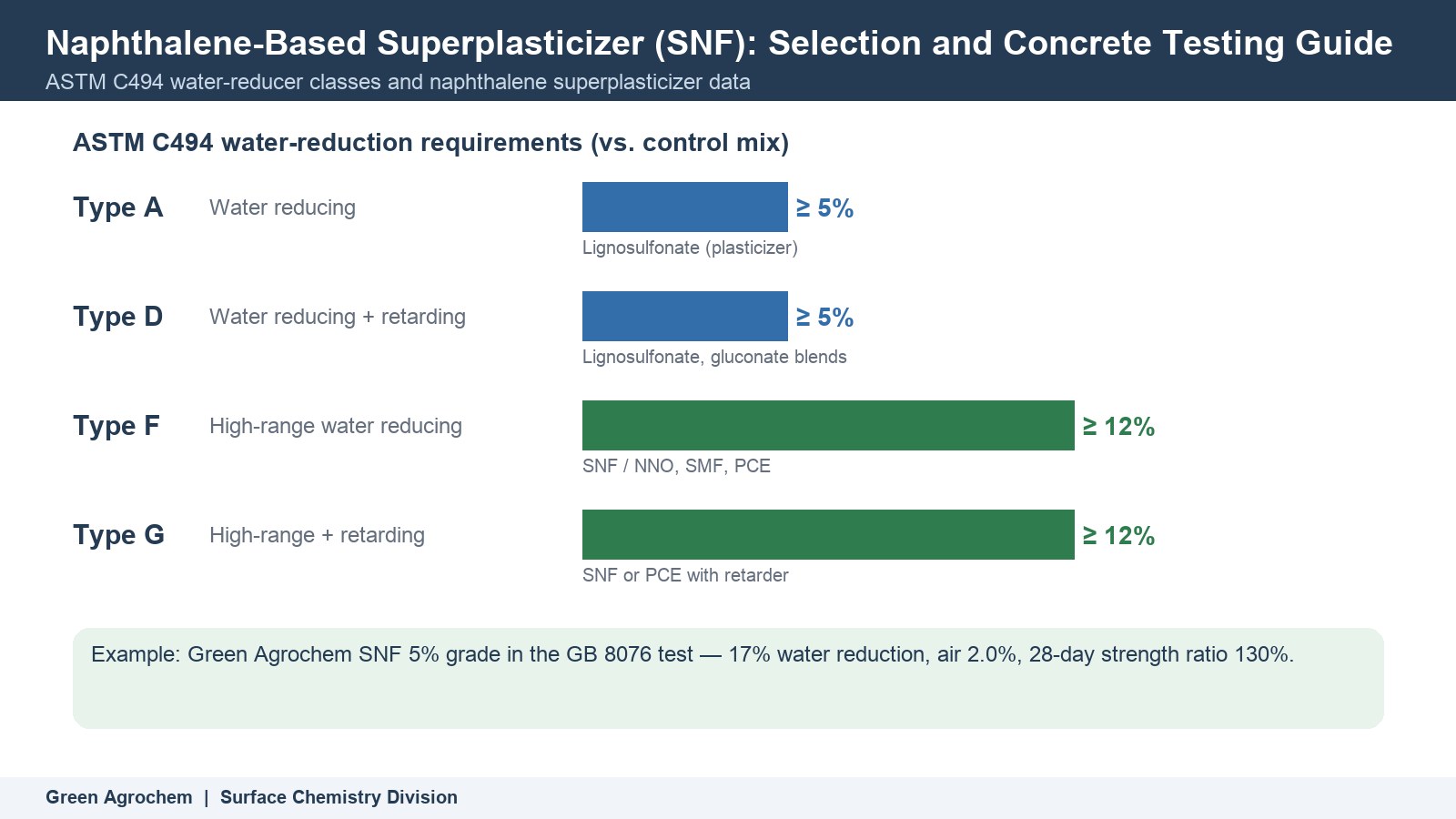
Naphthalene-based superplasticizer commonly refers to sodium naphthalene sulfonate formaldehyde condensate (SNF), also called PNS or FDN in some markets. It is an anionic concrete admixture raw material used to disperse cement particles, improve workability at a controlled water content, or support water reduction at a controlled consistency. Performance depends on the exact SNF grade, cementitious system, mix design, temperature, mixing sequence and test method.
How SNF disperses cement particles
After addition to a cementitious mix, sulfonated naphthalene-formaldehyde molecules adsorb on particle surfaces. Their ionic groups increase repulsion between adjacent particles and help break down flocculated clusters. Water that was trapped inside those clusters becomes more available for flow. This mechanism can improve initial dispersion without treating a published performance percentage as a universal guarantee.
SNF should be evaluated as one component of the complete admixture and concrete system. Cement chemistry, supplementary cementitious materials, aggregate moisture, water quality, temperature, other admixtures and time between batching and placement can materially change the result.
Where naphthalene-based superplasticizers are used
- Ready-mix concrete: initial workability and water-control programs where transport time and consistency retention are verified for the local materials.
- Precast concrete: mixes requiring controlled flow, surface finish and early production handling after plant trials.
- Pumped concrete: projects where pumpability, cohesion, bleeding and segregation are assessed together.
- Mortars and grouts: cementitious formulations that need particle dispersion and controlled rheology.
- Admixture blending: use as an active raw material in formulated products after compatibility and stability testing.
SNF compared with PCE and lignosulfonate admixtures
SNF, polycarboxylate ether (PCE) and lignosulfonate-based admixtures are not interchangeable by name alone. PCE products often use a different dispersion mechanism and may be selected when a formulation requires a higher level of water reduction or tailored workability retention. Lignosulfonate admixtures may be appropriate for conventional plasticizing and set-control programs. SNF remains relevant where its initial dispersion, established handling profile, cost-in-use and compatibility fit the project.
The selection should be made from controlled comparative trials, not from a generic claim that one chemistry is always superior. Compare equal consistency or equal water content, document the addition basis, and measure the properties required by the project specification.
Grade and document review
Before approving an SNF source, obtain the current grade-specific TDS, SDS and representative COA. Review the declared physical form, active or solids basis, moisture, pH, sodium sulfate or other relevant inorganic salts, water insolubles, bulk or solution properties, storage conditions and the supplier’s test methods. Values should be treated as specifications or typical properties only when supported by the current document for the offered grade.
Do not transfer a dosage from a different supplier, grade or cement system. A numerical addition level may be described as a supplier-recommended starting trial range only when the current TDS identifies the exact grade and whether the basis is as supplied, active solids or total cementitious material.
Laboratory and plant qualification
- Define the control mix: record all cementitious materials, aggregates, moisture corrections, water, admixtures, temperature and mixing procedure.
- Establish the dosage basis: use the exact supplier document and clearly distinguish as-supplied product from dry or active solids.
- Run a controlled series: change one variable at a time and include an untreated control where appropriate.
- Measure relevant properties: evaluate consistency, retention with time, air, setting behaviour, bleeding, segregation, pumpability, strength and durability indicators required by the project.
- Check compatibility: repeat testing when cement source, supplementary material, water, temperature or another admixture changes.
- Confirm at plant scale: verify batching accuracy, addition sequence, mixing energy, transport and placement before routine production.
Common troubleshooting points
- Insufficient initial flow: confirm product identity, weighing accuracy, water correction, addition sequence and mixing time before changing the addition level.
- Rapid workability loss: review temperature, cement compatibility, transport time and the need for a retention-focused admixture strategy.
- Unexpected set change: check the complete formulation, sulfate balance, contaminants and interaction with other admixtures.
- Bleeding or segregation: assess water content, grading, fines, paste volume and total admixture package rather than attributing the result to SNF alone.
- Batch variation: compare incoming COAs and retain samples against agreed acceptance criteria and a qualified reference lot.
Procurement information to include in an RFQ
State the required physical form, application, cementitious materials, target test standard, annual and shipment quantity, packaging, destination, Incoterm and required documentation. Request the current TDS, SDS, representative COA, packaging details, shelf-life statement and a sample for qualification. Commercial comparison should be based on delivered cost and verified performance in the buyer’s system rather than an unsupported market price.
Related SNF resources
- Sodium Naphthalene Formaldehyde (SNF) product-family page
- SNF grade selection and mix-design guide
- SNF qualification for high-strength concrete
- Request documents, a sample or a quotation
For grade-specific technical documents and application review, contact info@greenagrochem.com with the intended use, test method, local materials and purchasing requirements.
