
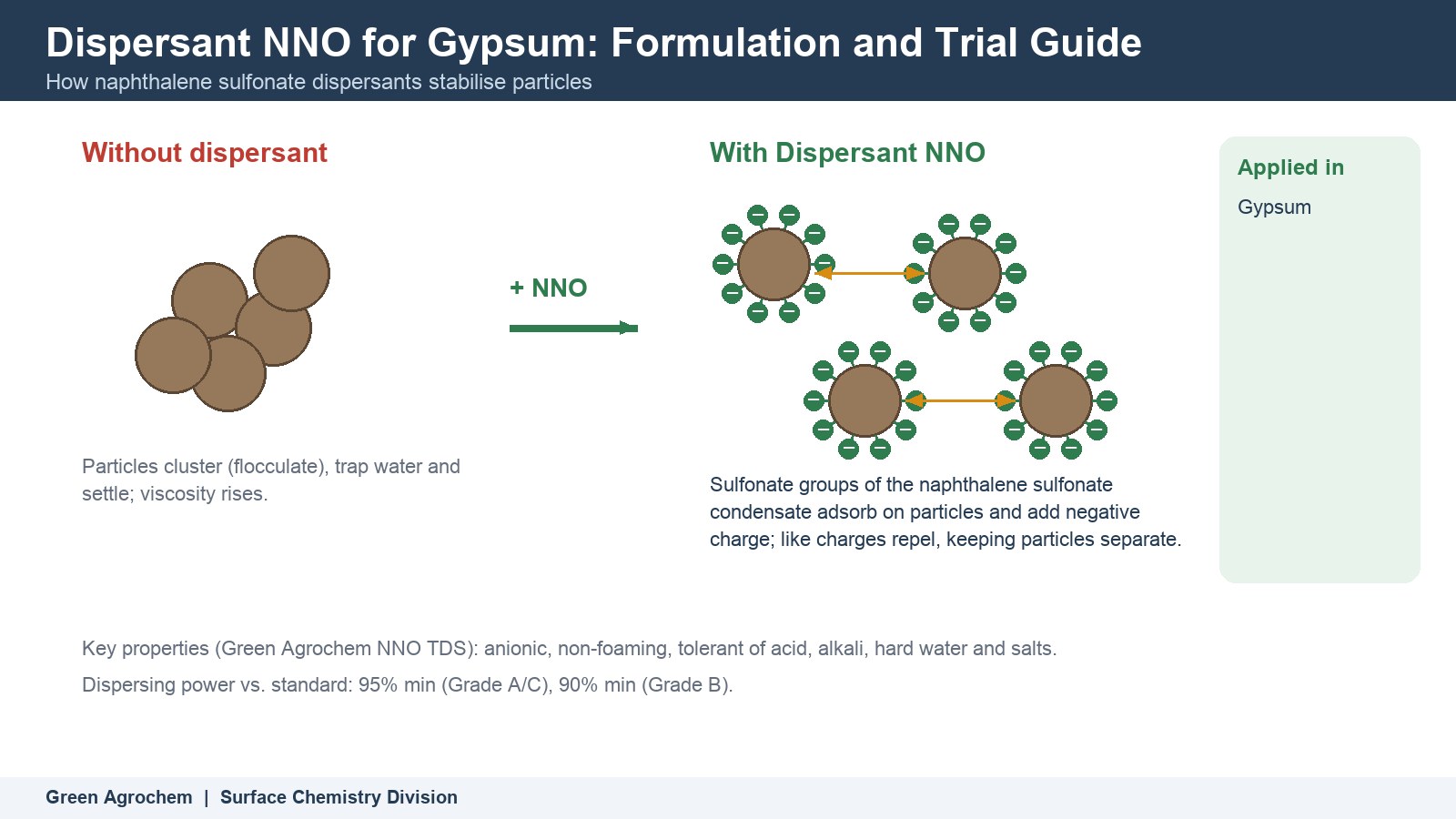
Dispersant NNO is a naphthalene-sulfonate formaldehyde condensate used as an anionic dispersant in selected gypsum formulations. Its purpose is to improve particle distribution and slurry handling—not to guarantee a fixed water reduction, setting time or strength result. Suitability depends on the NNO grade, gypsum source, particle-size distribution, soluble salts, water chemistry and the complete additive package.
Where NNO may be evaluated
- Gypsum plaster and dry-mix systems: to assess whether the required consistency can be reached with improved slurry dispersion.
- Gypsum board slurry: to study pumpability, mixing uniformity and compatibility with foaming agents, starch, accelerators, retarders and other board additives.
- Self-levelling and repair formulations: to control flow and placement while verifying segregation, bleeding and set development.
- Moulding and specialty gypsum: to evaluate surface reproduction, air release and dimensional quality under controlled conditions.
Dispersion mechanism
The sulfonated polymer can adsorb on compatible mineral-particle surfaces and increase electrostatic repulsion. Better separation of agglomerates may change slurry rheology and the amount of mixing water needed for a target consistency. Gypsum is a reactive system, so adsorption and performance can be altered by calcium ions, sulfate concentration, pH, temperature, impurities and competing admixtures.
Critical formulation variables
Gypsum raw material
Natural gypsum, flue-gas-desulfurization gypsum, phosphogypsum and calcined products can differ in purity, crystal habit, fineness, soluble salts and water demand. A result obtained with one source should not be transferred to another without testing.
Set-control package
Accelerators, retarders and dispersants can interact. Measure initial and final set using the buyer’s specified method, and observe false set, rapid stiffening and finishing window rather than assuming a neutral effect.
Foam and air system
For gypsum board and lightweight products, evaluate foam quality, entrained-air stability, density distribution and dried-board structure. A dispersant can change surfactant behaviour and should be screened with the actual foaming system.
Water and addition sequence
Hardness, dissolved salts, recycled process water, temperature and order of addition may affect dissolution and adsorption. Record them in every comparison.
Grade qualification
Request the current TDS, SDS and batch COA for the exact NNO grade. Confirm chemical identity, physical form, active or solids basis, pH, sodium sulfate and insoluble matter when specified, solution appearance, storage conditions and relevant restricted-substance documentation. Trade names such as NNO and SNF are not sufficient for grade equivalence.
Recommended laboratory screening
- Define the control. Use a representative gypsum lot, process water and the current additive package.
- Set the target response. Select measurable criteria such as consistency, spread, viscosity, mixing energy, pumpability, density, set time or surface quality.
- Choose a documented trial series. Use only the supplier-recommended range for the exact grade and define whether the basis is as-supplied product, active solids or dry gypsum. If no current technical document supports a number, do not publish one.
- Hold other variables constant. Keep gypsum mass, water, mixing time, temperature and addition sequence consistent.
- Check fresh properties. Record wetting, lumps, foam, flow, segregation, bleeding, temperature and time-dependent consistency.
- Check hardened properties. Evaluate set, density, dimensional behaviour, surface, strength and adhesion only with appropriate test methods and matched controls.
- Confirm in production. Scale up only after repeat laboratory batches establish a stable operating window.
Limitations
NNO is not universally compatible with every gypsum, retarder, accelerator, foaming agent or polymer modifier. Excess addition may cause unwanted air, segregation, delayed set or other formulation changes. Colour and impurity profile may also matter in white or decorative products. Do not claim fixed water reduction, strength gain, setting-time improvement or dosage without grade-specific documentation and comparative test conditions.
Procurement and technical enquiry checklist
Provide the gypsum origin and type, calcination route, fineness, target product, water source, current additives, mixing process, required flow or consistency method, set-time limits, density and strength tests, packaging preference and annual demand. For current grade documents, samples and supply evaluation, contact info@greenagrochem.com.
Related resources: naphthalene-sulfonate dispersion mechanism and SNF procurement and quotation factors. For pesticide, dye and pigment formulation dispersants, visit GreenAgrochem.net.
