
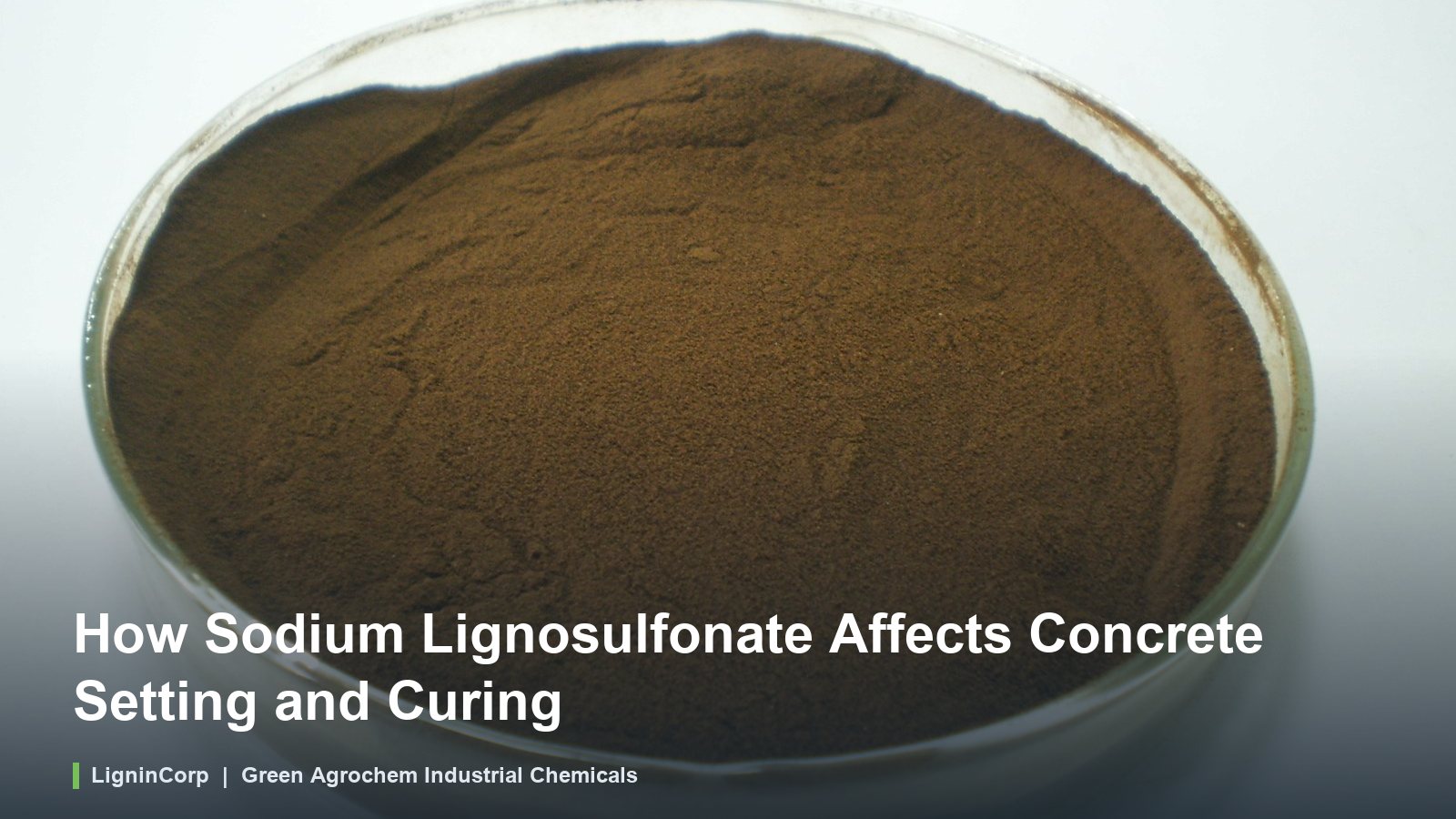
Sodium lignosulfonate can affect concrete setting and early hydration, but it does not replace curing. These are different processes: setting describes the transition from plastic to rigid concrete, while curing controls moisture and temperature after placement so hydration can continue.
Effect on setting
Some sodium lignosulfonate grades can delay initial and final set. The magnitude depends on dosage, reducing-sugar content, cement chemistry, sulfate balance, temperature and other admixtures. A fixed delay should never be assumed from the chemical name alone.
Effect on early strength
If setting is delayed, early strength development may also shift. This matters for formwork removal, prestressing, saw cutting, finishing and cold-weather placement. Later-age strength depends on water-to-binder ratio, consolidation and curing as well as the admixture. Test the actual concrete at the ages used for construction decisions.
Curing requirements remain unchanged
Concrete containing sodium lignosulfonate still requires the specified curing method. Protect the surface from premature moisture loss and maintain the required temperature. Do not shorten curing solely because workability improved, and do not delay curing simply because final set occurs later. Follow the project specification and applicable standard.
When set delay may be useful
- warm-weather concreting;
- long transport or placement sequences;
- large pours where joint management is important;
- formulations intentionally designed for extended workability.
These uses require trials. Excessive delay can disrupt finishing, formwork cycles and early loading.
Recommended test plan
- Prepare a control with the actual cement and SCMs.
- Screen several supplier-recommended dosages on an active-solids basis.
- Measure initial and final set at expected concrete temperatures.
- Record workability retention, air, bleeding and segregation.
- Test strength at early construction-control ages and specified later ages.
- Repeat with the complete admixture package and actual curing regime.
Troubleshooting unexpected delay
Verify dosing accuracy, solids content, cement source, material temperature and mixing sequence. Check whether a retarder or another water reducer is also present. Change one variable at a time. Increasing accelerator dosage without identifying the interaction can create inconsistent setting or finishing.
Product selection
Review pH, reducing sugars, solids or moisture, water insolubles and lot consistency. Use the supplier range only as a recommended trial starting range. See Sodium Lignosulfonate Construction Grade, the concrete technical guide, and LigninCorp technical support for documentation and samples.
