
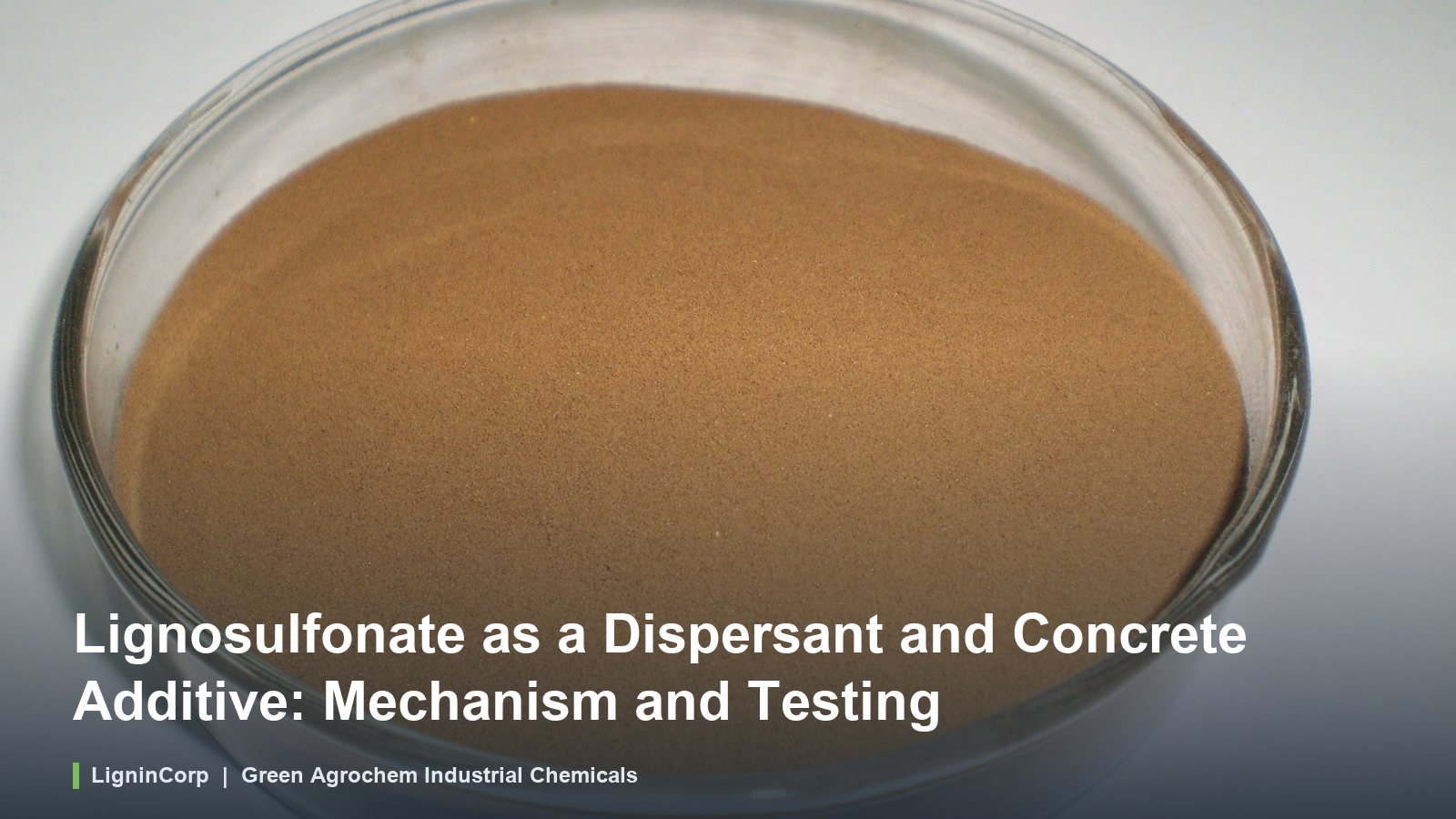
Lignosulfonates are anionic, water-compatible polymers that can help disperse particles in several industrial systems. In concrete they may reduce cement-particle flocculation; in pigment, dye, mineral or suspension systems they may support wetting and dispersion. These applications share an adsorption-and-charge mechanism, but they do not use one interchangeable grade or one universal addition level.
This guide explains the common chemistry, the application-specific differences and the evidence buyers should request before selecting a commercial material.
Shared Dispersing Mechanism
The lignin-derived backbone contains hydrophobic regions that can associate with a particle surface, while sulfonate and other ionizable groups support water compatibility and electrostatic effects. Adsorption can reduce particle–particle attraction and improve the distribution of solids. Actual performance depends on molecular distribution, charge density, degree of sulfonation, counter-ion, salts, pH and the surface chemistry of the material being dispersed.
More sulfonation or higher molecular weight is not automatically better. A grade must maintain a useful balance among adsorption, solubility, steric size, solution viscosity and compatibility with the continuous phase.
Concrete Admixture Versus General Dispersant
| Decision area | Concrete/cement system | Pigment, dye or mineral suspension |
|---|---|---|
| Primary substrate | Cement and supplementary cementitious materials undergoing hydration. | Selected organic or inorganic particles in a defined liquid phase. |
| Main response | Workability or water reduction at a selected consistency, with setting and air monitored. | Viscosity, particle-size distribution, settling, colour development or storage stability. |
| Critical side effects | Retardation, air change, bleeding, segregation and strength development. | Foam, shade change, electrolyte sensitivity, flocculation and thermal stability. |
| Qualification basis | Total cementitious material; distinguish as-supplied from dry solids. | Total formulation, pigment/mineral mass or active solids; define the basis explicitly. |
A concrete result cannot establish performance in dye or pigment processing, and a good pigment dispersant is not automatically a suitable concrete admixture.
Grade Variables to Compare
- counter-ion: sodium, calcium, magnesium or another form;
- molecular-weight distribution rather than one nominal average;
- sulfonate content or charge-density method;
- pH, moisture or liquid solids, ash and inorganic salts;
- reducing sugars and their relevance to cement setting;
- water insolubles, colour, viscosity and storage stability;
- thermal or electrolyte stability where the application requires it.
Published Review Data and Its Limits
| Review-reported value | System/context | Evidence status | Buyer interpretation |
|---|---|---|---|
| Molecular-weight range 10,000–50,000 g/mol and anionic charge density 0.1–0.9 meq/g | Broad lignosulfonate/sulfonated-lignin dispersant discussion. | Literature ranges summarized by Aro and Fatehi (2017), not a product specification. | Use only as background; request exact-grade methods and lot data. |
| Flow increased from 161 to 185 mm at 0.3 wt% after oxidation and sulfomethylation | A modified material in a cement test summarized by the review. | Review-reported experimental result; the old page omitted the original formulation, method and full control conditions. | Not a LigninCorp dosage or expected customer result. |
| Surface tension 41.5 versus 66 mN/m for different calcium-lignosulfonate fractions | Molecular-weight fractions in a research system. | Review-reported result, not proof that a commercial high-MW grade is universally superior. | Test adsorption and dispersion in the actual substrate. |
Source: Thomas Aro and Pedram Fatehi, “Production and Application of Lignosulfonates and Sulfonated Lignin,” ChemSusChem (2017). These figures describe the cited literature systems. They are not Green Agrochem product specifications, universal recommended dosages or performance guarantees.
Application-Specific Trial Design
For concrete
- Fix cement/SCM sources, aggregate moisture, temperature and other admixtures.
- Compare a control and several active-solids-normalized trial additions.
- Measure slump/flow over time, air, unit weight, bleeding, segregation and setting.
- Confirm early and specified-age strength plus required durability properties.
For suspensions and formulations
- Define particle identity, surface treatment, solids, pH, water quality and electrolyte load.
- Fix milling or mixing energy, sequence, temperature and residence time.
- Measure viscosity/rheology, dispersion, foam, settling and storage stability.
- Confirm colour, thermal stability or downstream-process performance where relevant.
Data and Dosage Rule
Use a numerical addition only when a current document identifies the exact grade, application, calculation basis and revision. Present supplier guidance as a supplier-recommended starting trial range, followed by laboratory and plant validation. Published research results remain attached to their tested system and must not be relabelled as commercial dosage.
Product and Technical Routes
For cement and concrete, review the industrial sodium lignosulfonate product page, the concrete admixtures hub and the concrete mix-design guide. For broader binder, dispersant and emulsion functions, see the industrial function overview. Contact LigninCorp with the substrate, solids, pH, process, target response and required test method.
