Technical focus: This page explains how lignosulfonate dispersants are selected and tested in industrial water-based systems. For commercial specifications and enquiries, use the linked exact-grade product resources rather than treating “lignosulfonate” as one uniform material.
How lignosulfonate dispersion works
Lignosulfonates are anionic, water-soluble lignin derivatives containing sulfonate and other functional groups. Depending on the particle surface and solution chemistry, molecules can adsorb at the solid–liquid interface and contribute electrostatic and steric stabilization. This may reduce agglomeration, lower slurry viscosity or improve particle distribution.
Performance is controlled by more than dosage. Particle mineralogy and size, surface charge, pH, electrolyte concentration, calcium or magnesium, temperature, solids loading, shear, addition sequence and competing surfactants can all change the result. A grade that works in one ceramic or mineral slurry cannot be assumed to perform identically in cement, dye, pigment or agrochemical systems.
Current powder dispersant-grade data
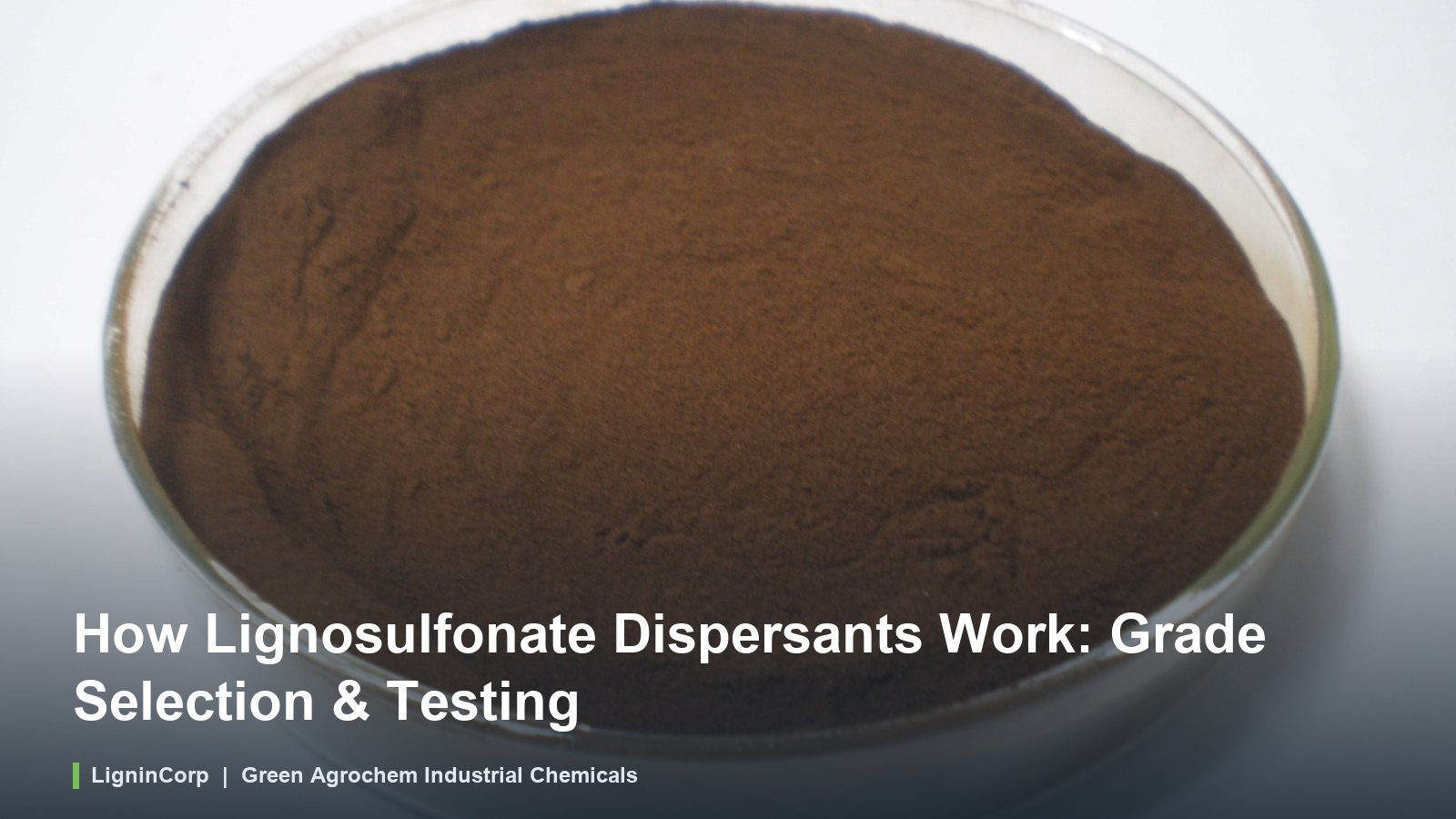
The current product document is Sodium Lignosulfonate — Dispersant Grade, GAC-NaLS-Dispersant-P, TDS Rev. 2.0. Values are stated by the TDS as typical production results for reference; the signed shipment COA supplies batch-specific results.
| Parameter | TDS value | Data type / formulation relevance |
|---|---|---|
| Appearance | Brown powder | Typical physical form |
| Dry matter | 95% min | Typical production limit; use for dry-solids dosage conversion |
| Water-insoluble matter | 0.5% max | Typical production limit; relevant to filtration and residue |
| Calcium and magnesium | 0.5% max | Typical production limit; relevant to electrolyte-sensitive systems |
| Lignosulphonate content | 70% min | Typical production limit |
| Moisture | 5% max | Typical value |
The same TDS notes a liquid alternative, GAC-NaLS-Dispersant-L, with dry matter of 45% min. Obtain that grade’s own current document before comparing liquid and powder on an as-supplied basis.
Application routing
| System | Primary test objective | Division / next resource |
|---|---|---|
| Ceramics, minerals and industrial suspensions | Viscosity, dispersion, settling and processing consistency | LigninCorp dispersant-grade page |
| Concrete and cement | Water demand, workability, setting and strength under a defined mix | LigninCorp industrial applications |
| Pesticide, dye and pigment formulations | Wetting, suspension, heat stability, colour interaction and storage | GreenAgrochem.net surface and interface technology |
| Fertilizer or crop formulations | Compatibility, nutrient interaction and crop-system validation | ChinaLignin agriculture division |
Laboratory screening workflow
- Record the exact grade, lot, dry matter and lignosulfonate content.
- Prepare a control and several additions on a clearly stated dry-dispersant or as-supplied basis.
- Keep particle solids, water quality, pH, temperature, shear energy and addition sequence constant.
- Measure the endpoint that matters: viscosity versus shear rate, flow, particle size, sedimentation, redispersibility, filtration, colour or process performance.
- Repeat after heat exposure and storage where the commercial process requires it.
- Confirm the optimum in pilot or plant equipment before production adoption.
Dosage and legacy-data status
GAC-NaLS-Dispersant-P TDS Rev. 2.0 does not provide a universal numerical dosage. Request a supplier-recommended starting trial range for the actual application and define its calculation basis. Do not copy an addition level from another particle system.
| Legacy statement | Evidence/status | Decision |
|---|---|---|
| Slow-release urea containing 90–99% urea and 1–10% lignin by weight | Unverified external formulation; lignin identity, process and source not supplied | Not a GAC-NaLS-Dispersant-P specification or dosage |
| Universal biodegradable and non-toxic dispersant | Overbroad safety/environmental claim | Use the exact-grade SDS and application-specific assessment |
| Scaling control, detergency, ink, polymerization and soil-restoration examples | Possible literature/application leads, but no sources were attached | Retained for research only; not offered-grade performance claims |
Buyer checks
Request the current TDS, MSDS/SDS and signed batch COA; specify the substrate, particle size, solids, liquid phase, pH, temperature, competing additives and target method. Confirm packaging, shelf life, MOQ and sample plan. Contact info@greenagrochem.com for exact-grade selection and trial support.
