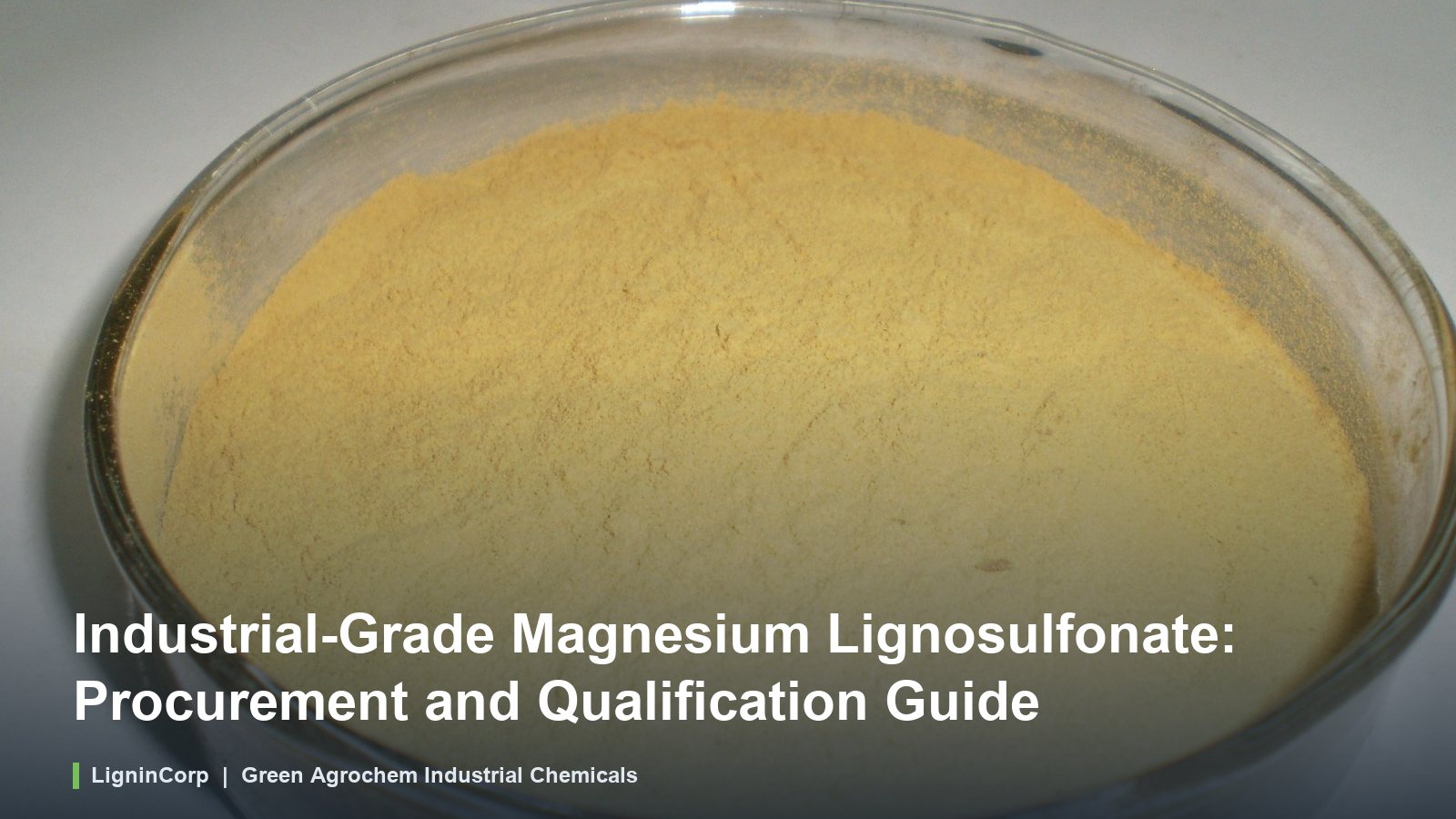
Industrial-grade magnesium lignosulfonate is a water-soluble, anionic lignin-derived material supplied for selected dispersion, binding and cementitious applications. “Industrial grade” is a commercial category rather than one universal chemical specification. Buyers should qualify the offered grade against the intended process, current TDS, SDS and lot-specific COA.
This page focuses on industrial procurement and supplier qualification. For current product specifications, forms, packaging and sample requests, use the LigninCorp Magnesium Lignosulfonate product page.
What defines an industrial grade?
Magnesium lignosulfonate is not a single molecular compound with one fixed molecular weight or composition. Feedstock, pulping conditions, refining and concentration can affect molecular distribution, sulfonation, reducing sugars, inorganic content, solubility and process response. A grade should therefore be defined by documented test limits and application performance rather than a generic internet specification.
Current documented powder grades
The current Green Agrochem technical data sheets identify two industrial powder grades. Keep their product codes separate in enquiries, samples, purchase orders and COAs; the values below must not be transferred to feed-grade or liquid material.
| Property | GAC-MgLS-1 Grade One | GAC-MgLS-2 Grade Two |
|---|---|---|
| Document | GAC-MgLS-1 TDS, Rev. 1.0 | GAC-MgLS-2 TDS, Rev. 1.0 |
| Appearance | Yellow-brown powder | Yellow-brown powder |
| pH | 4-7 | Approximately 10 |
| Dry matter | 95% minimum | 95% minimum |
| Water-insoluble matter | 1.0% maximum | 1.5% maximum |
| Total magnesium and calcium | 8% minimum | 5% minimum |
| Lignosulphonate content | 55% minimum | 50% minimum |
| Sulphate | 2% minimum | 2% minimum |
| Total reducing matter | 7% minimum | 7% minimum |
| Bulk density | 0.55 g/cm3 | 0.55 g/cm3 |
| Moisture | 5% maximum | 5% maximum |
Evidence status: these are TDS-listed reference values from Rev. 1.0 documents. The TDS documents state that the values represent typical production results for reference and direct buyers to the shipment COA for batch-specific results. Confirm contractual limits, test methods and acceptance tolerances in the quotation and purchase specification.
Liquid-grade note: request the current GAC-MgLS-L TDS and written confirmation of the basis used for solid content and lignosulphonate content before comparing it with powder grades or calculating active-solids cost.
Supplier and COA checklist
| Item | Procurement purpose |
|---|---|
| Product form and appearance | Confirms powder, granule or liquid identity and supports incoming inspection. |
| Moisture or liquid solids | Normalizes delivered dosage to active material. |
| pH and solubility method | Supports formulation screening and batch consistency. |
| Water insolubles and ash | Relevant to filtration, deposits, nozzles and sensitive formulations. |
| Reducing sugars | Relevant to cement hydration and selected biological or storage concerns. |
| Magnesium, chloride and other ions | Review where the end-use specification imposes limits. |
| Test methods and tolerances | Ensure supplier and buyer results can be compared consistently. |
Potential application routes
- Cementitious systems: conventional dispersion, plasticizing or set modification after concrete or mortar testing.
- Mineral and ceramic slurries: viscosity and stability screening using the actual solids and process water.
- Granulation and binding: evaluate green strength, attrition, moisture and drying behavior.
- Dust control: assess surface type, application rate, climate, traffic, runoff and reapplication needs.
- Selected drilling or industrial fluids: require rheology, filtration, salinity and temperature tests specific to the system.
Textile, pesticide, wastewater, carbon-black and leather uses should not be claimed as automatically suitable. Each requires a relevant formulation grade and performance evidence; pesticide and surface-technology applications are handled through the appropriate Green Agrochem division.
Recommended application qualification
Use supplier guidance as a recommended trial range. Normalize comparisons to active solids and test the actual materials and process.
- Define measurable acceptance criteria and a control formulation.
- Screen multiple dosages while holding other variables constant.
- Record water chemistry, pH, temperature, addition sequence and mixing energy.
- Measure immediate and time-dependent dispersion, viscosity, stability or binding.
- Verify final product properties and any applicable regulatory requirements.
- Confirm the selected grade in a controlled production trial.
Claims that require evidence
- No fixed water reduction, grinding-energy saving, dust reduction or strength increase should be assumed.
- Concrete-admixture compliance applies only to a tested formulation supported by the relevant standard documentation.
- High-temperature, broad-pH or alkaline-stability claims require grade-specific test data.
- Biodegradability, non-toxicity, regulatory compliance and lower-carbon claims require product-specific evidence.
- Compatibility with SNF, PCE, salts, binders or other additives must be tested.
Commercial approval and change control
Before approval, request a representative sample, current TDS and SDS, lot-specific COA, packaging information, shelf life and storage conditions. Agree on specification limits and test methods. For repeat supply, define notification requirements for changes in feedstock, process, manufacturing site or specification.
For broader grade-selection context, see the Magnesium Lignosulfonate Industrial Applications guide. For concrete-specific evaluation, see Magnesium Lignosulfonate Water Reducer. Contact info@greenagrochem.com with the target process and acceptance criteria.
Industrial Uses (TDS)
- Plasticizer in concrete, improving flow while reducing water demand
- Grinding aid in cement milling and raw-mix slurry deflocculant
- Expander in lead-acid battery negative plates
- Binder and filler in ceramic tiles, fiberboard and foundry sand
- Dust suppression
- Dispersant for pesticide and dye formulations and carbon black
- Thinner in oil-well drilling mud
- Water-reducing additive in plasterboard
- Binder for iron ore fines, coal, coke and pelletized feed
Downloads
Frequently Asked Questions
What is industrial-grade magnesium lignosulfonate?
Grade One (55% min lignosulphonate, pH 4 – 7) and Grade Two (50% min, pH around 10), for non-feed uses.
What should be in the purchase specification?
Grade code, TDS revision, limits with test methods and basis, packing and COA requirements.
