
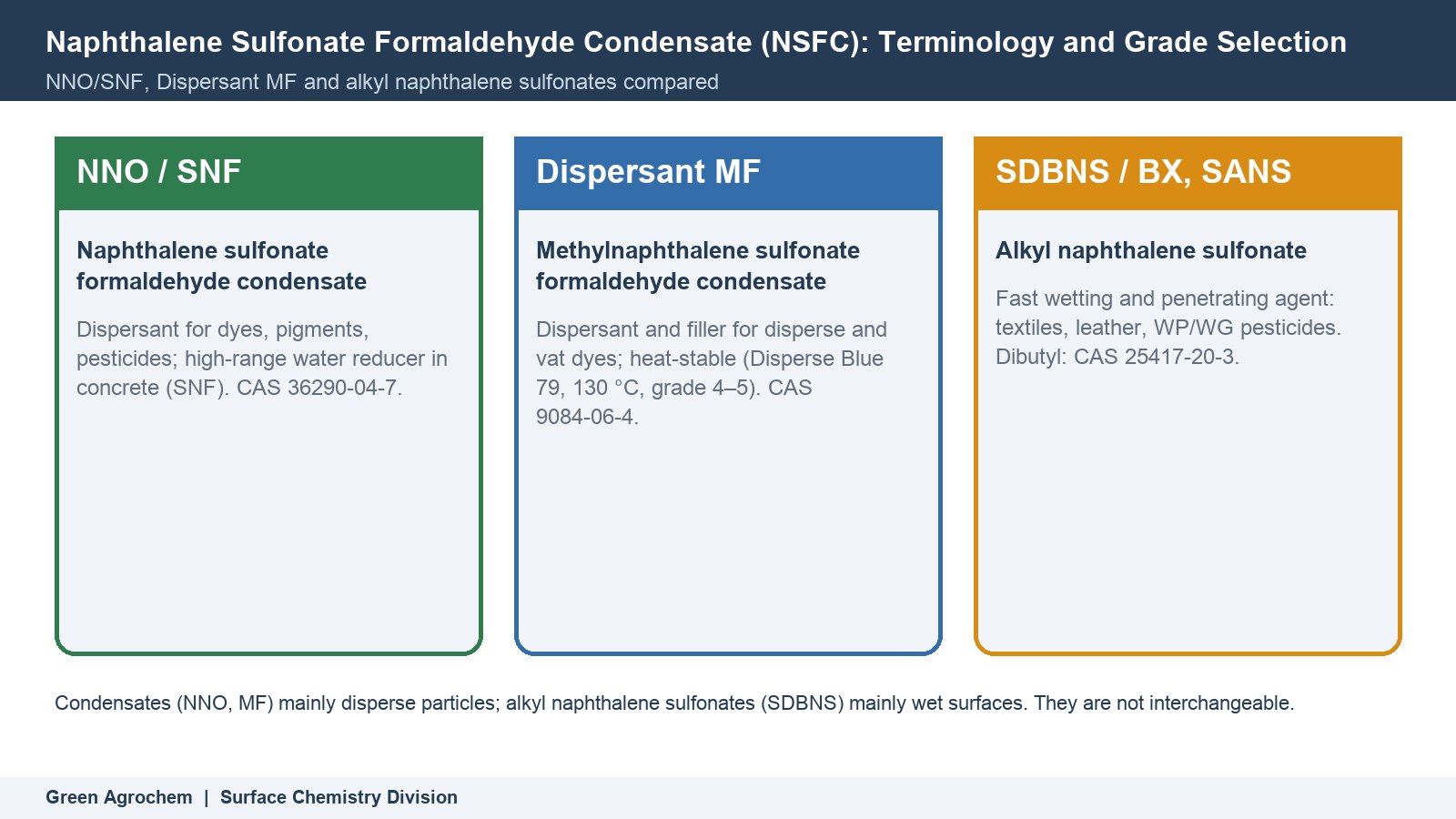
Naphthalene sulfonate formaldehyde condensate (NSFC) describes a family of anionic condensation polymers rather than one universal commercial grade. Buyers may also encounter the terms SNF, NSF, PNS, naphthalene-based superplasticizer and Dispersant NNO. These names overlap chemically, but they do not guarantee identical molecular distribution, salt content, dispersing power, concrete performance or application suitability.
This guide helps industrial buyers separate terminology from grade selection. For a purchasable concrete-admixture grade, review Sodium Naphthalene Formaldehyde (SNF) Superplasticizer. For an industrial dye, pigment or slurry dispersant, compare the Dispersant NNO product grades.
NSFC, SNF, PNS and NNO: What the Names Mean
| Term | Typical commercial meaning | Buyer caution |
|---|---|---|
| NSFC / NSF | General naphthalene sulfonate–formaldehyde condensate family. | Does not identify counter-ion, sulfate level, molecular distribution or end-use grade. |
| SNF | Sodium naphthalene formaldehyde/sulfonate condensate, commonly supplied for cement and concrete dispersion. | Confirm sodium sulfate, moisture/solids, pH, form and concrete acceptance tests. |
| PNS | Polynaphthalene sulfonate; often used as a family or product synonym. | Do not assume equivalence across suppliers from the acronym alone. |
| Dispersant NNO | An anionic naphthalene-condensate dispersant grade used in dye, pigment and aqueous solid–liquid systems. | Evaluate content, dispersing power, sulfate, pH and compatibility for the actual formulation. |
How the Chemistry Produces Dispersion
Industrial manufacture normally includes naphthalene sulfonation, controlled condensation with formaldehyde, neutralization and finishing. The resulting sulfonated aromatic polymer can adsorb on suitable particle surfaces. Its anionic charge contributes to particle separation and changes slurry or cement rheology. Actual performance depends on molecular distribution, sulfonation and condensation control, residual salts, dosage basis, particle surface, ionic environment and process conditions.
In cement systems, dispersion can release water trapped in agglomerates and improve flow at a selected water content. In dyes, pigments, ceramics and mineral slurries, the technical objective may instead be deagglomeration, viscosity control, suspension behavior or colour consistency. A result in one substrate must not be transferred to another application.
Select the Grade by Application
| Application | Primary qualification variables | Relevant route |
|---|---|---|
| Concrete and cement | Cement chemistry, supplementary materials, water, sulfate grade, workability retention, air, setting, strength and durability acceptance. | SNF grade selection and mix-design guide |
| Dyes and pigments | Dispersing power, salt tolerance, colour strength, shade, foaming, heat stability and compatibility. | Dispersant NNO grades |
| Ceramic/mineral slurry | Solids loading, viscosity curve, particle distribution, sedimentation, casting/spray behavior and fired-product effects. | Screen an industrial dispersant with the actual mineral system. |
| Oil-well cementing or other specialty use | Temperature, salinity, rheology, fluid loss, thickening time and compatibility with the complete additive package. | Request application-specific technical review. |
Data and Claims Requiring Evidence
| Former statement | Evidence/status | Correct interpretation |
|---|---|---|
| Concrete water reduction of 15–31%. | Unverified on the former page: no exact grade, dosage basis, concrete system, control, method or source. | Not a guaranteed or current supplier result. Determine water reduction in a defined mix according to the applicable test method. |
| Automatic increases in strength, durability and water resistance. | Unsupported universal outcome. | These properties depend on achieved water–binder ratio, air, curing, materials and mix design; verify independently. |
| Works reliably at high/low temperature and with other chemicals. | Compatibility claim without system-specific evidence. | Run laboratory and plant trials using the complete formulation and intended temperature/water conditions. |
| Environmentally friendly, biodegradable and low toxicity. | Safety and environmental claims cannot be inferred from function. | Use the current exact-grade SDS and applicable environmental or regulatory evidence. |
Procurement and Trial Checklist
- Identify the exact application, substrate, product form and required standard.
- Request current TDS, SDS, specification and representative COA with methods and units.
- Define sulfate/salt limits, active-content or solids basis, pH, moisture, insolubles and performance tests.
- State any cationic ingredients or other known incompatibilities.
- Compare candidates at equivalent dry-active addition where appropriate.
- Use controls and record addition sequence, water quality, temperature, shear/mixing, aging and acceptance criteria.
For grade selection, documents, samples and quotation, use the technical download library or contact info@greenagrochem.com with the application, target specification, quantity, packaging and destination.
