
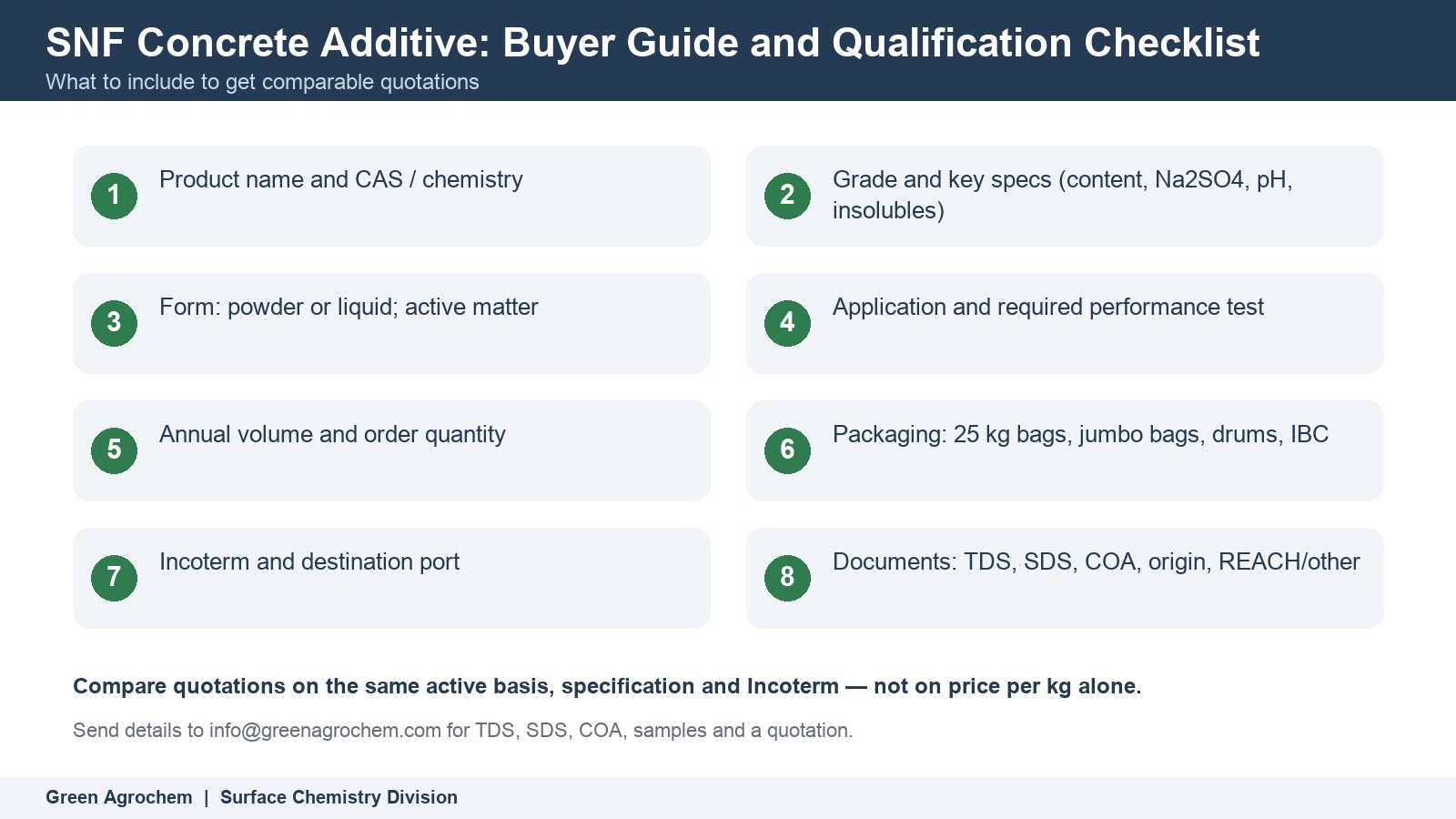
SNF concrete additive is a family of naphthalene-based cement dispersants, not one interchangeable specification. Buyers should define the required supply form, composition controls, concrete performance window and documentation before comparing quotations.
This procurement guide explains how to screen a sulphonated naphthalene formaldehyde (SNF) grade for concrete production. For available grades and inquiry details, visit the SNF product page.
What an SNF concrete additive does
SNF molecules adsorb on cement particles and increase electrostatic repulsion. Reduced flocculation improves particle dispersion and can make more of the mixing water available for workability. Depending on the approved mix-design objective, the producer may use this response to improve flow at controlled water content or to reduce water at matched workability.
The final effect is governed by the actual cementitious system, aggregate fines, temperature, addition sequence, dosage basis and elapsed time. An SNF grade does not automatically guarantee a fixed water reduction, strength, durability or cost saving.
Define the buying requirement
A useful request for quotation should identify:
- powder or liquid supply form and handling constraints;
- cement type and source, including expected source variation;
- supplementary cementitious materials and their proportions;
- target initial and retained slump or flow;
- transport, pumping, placing and finishing window;
- required strength ages and applicable acceptance method;
- limits for setting, air, bleeding and segregation;
- applicable project standard and required supporting reports;
- annual demand, shipment size, packaging, destination and Incoterm.
Without these inputs, a supplier can quote a product, but cannot responsibly confirm project suitability.
Powder versus liquid SNF
Powder
Powder can be suitable for dry blending, long-distance transport or plants equipped for dissolution and controlled dosing. Confirm moisture control, dissolution procedure, solution concentration, filtration needs and storage stability after preparation.
Liquid
Liquid can simplify pumping and automated dosing. Confirm its solids basis, density test basis, storage temperature, agitation requirements and contribution to total batch water. Do not compare liquid and powder prices without converting to an equivalent active or dry-solids basis.
Grade characteristics to verify
SNF grades can differ in solids or moisture, sodium sulfate, pH, insolubles and molecular distribution. Values should be taken only from the current TDS or product specification for the exact grade. A buyer should clarify which values are guaranteed limits, controlled ranges or typical results and which test methods apply.
Sodium sulfate classification may be relevant to a particular formulation or buyer limit, but a “lower” number is not automatically the best economic choice. Evaluate the grade against cement response, process reliability and total cost-in-use.
Required supplier documents
- current TDS for the exact commercial grade and revision;
- current SDS for the supplied form and destination market;
- representative certificate of analysis with declared methods;
- storage, packaging and shelf-life information;
- batch identification and traceability process;
- change-control procedure for formulation or manufacturing-site changes;
- current supporting report for any claimed admixture-standard classification.
Product schema, marketing names or a generic statement of compliance do not replace grade-specific technical evidence.
Dosage information: what is acceptable
A numeric addition level may be used only when it appears in the current technical document for the exact grade. Present it as a supplier-recommended starting trial range, state whether it is based on cement or total cementitious material, and specify whether it refers to as-supplied product or dry solids.
The final production dosage must be established through laboratory and plant trials using the buyer’s materials, water, temperature, mixer, sequence and test method. Do not reuse a generic online percentage or a value from another supplier.
Sample qualification plan
- Approve the supplier documents and confirm the sample matches the quoted grade.
- Define a reference mix and correct aggregate moisture.
- Bracket the exact-grade TDS starting trial recommendation.
- Measure initial and retained workability at project-relevant times.
- Record air, unit weight, temperature, bleeding, segregation and setting behavior.
- Cast, cure and test specimens using the specified procedure and ages.
- Repeat the preferred formulation in plant equipment and field conditions.
- Set acceptance limits and retain a traceable reference sample where required.
For a detailed functional qualification method, see SNF as a High-Range Water Reducer. Operational controls are covered in Using SNF in Cement Mixing.
Compare total cost-in-use
Normalize commercial offers before selection. Include:
- effective dose on a common solids or supplied-product basis;
- packaging, freight, duties and local handling;
- dissolution, storage and dosing-equipment requirements;
- workability retention and rejected-load risk;
- production consistency and technical support;
- lead time, safety stock and batch traceability.
Do not count cement reduction, earlier demoulding or service-life savings unless the approved trial and production records demonstrate them.
When SNF may not be the preferred option
Projects with very long retention requirements, extremely low water-to-binder ratios or difficult raw-material interactions should compare SNF with other admixture technologies. The correct decision depends on measured performance, robustness and delivered cost—not on a claim that one chemistry is universally superior.
RFQ checklist
For an efficient technical and commercial review, send the required form, binder system, concrete application, workability window, applicable standard, test requirements, annual volume, packaging, destination and Incoterm to info@greenagrochem.com. Request that the quotation identify the exact grade and its document revisions.
SNF Grades and Data Sheet Values
Our current SNF grades differ mainly in sodium sulfate content:
| Grade | Sodium sulfate (Na2SO4) | Chloride (Cl–) | Cement paste fluidity | Solids | pH |
|---|---|---|---|---|---|
| SNF-5 (GAC-SNF-5) | 5% max | 0.4% max | 220 mm min | 91% min | 7 – 9 |
| SNF-10 (GAC-SNF-10) | 10% max | 0.4% max | 220 mm min | 91% min | 7 – 9 |
| SNF-18 (GAC-SNF-18) | 18% max | 0.5% max | 210 mm min | 91% min | 7 – 9 |
| SNF-20 (GAC-SNF-20) | 20% max | 0.5% max | 210 mm min | 91% min | 7 – 9 |
| Powder Grade, high solids (GAC-SNF-P) | 10% max | Below 200 ppm | Not listed | 95% min | 6.5 – 8.5 (1:10) |
The current TDS gives a supplier-recommended starting trial range of 0.5–1.0% powder by weight of cementitious material, with 0.75% as the first trial point. Confirm the working dose by trial mixes with your own cement, aggregates and admixtures.
Concrete test data, packaging and TDS downloads are on the SNF product page.
Frequently Asked Questions
What is the full form of SNF in concrete admixtures?
Sodium naphthalene formaldehyde, short for sodium naphthalene sulfonate formaldehyde condensate.
Powder or liquid SNF?
Powder ships more active product per tonne and stores well; liquid is easier to dose. Liquids are usually made from low-sulfate grades.
How much SNF concrete additive is used?
The TDS starting trial range is 0.5–1.0% powder by weight of cementitious material, with 0.75% as the first trial.
