
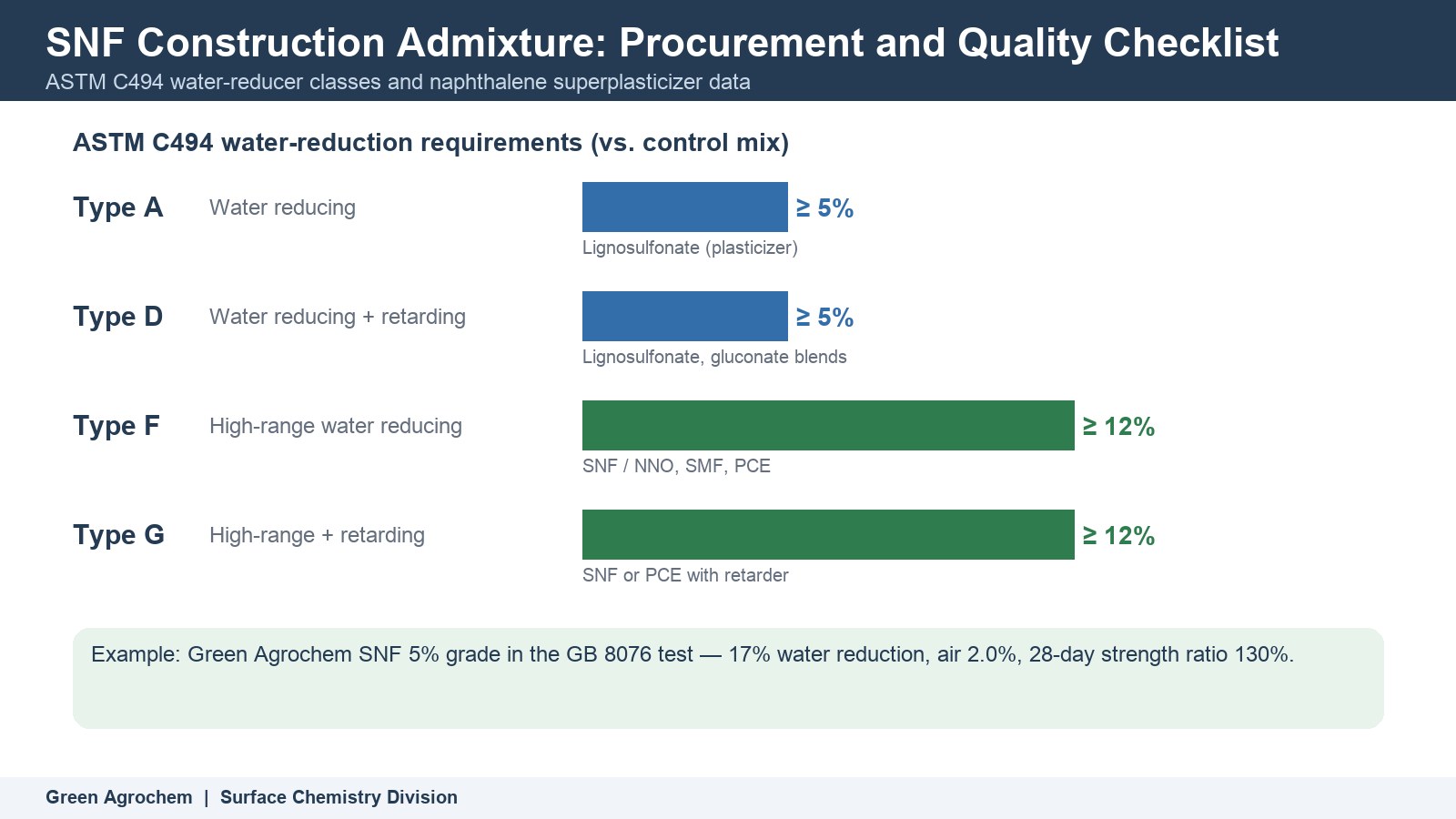
This guide is for concrete-admixture buyers comparing SNF construction grades. It focuses on procurement, specification alignment and supply approval rather than presenting every SNF product as interchangeable. Current commercial supply is provided by LigninCorp Industrial Chemicals.
SNF may be supplied as powder or liquid and may differ in active content, sodium sulfate, moisture, pH and other control parameters. The suitable grade depends on the customer’s formulation and cement system, so an RFQ should connect chemical acceptance limits with a practical concrete test protocol.
Information to include in an RFQ
- powder or liquid form and required active-solids basis;
- applicable concrete-admixture standard and destination market;
- agreed limits for sodium sulfate, chloride, moisture or solids, pH and insolubles;
- target concrete performance and cement/SCM system;
- monthly volume, packaging, palletization, destination and Incoterm;
- required documents, inspection and pre-shipment sample procedure.
Review the documents as a set
Technical data sheet
Use the TDS to identify the grade, product form, typical properties, storage guidance and supplier-recommended trial range. Typical values describe the product; they are not automatically contractual limits.
Safety data sheet
Confirm that the SDS matches the supplied form and destination requirements. Review handling, dust or spill controls, storage compatibility and transport classification with the importer and site safety team.
Lot-specific certificate of analysis
The COA should identify the batch and report the agreed purchasing parameters. Check that test methods, units and specification limits correspond to the purchase order rather than comparing numbers taken from unrelated grades.
Sample-to-shipment qualification
- Test a representative sample with the actual cement and companion admixtures.
- Agree on a retained reference sample and measurable acceptance properties.
- Verify the first commercial lot before unloading it into bulk storage.
- Track lot-to-lot trends instead of relying only on pass/fail limits.
- Requalify after a manufacturing change or a significant cement change.
Recommended concrete screening
First verify dispersion in a controlled paste, mortar or concrete test using the customer’s cement. Then assess initial and retained workability, air, setting, bleeding, segregation and early and later-age strength. Where the final use involves pumping or precast production, add a representative production trial.
Read how SNF disperses cement and the high-rise pumping qualification guide for application-specific checks.
Incoming-lot controls
- Confirm package condition, labels, batch numbers and net weight.
- Retain a sealed reference sample under defined storage conditions.
- Check agreed rapid identity and quality parameters before release.
- Record dissolution behaviour where powder is converted into a plant solution.
- Investigate trends before a result reaches the contractual rejection limit.
Use performance language carefully
Treat supplier dosage and water-reduction figures as recommended screening information. A purchase specification should not promise a universal strength, slump-retention or durability outcome. Concrete performance acceptance belongs in an agreed test protocol using project materials.
Commercial route
Request specifications, samples and a quotation through LigninCorp SNF. Include the RFQ information above to reduce grade-matching delays, or contact the industrial chemicals team with the destination, annual volume and required documents.
