
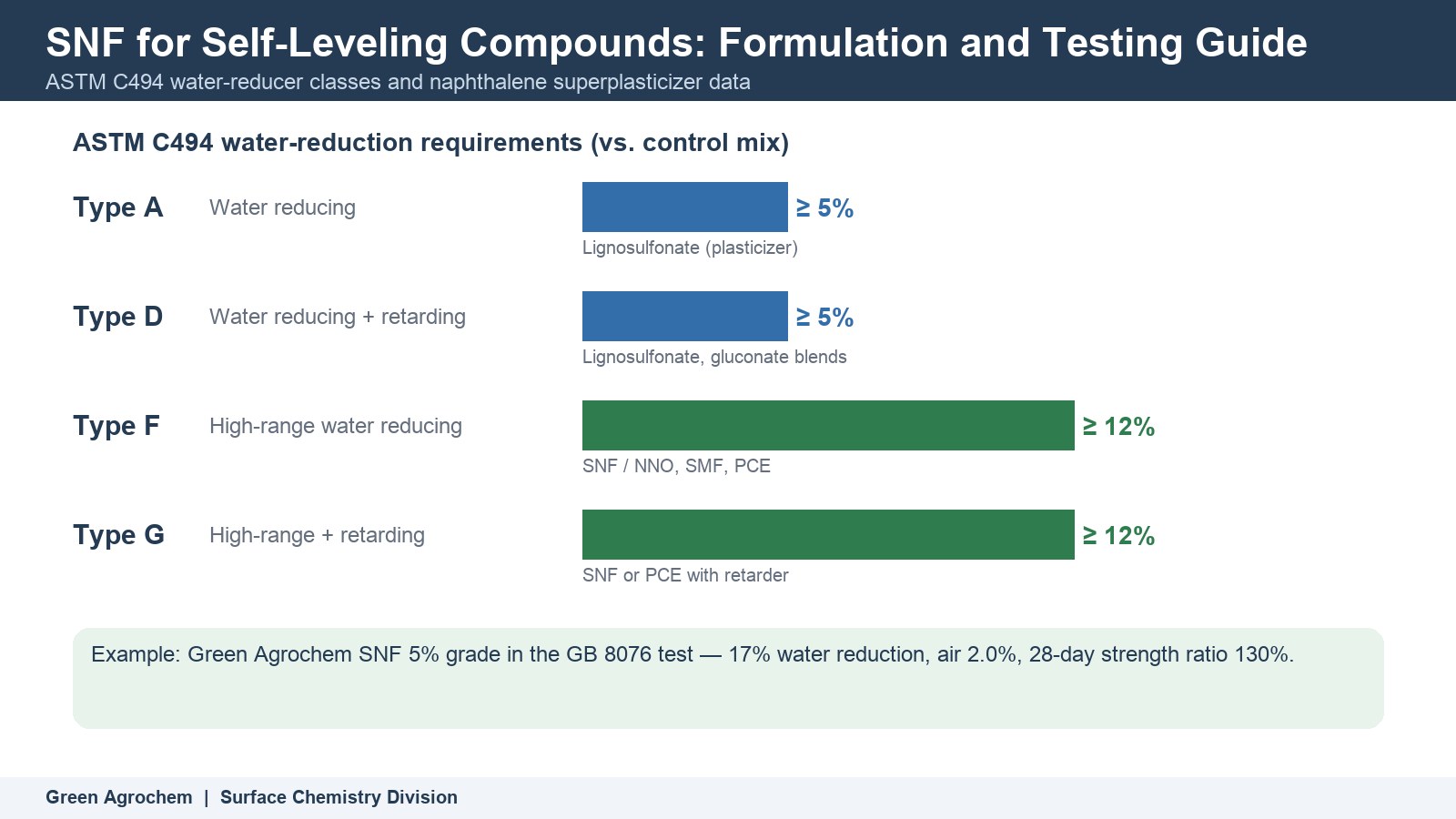
SNF can be evaluated as a dispersing admixture in selected self-leveling compound formulations, but it is not interchangeable with Dispersant NNO and it does not make a mortar self-leveling by itself. Flow, stability, open time, setting, adhesion and hardened performance depend on the complete binder and additive system.
This guide describes how to screen sulphonated naphthalene formaldehyde (SNF) in cement-based or gypsum-based self-leveling compounds. For commercial forms and documentation, see the SNF product page.
Role of SNF in a self-leveling formulation
SNF adsorbs on mineral-particle surfaces and increases electrostatic repulsion. Improved dispersion may help a formulation reach the required flow at controlled water content. Whether that response improves the finished compound depends on cohesion, air control, hydration kinetics and compatibility with the other additives.
SNF should be considered one component within a system that may also include binder, graded fillers, polymer powder, viscosity modifier, defoamer, set-control agents and other functional materials. Changing the dispersant can alter the demand for several of these components.
Cement-based and gypsum-based systems are different
A result obtained in a Portland-cement formulation cannot be transferred directly to calcium-aluminate, calcium-sulfate or blended-binder systems. Each binder has different surface chemistry, sulfate balance, hydration rate and sensitivity to additives. Qualify SNF separately for the intended formulation and raw-material sources.
- Cement-based compounds: monitor flow development, retention, segregation, setting, shrinkage, adhesion and strength.
- Gypsum-based compounds: monitor compatibility with the specific gypsum source, setting control, surface quality, dimensional stability and moisture-related requirements.
- Blended systems: test interactions among all binders rather than predicting behavior from one component.
Define the formulation targets first
Before choosing a dispersant level, define measurable acceptance criteria for:
- flow or spread at the specified test time;
- flow retention through mixing and application;
- segregation, bleeding, edge build-up and surface defects;
- fresh density and entrained air;
- working time, set and readiness for subsequent covering;
- compressive and flexural performance where specified;
- adhesion, shrinkage or dimensional stability;
- application thickness and substrate conditions.
The relevant regional standard, customer method or internal formulation method should be identified in the test plan.
Dosage must come from the exact-grade document
Do not use a universal percentage for SNF in self-leveling compounds. A numeric addition level is acceptable only when supported by the current TDS for the exact grade. Present it as the supplier-recommended starting trial range and identify whether the basis is total dry formulation, total binder, cementitious material, as-supplied product or dry solids.
Bracket that starting point in laboratory trials using the actual binders, fillers, polymers, defoamer, set-control package and mixing water. The final production level must be established from performance and robustness testing.
Controlled formulation-screening sequence
- Fix a reference formulation. Record every raw material, lot, mass basis and conditioning environment.
- Confirm product identity. Match the SNF sample to its TDS, SDS and representative COA.
- Change one variable at a time. Do not alter water, dispersant, defoamer and retarder simultaneously.
- Measure flow over time. Initial spread alone cannot establish application suitability.
- Inspect stability. Record sedimentation, bleeding, edge behavior, bubbles and surface appearance.
- Check hydration and setting. Compare working time, set development and readiness for covering.
- Test hardened properties. Use the specified conditioning, specimen geometry and test ages.
- Repeat around the preferred level. Test raw-material and temperature variation before approval.
Interaction with other additives
Defoamer
Greater fluidity does not prove lower air. Measure fresh density and air, then adjust the defoamer through controlled trials. Excess defoamer can also affect wetting and surface appearance.
Viscosity modifier
Dispersion and viscosity must be balanced. Too little cohesion may produce segregation or edge separation; excessive viscosity may reduce leveling and surface closure.
Set-control package
SNF may change hydration behavior differently across binder systems. Evaluate accelerator and retarder interactions at the expected application temperatures. Do not assume that a generic “faster” or “slower” setting effect applies.
Redispersible polymer powder
Check flow, air, adhesion and surface formation with the actual polymer grade. Compatibility should be established for the full dry-mix formulation.
Common defects and diagnostic checks
- Good initial flow but rapid loss: review binder compatibility, temperature, set-control package and dispersant demand.
- Segregation or bleeding: review water, grading, paste volume, SNF level, viscosity modifier and mixing.
- Pinholes or foam: check air generation, defoamer compatibility, mixing energy and substrate condition.
- Weak or dusty surface: audit actual water, segregation, curing/conditioning, binder balance and readiness-for-covering time.
- Cracking or curling: investigate water demand, layer thickness, drying, binder system, shrinkage control and substrate restraint.
- Variable set: check raw-material lots, temperature, weighing accuracy and additive interactions.
Powder handling and dry-mix production
For factory dry mixes, verify SNF powder flow, moisture sensitivity, minimum weighment and distribution at the plant’s real batch size. Establish the charging order and mixing time needed for uniformity. Storage and shelf-life statements must come from the exact product TDS or SDS; do not assume that caked or moisture-exposed product remains suitable.
Supplier documentation and approval
Request the current exact-grade TDS and SDS, representative COA with methods, physical-form specification, batch traceability, storage instructions and change-control process. Any claim about composition, shelf life, safety or environmental behavior must be supported by the applicable product document and market requirements.
For general grade-screening and procurement controls, see the SNF concrete additive buyer guide. For its cement-dispersion mechanism, see how SNF works.
Selection conclusion
SNF may be a practical dispersant for a self-leveling compound when it delivers the required flow without unacceptable air, segregation, setting changes or loss of hardened performance. Select the exact grade from documented evidence, begin with its current TDS trial recommendation and validate the complete formulation under production and application conditions.
Send the binder system, dry-mix basis, target flow method, working-time requirement and required documents to info@greenagrochem.com for initial grade screening.
