
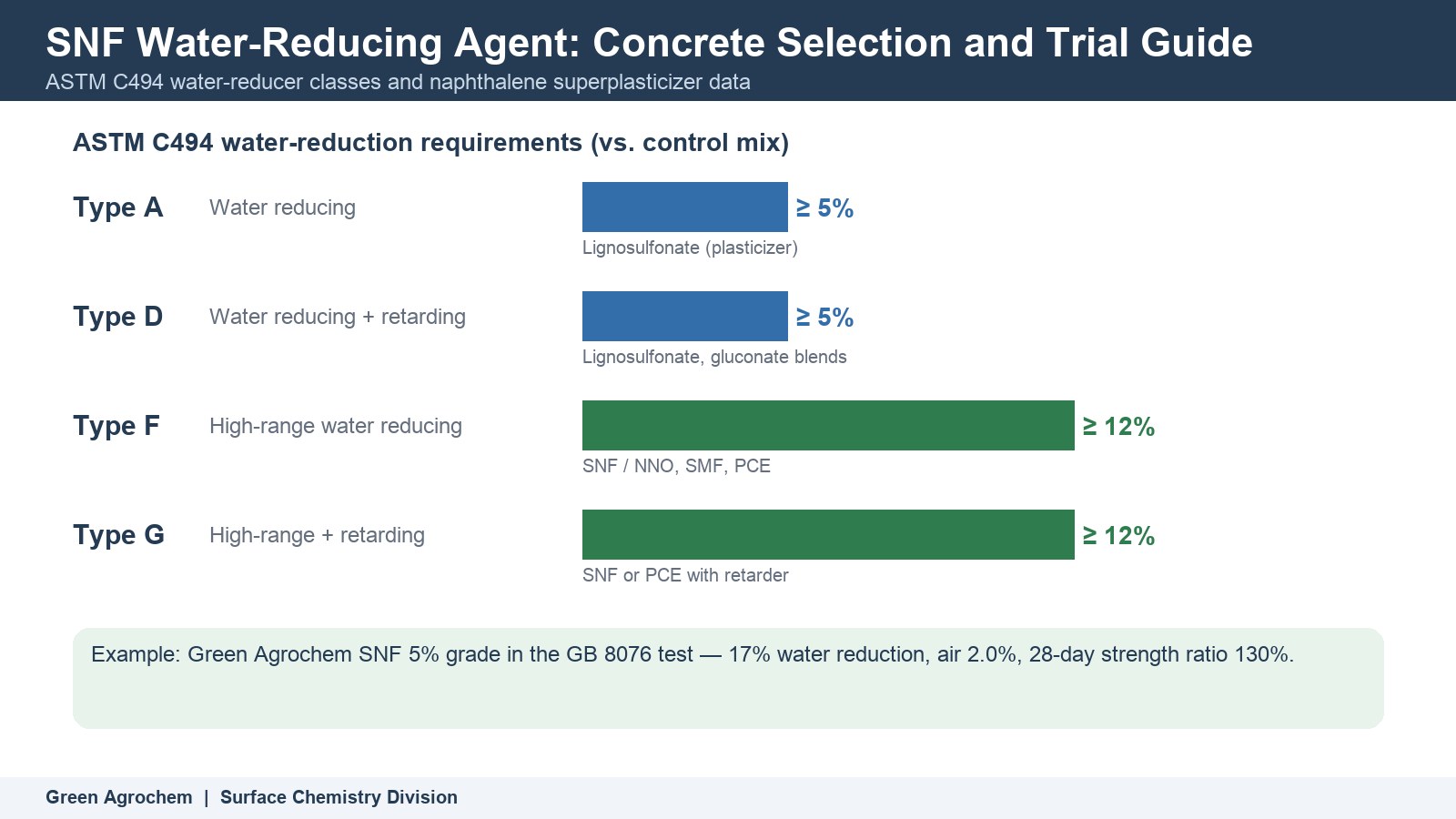
Sulfonated naphthalene-formaldehyde condensate, commonly abbreviated SNF, is an anionic concrete admixture used to disperse cementitious particles and adjust water demand or workability. Actual performance depends on the supplied grade, solids basis, cement chemistry, supplementary cementitious materials, aggregates, temperature, mixing sequence and other admixtures.
This page explains how concrete producers should select and qualify an SNF water-reducing agent. It does not present a universal dosage, water-reduction percentage or guaranteed strength result. Procurement teams can use the separate SNF price and RFQ guide to compare quotations on a common basis.
How SNF affects fresh concrete
SNF can adsorb on cementitious particles and increase electrostatic repulsion, reducing part of the flocculation present in an untreated paste. Water held within flocs can then contribute more effectively to flow. The observed response is controlled by adsorption, sulfate balance, particle surfaces, hydration stage and the total mix system.
Dispersion does not automatically establish durability, strength, slump retention or setting behaviour. These properties must be measured in the buyer’s concrete using the applicable project or product standard.
Qualification objectives
Define the purpose of the trial before adjusting dosage:
- Maintain target consistency while reducing mixing water
- Increase initial flow at a fixed water-to-binder ratio
- Improve placement or compaction in a precast or ready-mix process
- Control pumpability, segregation and bleeding in the selected mix
- Compare SNF with lignosulfonate, SMF or PCE under the same conditions
Recommended trial-mix program
- Document the control: record all binder sources, aggregate grading and moisture, water, admixtures, temperature and mixing sequence.
- Select a recommended trial range: start with the supplier’s current guidance for the supplied grade, then bracket the level in laboratory mixes.
- Measure fresh properties: use the specified consistency or flow method and record retention, air, density, bleeding, segregation and finishing behaviour.
- Check setting and strength: test at the ages required by the project; do not assume that greater initial flow guarantees earlier or higher strength.
- Test robustness: repeat with expected variations in cement lot, supplementary materials, aggregate moisture and ambient temperature.
- Run a production trial: confirm batching, mixing, transport, placement, finishing and curing before commercial approval.
Compatibility variables
SNF response can change with cement alkalis, soluble sulfate, C3A behaviour, limestone or clay-bearing fines, fly ash, slag, silica fume and other supplementary materials. Addition sequence and mixing energy also matter. Evaluate the complete system when using retarders, accelerators, air entrainers, defoamers or other water reducers.
Slump loss should be measured over the actual production and delivery period. A grade that provides high initial flow may not supply the required retention under hot weather, delayed placement or long transport.
SNF compared with other water reducers
- Lignosulfonate: often evaluated for conventional water reduction; assess air and setting response. See the lignosulfonate water-reducer guide.
- SMF: a different condensation-product chemistry requiring its own concrete trial. See the SMF concrete guide.
- PCE: a different polymer platform whose performance and sensitivity depend on molecular design, cement, fines and formulation.
No family is automatically best for every mix. Compare materials at equivalent solids where appropriate and against the same acceptance criteria.
Product specification and incoming control
Request the current TDS, SDS and lot-specific COA. The purchase specification may include physical form, colour, solids or moisture basis, pH, density for liquids, inorganic salts and insoluble matter, with methods and tolerances taken from the current product documents.
Incoming chemical checks should be supported by periodic concrete performance testing. Basic COA parameters alone cannot confirm compatibility with every cement or mix.
Example incoming-control limits for the high-solids powder grade; other grades are compared on the SNF product page:
| Parameter | SNF powder, high-solids grade (GAC-SNF-P) |
|---|---|
| Appearance | Brownish powder |
| Solid content | 95% min |
| Sodium sulphate | 10% max |
| Chloride | < 200 ppm |
| pH (1:10 solution) | 6.5–8.5 |
| Solubility | Completely soluble in water |
Handling, storage and compliance
Follow the current SDS and supplier storage instructions for the supplied powder or liquid. Control dust or splashes as applicable and prevent contamination or moisture exposure. Claims such as chloride-free, non-toxic, non-flammable or compliant with a named standard should be made only when supported by the exact product documentation and required test evidence.
Information to include in an RFQ
- Concrete or mortar application and applicable standard
- Cement and supplementary cementitious material types
- Required fresh-property, setting and strength endpoints
- Current admixture and trial benchmark
- Temperature and retention requirements
- Estimated quantity, supplied form, packaging and delivery schedule
- Destination and Incoterm
For grade review, a representative sample or quotation, contact info@greenagrochem.com.
