
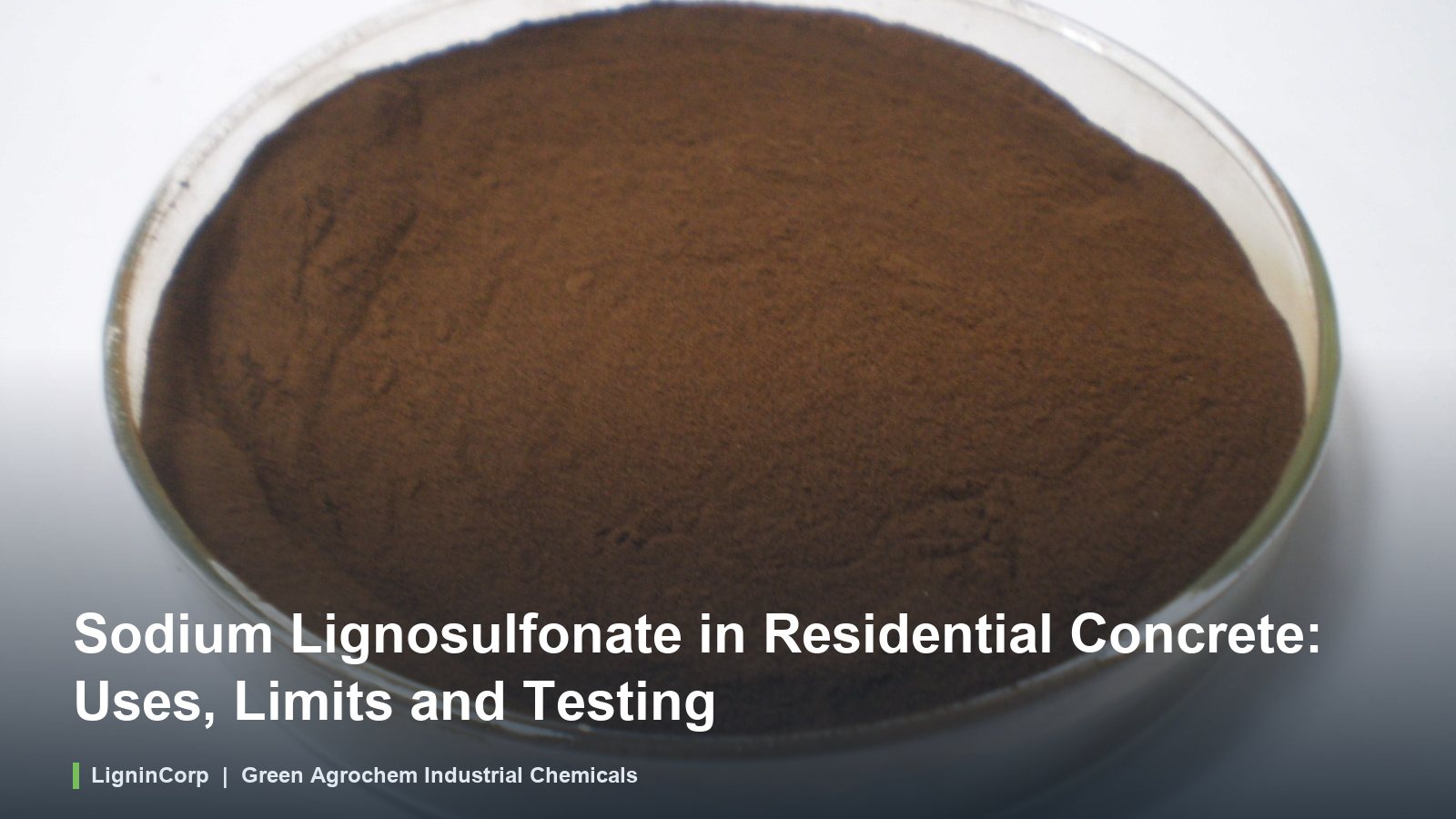
Sodium lignosulfonate may be evaluated as a conventional water-reducing, plasticizing or set-modifying component in concrete used for residential foundations, slabs, walls, masonry units and site-cast elements. Its role is inside a qualified concrete or mortar formulation—it is not a stand-alone fireproofing, waterproofing or exterior-wall coating.
This guide helps ready-mix producers, precasters, contractors and material buyers decide where a concrete-grade sodium lignosulfonate may fit, what can go wrong and which tests are needed before project use.
Where It May Fit in Residential Concrete
| Application | Possible formulation objective | Project checks |
|---|---|---|
| Foundations and footings | Workability or water reduction at a selected consistency. | Placement time, setting, bleeding, strength and exposure requirements. |
| Slabs and driveways | Workability control while maintaining the approved water–cementitious ratio. | Finishing window, air system, surface quality, curing and weather. |
| Cast walls and structural elements | Improved particle dispersion and pumpable consistency. | Form pressure, segregation, pump response, setting and stripping schedule. |
| Concrete masonry or precast units | Process-specific dispersion or compaction support. | Moisture, cycle time, green strength, dimensional quality and curing. |
Suitability depends on the cement, supplementary cementitious materials, aggregates, water, temperature, mixing sequence and other admixtures. A result from one residential mix cannot be treated as a guarantee for another.
How the Admixture Works
Lignosulfonate molecules can adsorb on cement particles and reduce flocculation. Water held in the flocculated structure can then contribute more effectively to workability. Depending on the grade and addition level, the same chemistry may also influence setting and air content. These effects must be measured together; optimizing slump alone is not sufficient.
What It Does Not Do
Sodium lignosulfonate should not be described as a surface-applied waterproof coating, a fire-resistant barrier, a mould-prevention treatment or a guaranteed durability additive. Residential waterproofing, fire resistance and moisture control are system-level design requirements involving approved membranes, assemblies, details, test standards and code compliance. Concrete containing lignosulfonate still requires the specified curing, cover, joint, drainage and protective-system controls.
Grade and Document Review
- confirm that the offered material is an identified concrete or industrial grade;
- review the current TDS, SDS and lot-specific COA;
- check moisture or solids, pH, insolubles, reducing sugars, chloride and relevant alkali contribution;
- define whether trial addition is based on as-supplied product or dry solids and on total cementitious material;
- confirm packaging, storage, shelf life and change-control arrangements.
Any numeric addition level may be shown only when supported by the current exact-grade supplier document. It must be labelled a supplier-recommended starting trial range with its basis and revision—not a universal production dosage.
Residential Mix Qualification Workflow
- Define the control: use the approved cementitious system, aggregate moisture, target consistency and air requirement.
- Screen additions: compare an untreated control with several documented, active-solids-normalized trial levels.
- Measure fresh concrete: slump or flow over time, air, temperature, unit weight, bleeding, segregation and setting.
- Check construction operations: pumping, placement, consolidation, finishing, saw-cut timing, curing and form removal.
- Test hardened properties: specified-age strength and project-required permeability, shrinkage or durability methods.
- Validate at plant scale: confirm batching accuracy, moisture corrections, delivery time and field consistency before routine supply.
Common Failure Modes
- Delayed finishing or stripping: review temperature, grade, addition level and cement compatibility.
- Unexpected air: measure air throughout the trial and coordinate with the air-entraining system.
- Variable slump: check aggregate moisture, solids conversion, dosing calibration and addition sequence.
- Low early strength: compare equal-consistency and equal-water conditions and review setting response.
- Surface defects: investigate bleeding, finishing timing, curing and total mix design rather than attributing the result to one ingredient alone.
Technical and Procurement Routes
Review the concrete-grade sodium lignosulfonate product route, the broader concrete admixtures application hub and the sodium lignosulfonate concrete technical guide. For a sample or quotation, contact LigninCorp with the cementitious system, target consistency, setting window, air requirement, temperature range and applicable test standard.
