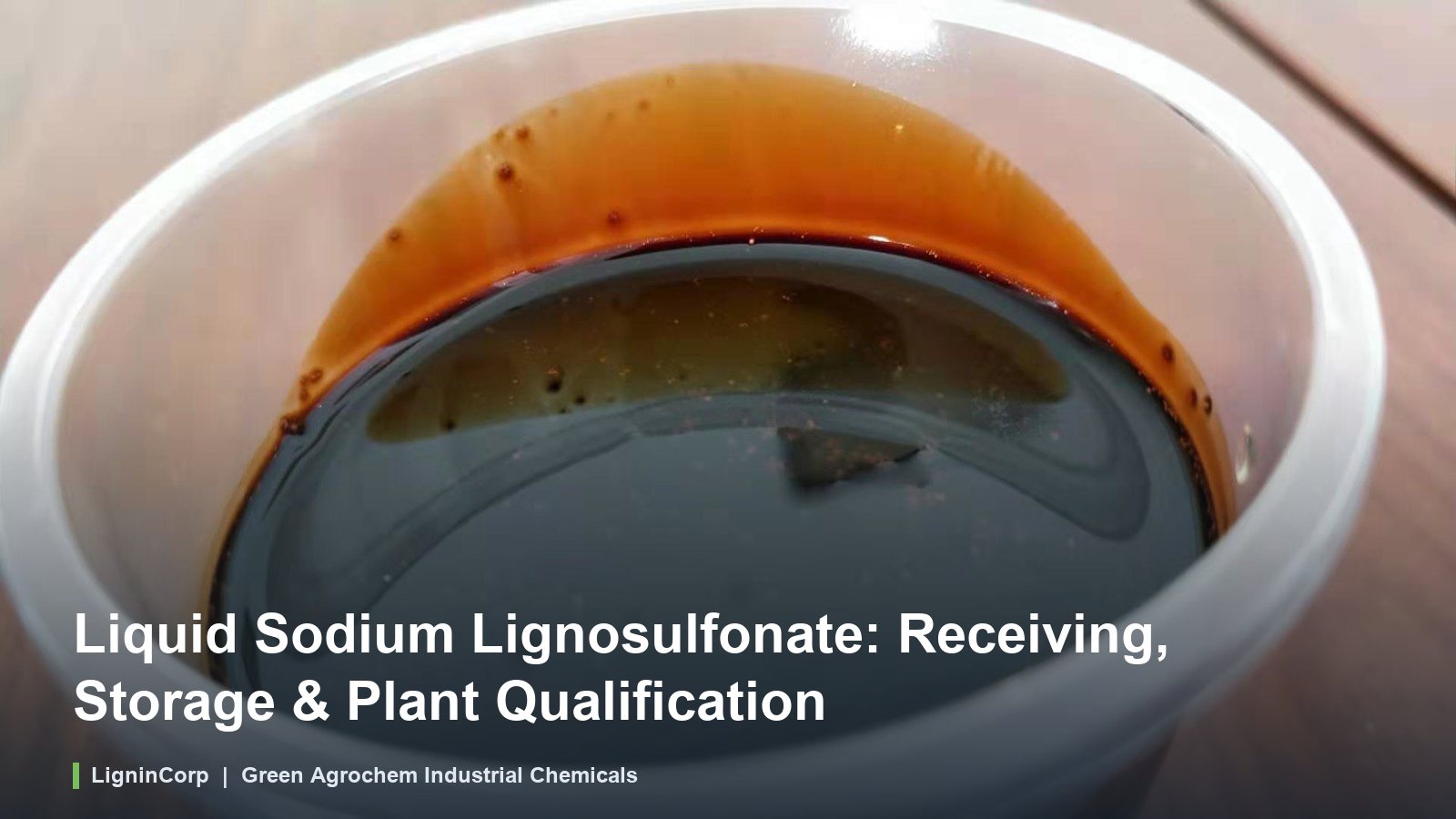
Liquid sodium lignosulfonate is supplied as an aqueous lignosulfonate solution for industrial formulation and binder systems. This guide focuses on procurement, receiving inspection, storage, transfer and plant qualification. For the current Grade One specification and quotation route, use the Liquid Sodium Lignosulfonate – Grade One product page.
Define the grade before purchasing
The generic name does not define solids, lignosulfonate content, insoluble matter, reducing sugar, density, pH or application suitability. Buyers should issue a written specification and identify the intended process, destination market, packaging and annual demand before comparing offers.
Grade One reference data
| Parameter | Current TDS value | Receiving check |
|---|---|---|
| Appearance | Black liquid | Record color and visible separation |
| Solid content | 45% min | Confirm test method and sampling |
| Water-insoluble matter | 1% max | Review sediment, filtration and nozzle risk |
| Lignosulphonate content | 50% min | Confirm analytical and reporting basis |
| Reducing sugar | Around 7% | Treat as a typical reference |
| Density | 1.20–1.32 g/ml | Record measurement temperature |
The current Grade One TDS gives a pH value of 7.0 – 11.0; confirm the method on the COA. Where pH affects the process, define the test concentration, method and temperature in the purchase specification and confirm the lot result on the COA.
Documents to approve before shipment
- Current TDS and SDS for the offered product code.
- Representative COA and agreed contract limits.
- Packaging, net weight, shelf life and storage instructions.
- Batch traceability and labeling requirements.
- Application-specific sample and qualification plan.
Receiving inspection
- Check container integrity, seal numbers, labels, batch code and net weight.
- Use a documented sampling method appropriate to the container and any potential stratification.
- Compare appearance, density, solids and agreed critical parameters with the COA.
- Quarantine nonconforming or visibly separated material until the supplier and buyer complete a technical review.
- Retain a labeled reference sample according to the site quality procedure.
Storage and transfer
Keep containers closed in a cool, dry and ventilated area and protect the product from freezing, contamination and incompatible materials. Select tanks, pumps, hoses, seals and filters according to the approved SDS, temperature range and site engineering review. Where recirculation or agitation is used, set it according to actual storage observations rather than a universal schedule.
Plant qualification
Use an untreated control and a supplier-recommended trial range for the selected application. Calculate additions on the declared as-supplied or dry-solids basis, include the solution water in the formulation balance and record temperature. Evaluate application-specific outcomes such as viscosity, sedimentation, pumpability, green strength, dust control or finished-product handling. No universal dosage or fixed performance improvement applies across different formulations.
Application routes
- Grade One industrial product and documentation
- Dust-control liquid grade
- Industrial dispersant grade
- Construction grade
For TDS, SDS, COA, samples or an industrial quotation, contact info@greenagrochem.com with the application, required function, quantity, packaging and destination port.
COA Acceptance Limits by Grade
| Item | Grade One (GAC-NaLS-L) | Grade Two (GAC-NaLS-L-2) | Grade Three (GAC-NaLS-L-3) |
|---|---|---|---|
| Solid content | 45% min | 45% min | 45% min |
| Lignosulphonate | 50% min (dry basis) | 50% min (dry basis) | 50% min (w/w) |
| Water-insoluble matter | 1% max | 2.5% max | 2.5% max |
| pH | 7.0 – 11.0 | 9.0 – 13.0 | 4.0 – 7.0 |
| Reducing sugar | around 7% | around 4% | around 14% |
| Density | 1.20 – 1.32 g/ml | 1.20 – 1.30 g/ml | 1.20 – 1.30 g/ml |
Sampling at Delivery
- Circulate or mix the container before sampling; liquids can stratify in transit.
- Take samples from the top and bottom of the tank or IBC and check they match.
- Measure density and solids on site if possible; compare with the COA.
- Keep a retained sample of each batch, sealed and labelled, until the batch is used.
- Record the batch number, COA number, delivery date and tank.
Tank and Transfer Equipment
- Use stainless steel, plastic (HDPE) or lined tanks; keep tanks closed.
- Protect tanks and lines from freezing, as the TDS requires.
- Fit a strainer before pumps and nozzles; Grade Two and Three allow up to 2.5% insolubles.
- Do not mix different grades or salts in one tank without a compatibility test.
- Use the oldest batch first and plan to use it within the 12-month shelf life.
Frequently Asked Questions
What is liquid sodium lignosulfonate?
Sodium lignosulfonate supplied as a water solution of about 45% solids. Our liquid sodium grades differ in pH, sugar and insolubles.
How should liquid sodium lignosulfonate be stored?
In closed stainless, HDPE or lined tanks, protected from freezing, and circulated before use. Shelf life is 12 months in sealed containers.
What should be checked when a delivery arrives?
Batch number and COA, appearance, density and solids, and samples from top and bottom of the container.
Does liquid sodium lignosulfonate settle?
It can stratify during transport or long storage, so mix or circulate before sampling and before use.
