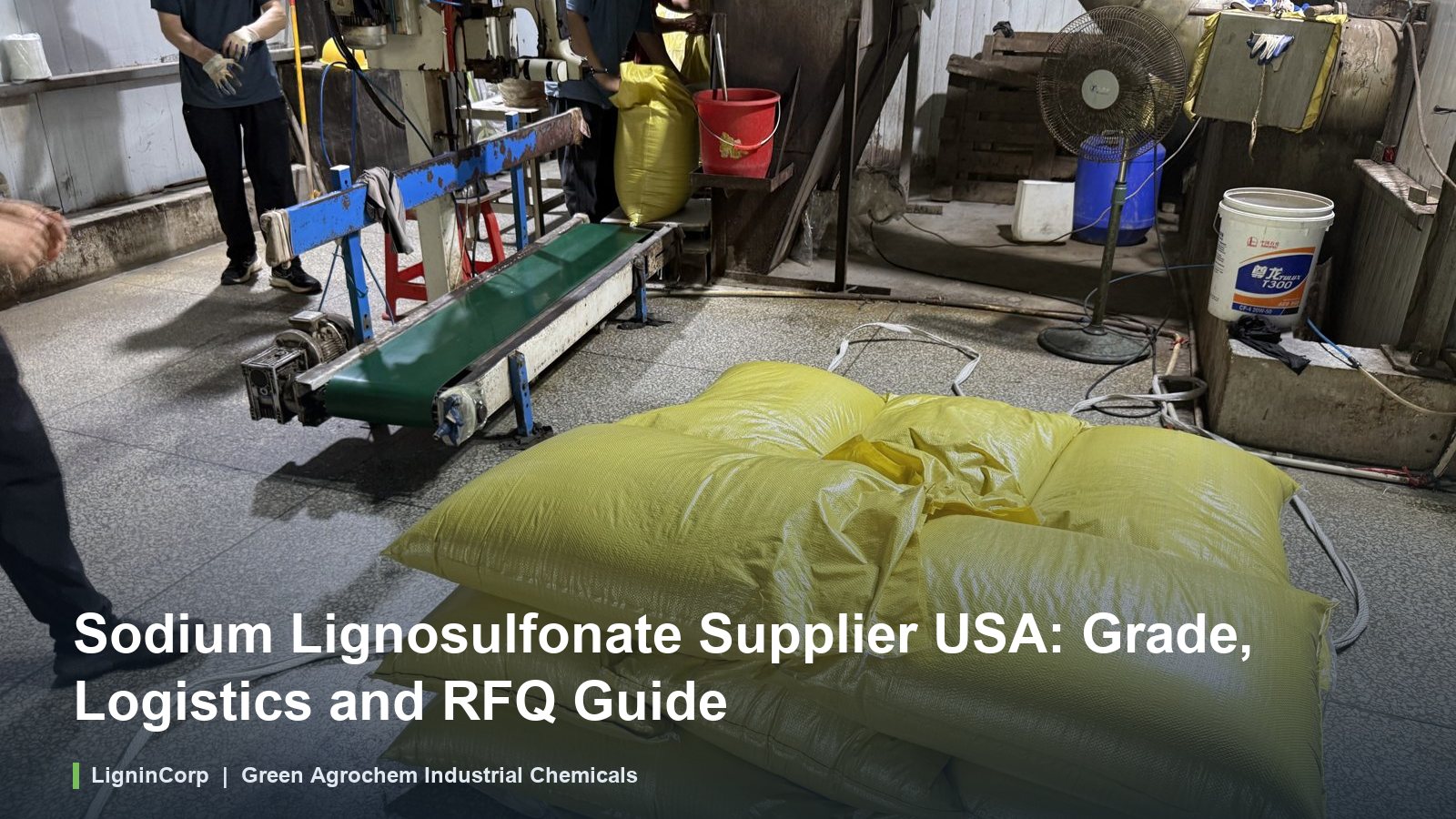
US buyers sourcing sodium lignosulfonate should compare the exact grade, application fit, technical documents and landed supply conditions—not only the product name or quoted price. LigninCorp supplies industrial sodium lignosulfonate from China for qualification and export to customers and distribution partners serving the United States.
This page is a procurement and qualification guide. It does not imply domestic US manufacturing, local inventory, regulatory approval for every application or a fixed delivered price.
Start with the intended industrial function
| Application | Required function | Buyer checks |
|---|---|---|
| Concrete admixtures | Cement dispersion and water-reduction support | Cement/SCM compatibility, water reduction, setting, air, slump retention and strength under the selected test method |
| Dust control | Surface binding and fine-particle control | Soil/aggregate type, solids, application equipment, traffic, weather, runoff controls and reapplication criteria |
| Ceramics and refractories | Slurry dispersion, temporary binding or processing support | Clay/mineral system, solids loading, viscosity curve, green strength, drying and firing response |
| Industrial granulation and briquetting | Particle binding and green-body integrity | Feedstock size, moisture, compaction, drop/compression strength, curing and downstream thermal effects |
| Drilling and other aqueous formulations | Deflocculation, rheology or dispersion support | Fluid chemistry, salinity, temperature, solids, compatibility and application-specific acceptance tests |
Feed-grade and agricultural uses require separate product, documentation and regulatory review. Industrial product identity alone does not establish suitability for feed, food-contact, fertilizer or pesticide applications.
Grade variables that affect performance
- Lignosulfonate content and molecular distribution: influence adsorption, dispersion and binding behaviour.
- Sodium, sulfate, ash and reducing sugars: may affect mineral balance, hydration, setting, thermal processing or formulation stability.
- Moisture, insolubles and particle size: influence storage, dissolution, filtration and dosing.
- pH and solution behaviour: matter for compatibility with the buyer’s water, minerals, polymers and process chemicals.
- Powder or liquid supply: changes freight, storage, pump/feeder design and dry-solids calculations.
Request the current TDS and a representative COA before comparing suppliers. Values from different grades, document revisions or calculation bases should not be combined into one specification.
Documents to request before a US order
| Document or record | Why it matters |
|---|---|
| Current TDS | Identifies the offered grade, specification limits or typical properties and intended industrial use |
| Current SDS | Supports hazard communication, handling, storage and transport review |
| Batch COA format | Shows which parameters are reported for each production lot |
| Sample identification | Connects laboratory and plant results to the grade proposed for commercial supply |
| Packaging and loading information | Supports warehouse, unloading, container and landed-cost planning |
| Origin and shipment documents | Supports customs-broker and importer-of-record review |
US regulatory obligations depend on product identity, intended use and the buyer’s position in the supply chain. The importer, distributor or end user should confirm applicable chemical inventory, workplace, environmental, transport and sector-specific requirements with qualified professionals. An SDS or general CAS number is not a blanket approval.
Sample-to-commercial qualification
- Define the application, substrate or formulation and measurable acceptance criteria.
- Review the current grade documents and identify any mandatory composition or contaminant limits.
- Test a traceable sample against the existing material or an untreated control using the same method.
- Evaluate more than one addition level only within a documented, technically justified trial plan.
- Check process compatibility, finished-product performance and batch repeatability.
- Approve a commercial specification before placing a bulk order; retain the qualified sample and test record.
Any application dosage must come from the current exact-grade technical guidance or a controlled development program. A range copied from another supplier or application must not be relabelled as a LigninCorp recommendation.
How to compare quotations
Compare quotations on a common basis: exact grade, dry solids or as-supplied form, packaging, order quantity, Incoterm, origin, destination, freight assumptions, payment terms, lead time, document scope and sample status. A lower price per metric tonne may not provide a lower cost-in-use if solids, ash, insolubles, dosage, process efficiency or rejection risk differ.
Price and delivery information should be issued as a dated quotation because freight, availability, packaging and commercial terms change. This page does not publish an unsupported market-price range.
Supply and logistics questions
- Is the quotation for powder or liquid, and what is the declared solids basis?
- Which packaging and container loading configuration is offered?
- What is the production and shipment lead-time basis?
- Which port, Incoterm and destination are included?
- Will the commercial grade match the qualified sample and agreed specification?
- Which TDS, SDS, COA and origin documents accompany the shipment?
Related industrial resources
- Industrial sodium lignosulfonate product and grade overview
- Sodium lignosulfonate supplier qualification guide
- Industrial TDS and SDS resources
- Request documents, samples and an export quotation
RFQ checklist for US buyers
Send the application, current material, required specification, annual and trial quantity, powder/liquid preference, packaging, destination city or port, Incoterm, required delivery window and document requirements to info@greenagrochem.com. LigninCorp can propose candidate industrial grades for customer validation.
