
“SNF near me” is usually a logistics question rather than a chemistry question. A nearby warehouse may shorten replenishment time, but local availability does not prove that the stocked material is the correct grade, source or form for the buyer’s concrete system.
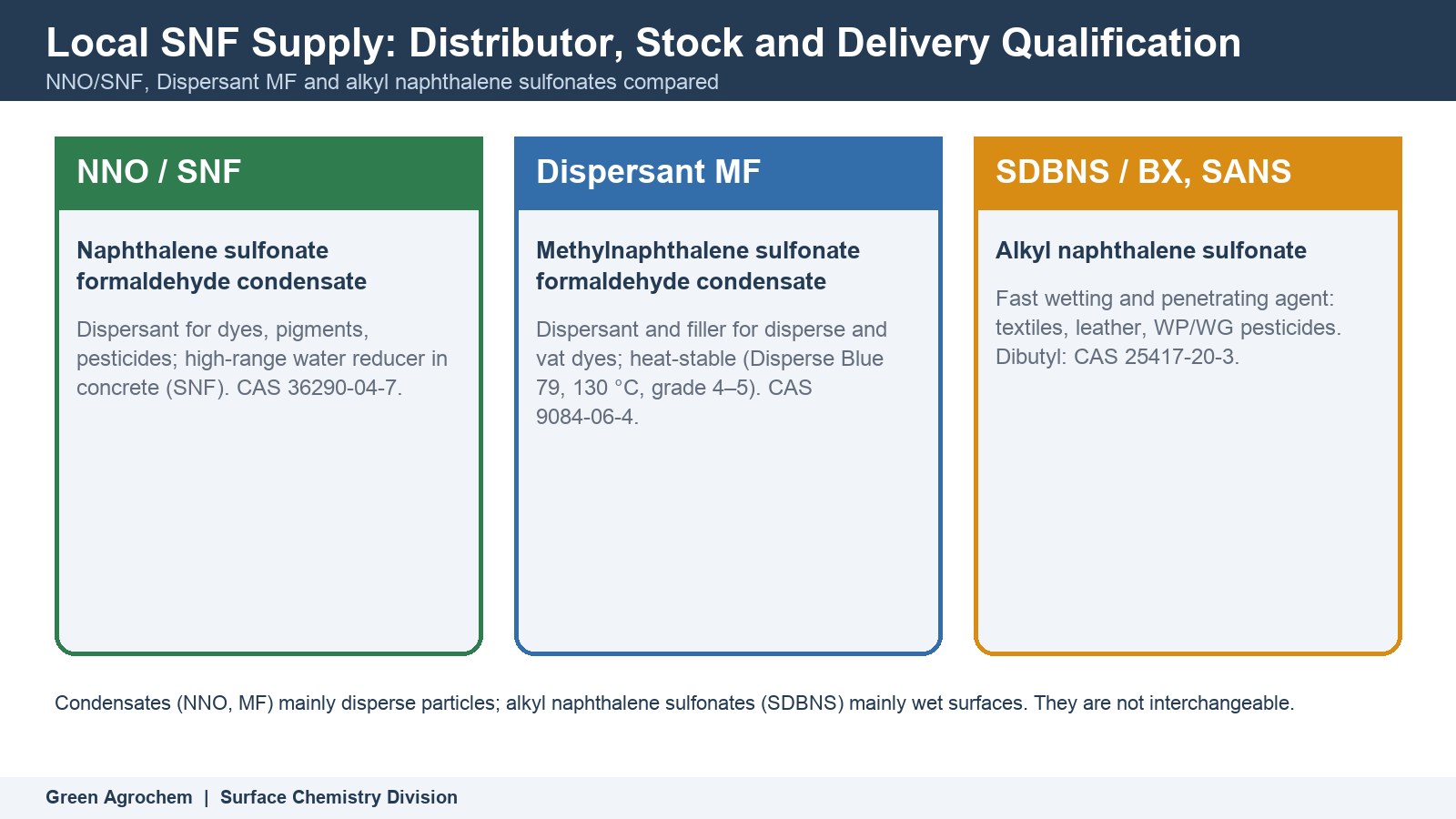
Construction buyers commonly use SNF to mean sulphonated naphthalene formaldehyde condensate, an anionic cement dispersant. It is not automatically equivalent to monomeric sodium naphthalene sulfonate, Dispersant NNO or a formulated concrete admixture. Confirm the identity before comparing locations or delivery dates. See the construction-grade SNF product page.
Choose the right local supply model
Manufacturer-direct supply
Direct supply may suit planned or recurring requirements where grade consistency, batch traceability and change control are important. The shortest geographic distance is not always the shortest reliable lead time; confirm production schedule, export route and destination handling.
Authorized regional distributor
A distributor may offer local stock, smaller releases and regional support. Verify the authorization, original manufacturer, grade code and whether repacking preserves lot identity. Ask how the distributor handles aged, damaged or nonconforming inventory.
Local stockist or trader
A stockist can be useful for urgent replenishment, but the buyer should confirm source continuity, storage history and document traceability. A seller offering the same name from changing manufacturers should notify the buyer before substituting the source.
Local formulated-admixture supplier
A ready-to-use concrete admixture may contain SNF together with other ingredients. It is not purchased or dosed as raw SNF. Confirm whether the requirement is a raw material for formulation or a finished admixture for concrete production.
Questions to ask about local inventory
- What exact commercial grade and supply form is in stock?
- Who manufactured it, and can the lot be traced to that site?
- Is the stock original packed or locally repacked?
- What are the manufacture date, storage conditions and remaining shelf life?
- Are the TDS, SDS, specification and shipment COA for the same grade?
- What quantity is physically available rather than merely listed?
- What is the dispatch point, delivery basis and estimated—not guaranteed—transit window?
- What replenishment plan applies after the current stock is consumed?
Confirm identity and quality before urgency drives the decision
Request current grade-specific documents and a representative sample. Specification values need units, methods, basis and clear status as limits, ranges or typical results. Do not qualify material from generic “purity,” sulfate or compliance statements copied from an online listing.
Test the sample with the actual cement, supplementary materials, aggregates, water and other admixtures. Include initial and retained workability, air, unit weight, stability, setting and strength at project-required ages. When a local source replaces an approved source, treat it as a material change and repeat the appropriate validation.
Compare local and imported offers on landed basis
A warehouse price and a manufacturer price are not directly comparable unless both offers use the same grade, quantity, packaging, currency, Incoterm and destination. Include freight, duties, handling, local delivery, inventory financing, storage, loss, sampling and quality-control costs. For liquid grades, normalize concentration or dry-solids basis where appropriate.
Local stock can justify a higher unit price when it reduces a documented shutdown, emergency freight or inventory risk, but that value is site-specific. Do not publish a universal savings percentage or delivery promise.
Emergency replenishment controls
- Confirm the minimum quantity needed to protect production.
- Verify the offered lot, label, seals and technical documents.
- Run a rapid but controlled compatibility comparison against the approved material.
- Define temporary receiving and release criteria in writing.
- Keep the emergency lot segregated until quality approval.
- Document any mix or process adjustment and return to normal change control afterward.
Dosage when changing supply source
Do not substitute equal mass merely because two products are both called SNF. If a numerical value is used, it must be the supplier-recommended starting trial range in the current TDS for the exact grade, with the cementitious-material and as-supplied or dry-solids basis stated. Determine the final dosage through laboratory and plant trials.
Prepare a location-specific inquiry
Send the city and country, application, exact chemistry, powder or liquid form, required quantity, delivery window, approved specification, packaging constraints and unloading facilities to info@greenagrochem.com. Ask whether the proposal is manufacturer-direct, distributor stock, trader stock or a formulated admixture.
For sourcing-channel and RFQ preparation, read Where to Buy SNF. For online transaction controls, use the Buy SNF Online guide.
