Before asking where to buy sodium naphthalene sulfonate, confirm which product you actually need. Similar names are used for different materials, and purchasing the wrong chemistry can invalidate a concrete or formulation trial.
Construction buyers commonly mean sulphonated naphthalene formaldehyde condensate (SNF/NSF), a cement dispersant and high-range water-reducing admixture. This is not automatically the same as a monomeric sodium naphthalene sulfonate, Dispersant NNO or a laboratory reagent. For construction-grade SNF options, see the SNF product page.
Step 1: identify the required chemistry
Put the intended application, functional requirement and exact product description in the RFQ. Request matching identity information in the supplier’s TDS and SDS. Useful distinctions include:
- SNF/NSF condensate: typically evaluated as a cement or industrial dispersant;
- sodium naphthalene sulfonate: may refer to a different molecular product or isomer mixture;
- Dispersant NNO: a named dispersant grade used in formulation markets and not automatically interchangeable with concrete SNF;
- laboratory reagent: supplied for analytical or research use, not necessarily for construction production.
If the supplier cannot clearly identify the offered material, do not compare its price or test it as an equivalent.
Where industrial buyers can source SNF
Direct manufacturers
Direct sourcing can suit recurring or larger-volume requirements where the buyer needs grade control, batch traceability, technical documents and change notification. Confirm whether the seller owns the manufacturing site or is representing another producer.
Authorized distributors
A distributor may provide local inventory, smaller shipments, credit terms and regional support. Ask for authorization evidence, original manufacturer and lot traceability. Confirm whether repacking changes the batch identification or warranty.
Industrial chemical traders
Traders may consolidate logistics and offer multiple origins. Approval should focus on supply-chain visibility, consistent source, document control, inspection rights and notification before source changes.
B2B marketplaces
Marketplaces can identify potential sellers but a badge, review or listing is not technical approval. Verify legal entity, manufacturing relationship, grade documents, sample identity and payment instructions independently.
Local construction-chemical suppliers
Local supply may reduce lead time and import complexity. Confirm whether the product is a pure/raw SNF grade or a formulated concrete admixture containing multiple ingredients; they are purchased and dosed differently.
Documents to request before a sample
- current TDS for the exact commercial grade and revision;
- current SDS for the supplied form and destination market;
- representative COA with units and test methods;
- product specification identifying limits, ranges and typical values;
- manufacturing site and country of origin;
- packaging, storage and shelf-life statement;
- batch traceability and change-control procedure;
- supporting test report for any claimed standard classification.
Do not assume a generic purity percentage is meaningful for a polymeric condensate. Grade control is normally evaluated through relevant compositional, physical and application tests stated in the purchase specification.
Sample qualification
Match the sample label to the quotation and technical documents. For concrete use, test it with the actual cement, supplementary materials, aggregates, water and other admixtures. Compare a controlled reference and record initial and retained workability, air, unit weight, stability, setting and strength at the project-specified ages.
A numeric addition level should be used only as the supplier-recommended starting trial range in the current TDS for the exact grade. Confirm whether the basis is cement or total cementitious material and whether it refers to supplied product or dry solids. Final dosage requires laboratory and plant validation.
How to request a comparable quotation
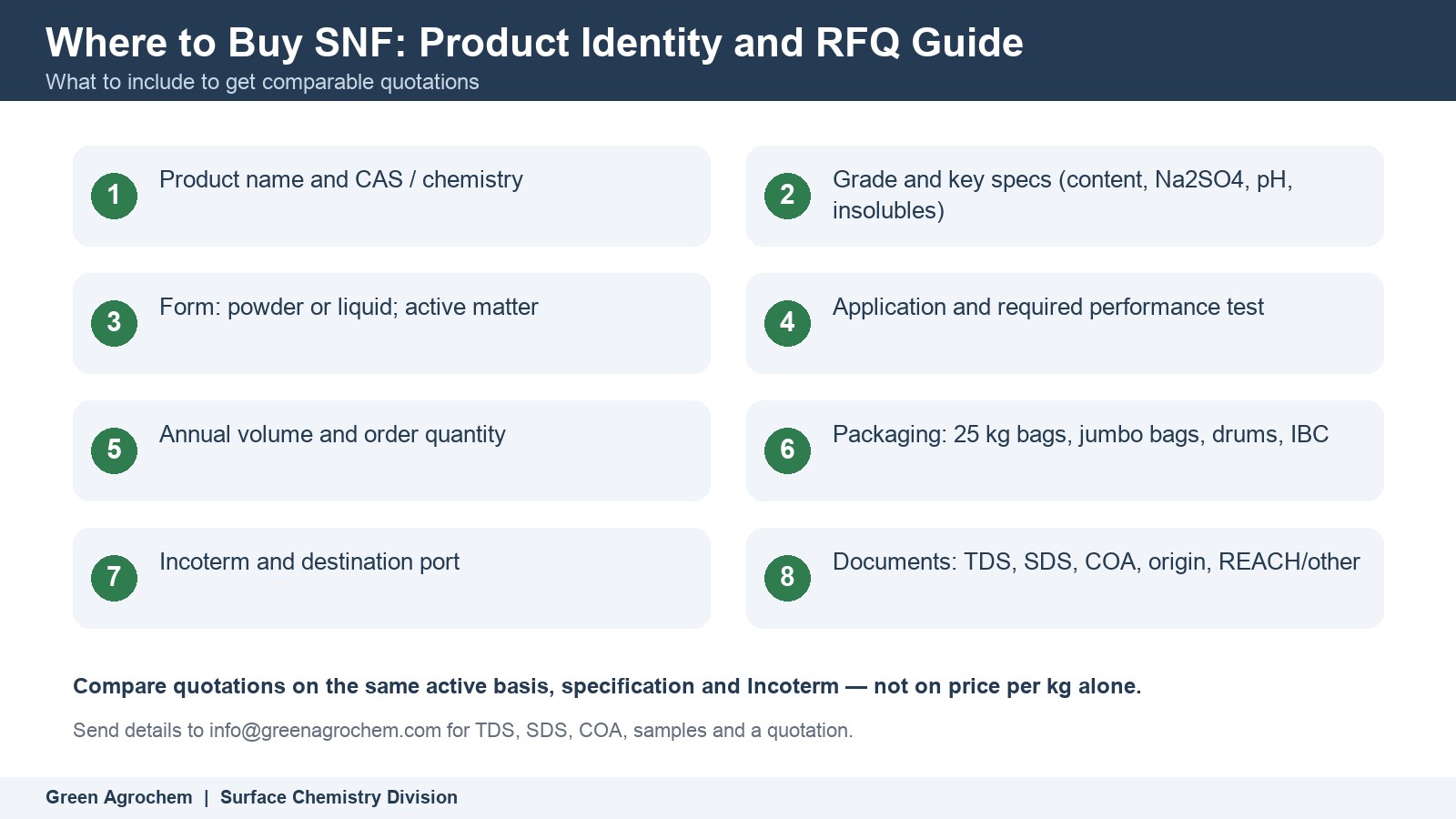
Ask every seller to quote the same:
- exact grade and powder or liquid form;
- quantity and packaging;
- currency and quotation-validity period;
- Incoterm and named place;
- origin and destination;
- production lead time and shipment basis;
- payment and inspection terms;
- required documents and sample terms.
There is no responsible universal online price. A usable price must be dated and tied to the defined grade, order, packaging, currency, Incoterm and route.
Compare powder and liquid correctly
Powder and liquid offers cannot be compared by price per tonne alone. Normalize on an appropriate dry-solids or active basis, then include freight, packaging, storage, solution preparation, dosing equipment, loss and quality-control cost. See the SNF powder handling and buyer guide for powder-specific controls.
Verify the supplier and payment route
- check the legal entity, registration and manufacturing relationship;
- verify the beneficiary name and bank-account ownership;
- confirm changes to payment instructions through a separate contact channel;
- use inspection, retained samples or third-party testing according to order risk;
- agree on claims, replacement and nonconformance handling in writing.
Shipping and receiving controls
Confirm product transport classification from the current SDS rather than assuming it is non-hazardous. Define packaging integrity, moisture protection for powder, container compatibility for liquid, labeling and required export documents. At receipt, check the lot and documents against the purchase order before releasing material.
Safety and regulatory review
Safety, impurity and environmental claims must be supported by the exact product SDS and applicable market documentation. Do not accept generic “safe,” “biodegradable,” “low toxicity” or fixed residual-formaldehyde claims without a specified grade, method and current evidence.
When to compare another technology
If the required workability retention, binder compatibility or water-to-binder target is not robust with the qualified SNF candidates, compare another admixture technology under the same test conditions. Substitute by verified performance, not by equal mass or product name.
Send a complete SNF RFQ
Send the intended chemistry, application, binder or formulation system, supply form, required specification, testing standard, annual demand, shipment size, packaging, destination and Incoterm to info@greenagrochem.com. Ask that the quotation, sample, TDS, SDS and COA all identify the same commercial grade.
For supplier-level due diligence, also use How to Choose an SNF Supplier in China.
