
SNF powder is selected for construction formulations when a dry, transport-efficient cement dispersant fits the buyer’s production and handling process. Powder form offers operational advantages only when moisture protection, weighment, dissolution or dry blending, dust control and batch traceability are properly managed.
This guide focuses on purchasing and using powdered sulphonated naphthalene formaldehyde (SNF). For available commercial grades and documents, see the SNF product page.
Where powder form may be preferred
- factory-produced dry-mix mortars and construction compounds;
- plants equipped to prepare and control an aqueous stock solution;
- shipments where water freight and liquid-container handling are disadvantages;
- operations needing stable, accurately weighed dry raw materials;
- formulations where the exact SNF powder grade has passed compatibility testing.
Powder is not automatically better than liquid. The comparison should include active or dry-solids basis, dissolution equipment, labor, dust control, storage, dosing accuracy and total delivered cost.
Product identity and grade evidence
SNF powder grades can differ in moisture, sodium sulfate, pH of a specified solution, insolubles, particle form and molecular distribution. Retain a value only when it appears in the current specification or TDS for the exact offered grade, with its unit, test method and status as a limit, range or typical result.
Request the following before qualification:
- current grade-specific TDS and revision;
- current SDS for powder handling and the destination market;
- representative COA with declared test methods;
- packaging, storage and shelf-life statement;
- batch traceability and change-control procedure;
- supporting report for any claimed construction-admixture classification.
Incoming batch inspection
Use an approved sampling plan. Confirm supplier, grade, lot, production date, packaging integrity and document match before release. Inspect the material according to the purchase specification and quarantine damaged or moisture-exposed packages pending technical review.
Do not approve a batch from color alone. Appearance may be a useful identity observation, but composition and performance require the specified analytical and application tests. Retain reference samples when the quality system requires them.
Storage and powder handling
Follow the current product TDS and SDS for storage conditions and shelf life. Keep packages closed and protected from moisture and contamination. Use a managed first-in/first-out or first-expire/first-out system as appropriate, and record partial-bag handling.
Powder transfer can generate dust. Engineering controls, housekeeping and personal protective equipment must be selected from the product SDS and workplace risk assessment. Generic statements such as “safe” or “non-toxic” are not substitutes for the supplied safety document.
Accurate dry dosing
Confirm that the weighing system can resolve the required addition mass at the minimum batch size. Check scale calibration, feeder repeatability, material bridging, residue and transfer loss. A correct formula cannot compensate for a feeder that delivers inconsistently.
When SNF is used in a factory dry mix, validate charging order and mixing time by an appropriate uniformity study. Small-dose additives may require a premix or another validated distribution strategy; do not assume that longer mixing always solves poor distribution.
Preparing an aqueous stock solution
If powder is converted to liquid at the plant, establish a written procedure covering water quality, target concentration, order of addition, agitation, temperature limits, dissolution time, filtration if needed, tank identification and permitted storage period. These parameters must be developed for the exact grade and equipment.
Record powder mass, water mass, final batch mass and any density or concentration check used by the quality system. Include solution water in concrete batch-water accounting. Prevent cross-contamination with other admixtures and verify compatibility before common-line or tank use.
Dosage basis and concrete trials
Do not publish or use a universal percentage. Begin with the supplier-recommended starting trial range in the current TDS for the exact powder grade. State whether it is based on cement or total cementitious material and whether it refers to as-supplied powder or dry solids.
Bracket that starting point using the actual cement, supplementary materials, aggregates, water, other admixtures, temperature and mixing sequence. Measure initial and retained workability, air, unit weight, bleeding, segregation, setting and strength at the project-specified ages. Confirm the preferred level in plant and field conditions.
Dry-mix mortar and compound trials
For self-leveling compounds, grouts or repair mortars, define the percentage basis as total dry formulation, binder or another explicit component. Evaluate flow and retention together with stability, air, set, adhesion, shrinkage and hardened performance. See the dedicated SNF self-leveling compounds guide.
Common powder-form problems
- Caking: investigate package integrity, humidity exposure and storage history; do not assume reprocessing restores specification.
- Slow dissolution: check grade identity, water, concentration, order of addition, agitation and contamination.
- Variable concrete response: audit batch mass, solution concentration, moisture corrections, cement source and sequence.
- Feeder inconsistency: inspect bridging, minimum weighment, calibration and transfer residue.
- Dust accumulation: review enclosure, extraction, cleaning method and SDS-based controls.
Powder versus liquid commercial comparison
Normalize offers to a common technical and commercial basis. Include grade solids or active basis, packaging, freight, duties, storage footprint, dissolution equipment, energy, labor, loss, quality testing and dosing reliability. Avoid undated per-kilogram price claims; request a quotation tied to grade, quantity, packaging, currency, Incoterm, origin and destination.
For broader purchasing criteria, use the SNF concrete additive buyer guide. For plant addition sequence and water control, see Using SNF in Cement Mixing.
RFQ information
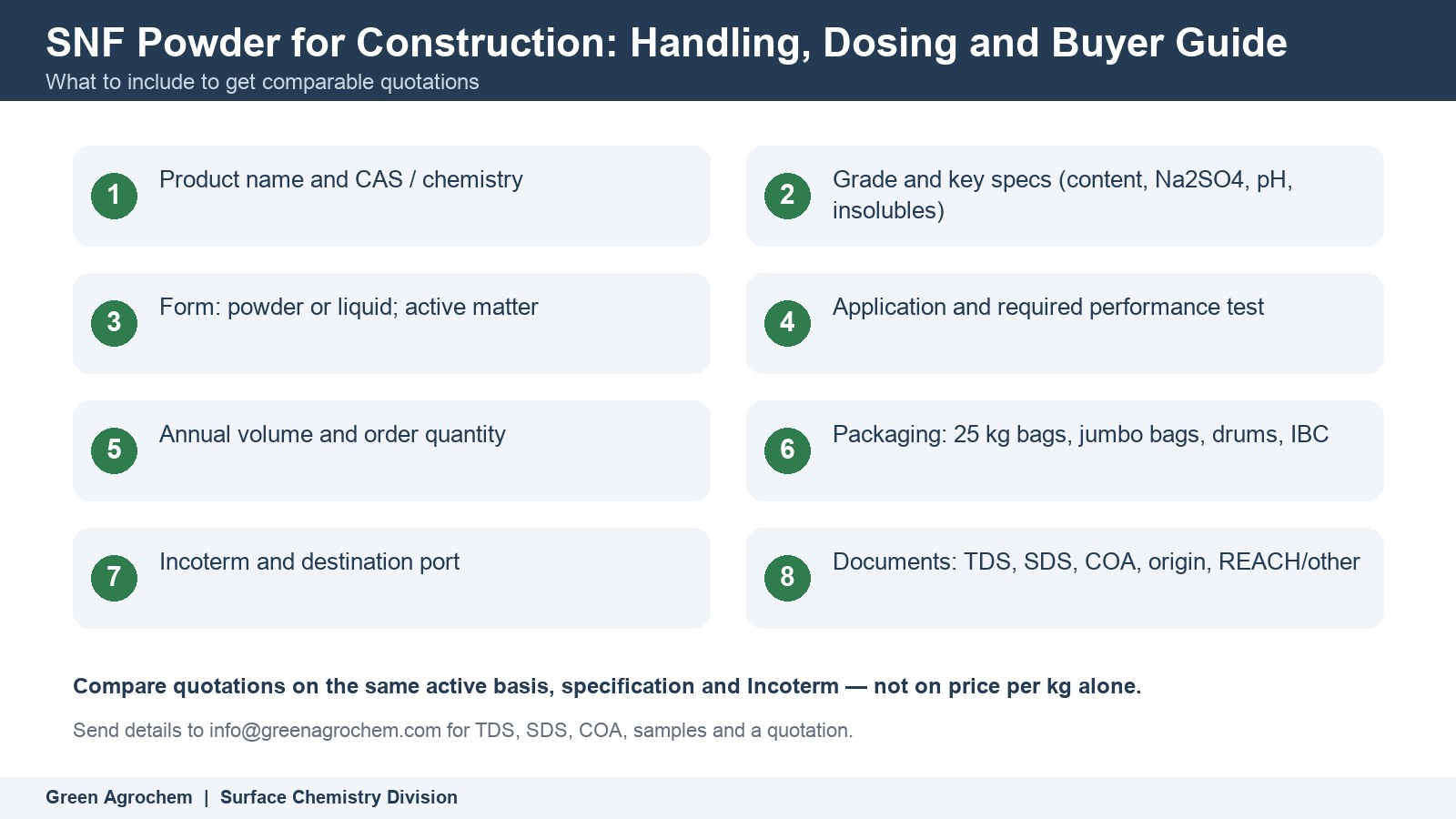
Send the application, binder system, powder or stock-solution process, annual demand, package preference, required test documents, destination and Incoterm to info@greenagrochem.com. Require the quotation and sample documents to identify the same exact grade.
SNF Grades and Data Sheet Values
Our current SNF grades differ mainly in sodium sulfate content:
| Grade | Sodium sulfate (Na2SO4) | Chloride (Cl–) | Cement paste fluidity | Solids | pH |
|---|---|---|---|---|---|
| SNF-5 (GAC-SNF-5) | 5% max | 0.4% max | 220 mm min | 91% min | 7 – 9 |
| SNF-10 (GAC-SNF-10) | 10% max | 0.4% max | 220 mm min | 91% min | 7 – 9 |
| SNF-18 (GAC-SNF-18) | 18% max | 0.5% max | 210 mm min | 91% min | 7 – 9 |
| SNF-20 (GAC-SNF-20) | 20% max | 0.5% max | 210 mm min | 91% min | 7 – 9 |
| Powder Grade, high solids (GAC-SNF-P) | 10% max | Below 200 ppm | Not listed | 95% min | 6.5 – 8.5 (1:10) |
The current TDS gives a supplier-recommended starting trial range of 0.5–1.0% powder by weight of cementitious material, with 0.75% as the first trial point. Confirm the working dose by trial mixes with your own cement, aggregates and admixtures.
Concrete test data, packaging and TDS downloads are on the SNF product page.
Frequently Asked Questions
What is SNF powder?
Sodium naphthalene sulfonate formaldehyde condensate in dry form: a brown, water-soluble powder used as a concrete superplasticizer.
How should SNF powder be stored?
In sealed bags in a dry, ventilated warehouse. Shelf life is typically 12 months in the original packaging. If it takes up moisture, crush or dissolve it and check performance.
How is SNF powder packed?
In 25 kg woven bags or 500–600 kg jumbo bags.
