
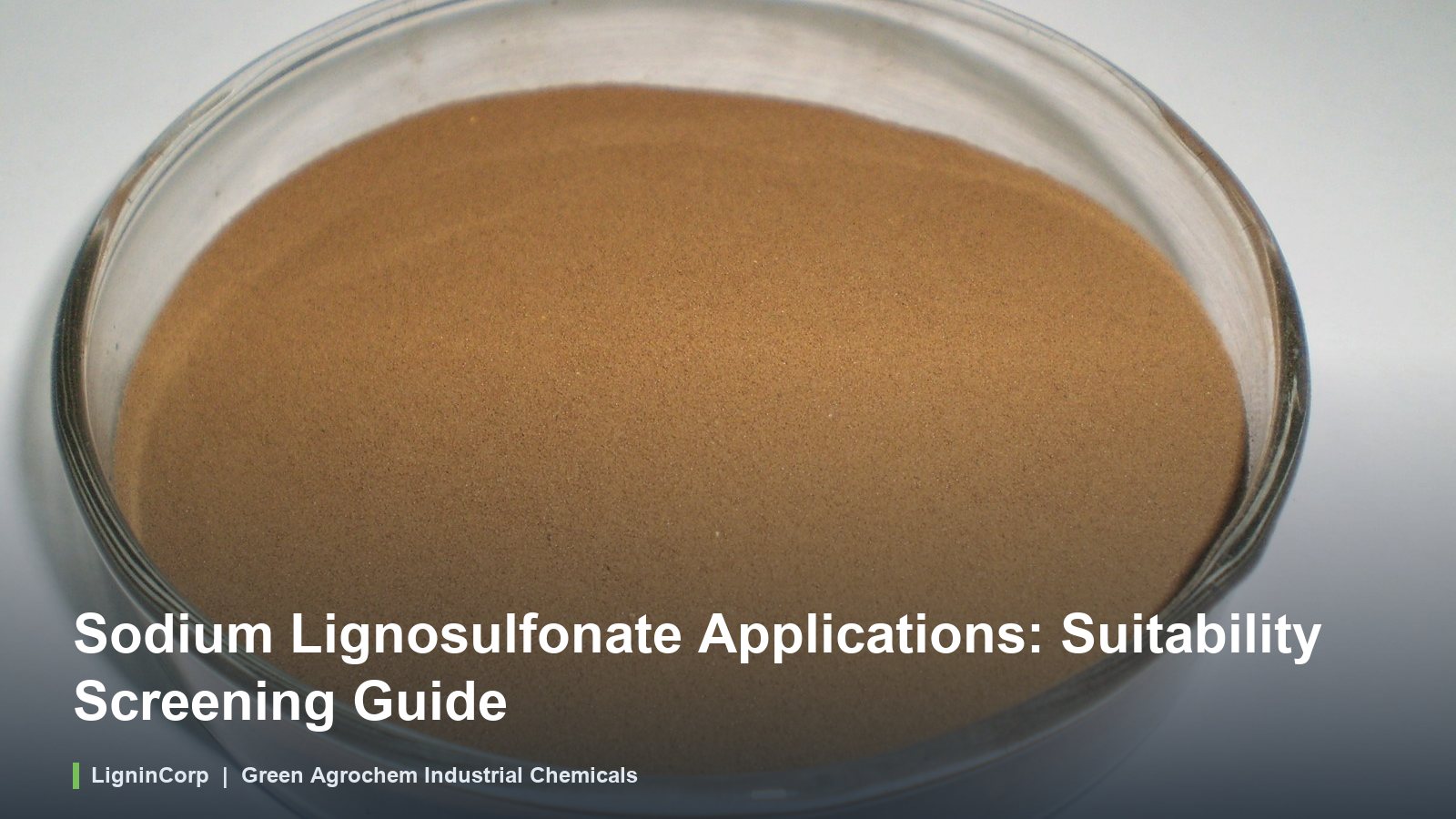
Sodium lignosulfonate is evaluated in industrial formulations primarily for particle dispersion, conventional cement plasticization, binding, interfacial stabilization and selected process-control functions. These roles are not interchangeable: a grade that performs in concrete may not be suitable for a ceramic slip, drilling fluid, mineral pellet or emulsion.
This page helps technical and procurement teams screen application fit before requesting a sample. For the available commercial family, start with the LigninCorp sodium lignosulfonate product page. For navigation by sector, use the industrial applications directory.
Match the Required Function, Not Just the Industry Name
| Industrial system | Function commonly evaluated | Critical variables | Evidence required |
|---|---|---|---|
| Concrete, mortar and gypsum | Cement-particle dispersion, workability and possible set control. | Cement/SCM chemistry, reducing sugars, sulfate/chloride contribution, air response, temperature and other admixtures. | Exact-grade TDS plus controlled mix trials for workability, air, setting, strength and project durability requirements. |
| Ceramic and refractory slurries | Particle dispersion, viscosity control and possible green-body binding. | Mineralogy, solids loading, particle-size distribution, pH, water chemistry, casting/spray conditions and firing cycle. | Rheology curve, ageing, casting or forming response, drying and fired-property comparison against a control. |
| Mineral processing and agglomeration | Slurry dispersion or particle binding, depending on the process. | Ore/mineral surface, fines distribution, moisture, salts, mixing energy and downstream thermal treatment. | System-specific dispersion or pellet/briquette tests, handling strength and downstream process checks. |
| Dust suppression and road-surface treatment | Fine-particle binding and surface cohesion. | Soil/aggregate grading, application water, climate, traffic, drainage and reapplication strategy. | Field section with defined application basis, weather/traffic exposure and acceptance measurements. |
| Drilling and industrial aqueous fluids | Selected dispersion, rheology or filtration-control support. | Base-fluid chemistry, salinity, hardness, temperature, solids, pH and compatibility with the complete additive package. | Application-standard tests under representative fluid, contamination, temperature and ageing conditions. |
| Industrial suspensions and emulsions | Particle stabilization or protective-colloid support in selected systems. | Dispersed phase, surface chemistry, electrolyte, pH, shear, order of addition and storage conditions. | Particle-size/settling or emulsion-size/separation testing; dispersion performance does not prove emulsion stability. |
Properties Used to Screen a Grade
Relevant controls may include powder moisture or liquid solids, pH at a defined concentration, water-insoluble matter, lignosulfonate content by a stated method, reducing sugars, ash and counter-ion profile, sulfate and chloride where relevant, apparent density, solution viscosity, molecular distribution and charge-related measurements. Not every parameter matters equally in every process.
Compare supplier data only when units, sample basis and test methods are equivalent. “Purity” without a defined analytical method is not enough to establish grade equivalence. The structure and property buyer guide provides further interpretation.
Application Claims Removed from the Former Page
| Former claim | Evidence/status | Correct treatment |
|---|---|---|
| Commonly used as a flocculant to remove suspended solids in water treatment. | Overgeneralized and unsupported for an offered exact grade. | Industrial water systems require a defined role, water matrix and bench test; dispersant and flocculant functions must not be confused. |
| Used as a flocculant to remove lignin and impurities from wood pulp. | Unsupported process-generalization. | Do not represent this as a routine commercial application without a process-specific source and grade data. |
| Used as a flocculant to remove impurities from textile fibres and yarns. | Unsupported and technically vague. | Identify the actual formulation function, substrate, bath chemistry and test method before claiming suitability. |
| Removes impurities from pharmaceutical products. | Unsupported pharmaceutical-use claim. | Not an approved use statement. Exact product, process, quality system and jurisdiction-specific evidence would be required. |
| Removes impurities from milk, cheese and bread. | Unsupported food-use claim. | Do not infer food suitability from the chemical family name; regulatory and exact-grade documentation are mandatory. |
| Removes impurities from face creams and body lotions. | Unsupported cosmetic-use claim. | Requires formulation, safety, quality and market-specific substantiation; it is not part of this industrial application guide. |
The previous statements are preserved in this correction table for traceability. They are not current product claims, specifications or recommendations.
Controlled Application-Qualification Workflow
- Define the job: state the target function and measurable failure, not only the industry.
- Establish a control: record the current formulation, raw materials, water, process, equipment and acceptance limits.
- Screen documents: reconcile exact grade across quotation, TDS, SDS, representative COA and label.
- Design a dosage series: use a numerical starting range only when the current exact-grade supplier document states its revision and calculation basis.
- Run laboratory comparisons: hold non-test variables constant and measure both the intended function and relevant side effects.
- Challenge compatibility: examine pH, salts, temperature, ageing, addition sequence and other additives.
- Confirm at process scale: complete a controlled plant or field trial before routine production.
How Numerical Data Should Be Presented
Current exact-grade specification values must identify the TDS or COA revision, units, basis, method and whether each value is a limit, range or typical result. A dosage may be shown only as a supplier-recommended starting trial range when its exact grade, source, revision and calculation basis are known. A performance number must remain attached to its control, material system, dosage basis, method and conditions. None should be converted into a universal performance guarantee.
Choose the Correct Next Page
For sodium-specific industrial grade matching, read Applications of Sodium Lignosulphonate: Grade Selection and Validation. Current TDS, SDS and COA resources can be requested through the technical document centre. To discuss a sample or application trial, contact LigninCorp or email info@greenagrochem.com.
