
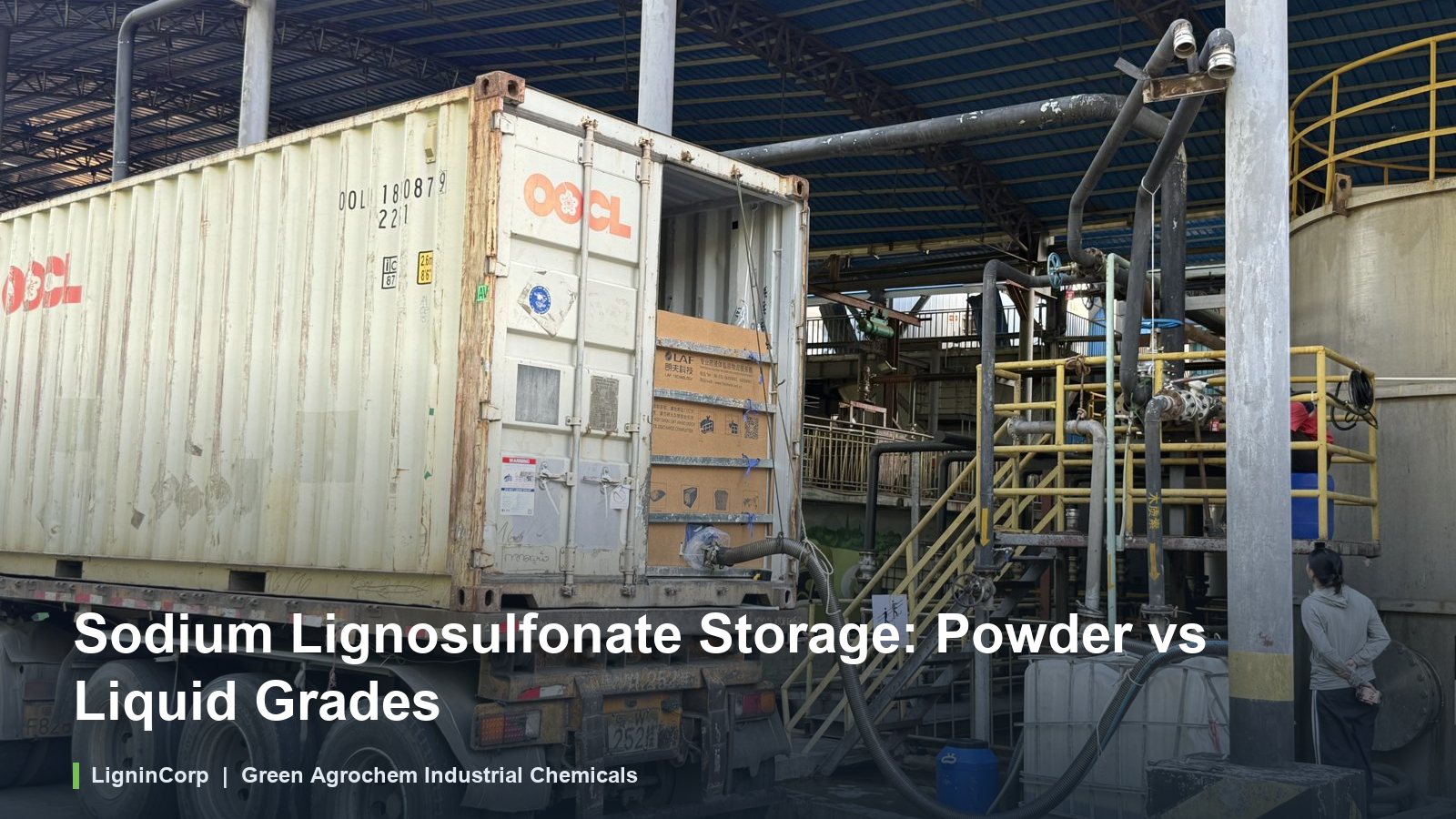
Sodium lignosulfonate storage requirements depend first on whether the supplied grade is a hygroscopic powder or an aqueous liquid. The product code, current TDS/SDS, package and shipment COA should govern the warehouse plan; a generic chemical name is not enough.
Current grade-specific storage summary
| Grade and source | Physical form | Current storage instruction | Packaging and shelf life |
|---|---|---|---|
| GAC-NaLS-1 Sodium Lignosulfonate — Grade One TDS/SDS Rev. 2.0 | Yellow-brown powder | Store in a cool, dry, well-ventilated area. Protect against moisture ingress, excessive heat and incompatible strong oxidizers, acids and bases. Keep opened bags resealed. | 20 or 25 kg lined woven bags; 500 or 600 kg FIBC. 24 months from production in original unopened packaging. |
| GAC-NaLS-L Sodium Lignosulfonate — Liquid Grade TDS/SDS Rev. 2.0 | Dark brown/black liquid | Store cool and well ventilated in sealed original packaging. Protect from freezing and avoid prolonged extreme temperatures. Segregate from strong oxidizers, acids and bases. | IBC, drum or flexitank according to volume and confirmed package selection. 12 months from production in original sealed packaging. |
These shelf-life statements apply only to the identified grades, document revisions and package status. They do not automatically apply to another sodium lignosulfonate grade, a repacked material or a prepared customer solution.
Powder warehouse controls
- Receive bags and FIBCs on intact pallets; inspect liners, seams, lifting loops and water damage before acceptance.
- Keep stock off floors and away from walls, roof leaks, washdown spray and condensation points.
- Control dust during transfer and housekeeping; avoid sweeping methods that generate airborne dust.
- Close partial bags promptly and identify the original lot, opening date and remaining quantity.
- Use first-expiring-first-out inventory control and investigate caking, wet patches, odour, contamination or package damage.
Liquid tank and container controls
- Confirm that the drum, IBC, flexitank, liner, valve, gasket, hose and pump are compatible with the exact grade and logistics duration.
- Define a site-specific minimum storage and transfer temperature from validated low-temperature viscosity, phase behaviour and pumpability data. “Protect from freezing” is not a universal numeric set point.
- Keep containers sealed when not in use and prevent dilution, rainwater, dust or incompatible chemical ingress.
- Before unloading, check lot identity, seal integrity, leakage, temperature, appearance, sediment/separation and COA conformity.
- For bulk tanks, define agitation or recirculation only from stability testing; unnecessary aeration or mixing should not be assumed beneficial.
Inspection and release after storage
| Situation | Minimum review | Release decision |
|---|---|---|
| Routine unopened stock | Lot, manufacture date, package condition and warehouse history | Release only within the applicable grade shelf life and agreed specification |
| Opened or repacked powder | Traceability, moisture exposure, caking, contamination and representative testing | Do not rely on the unopened-package shelf-life statement |
| Liquid exposed to cold | Temperature history, phase/separation, viscosity, pumpability and recovery after the approved conditioning procedure | Do not heat or use until the supplier-approved recovery and testing criteria are met |
| Damaged, leaking or contaminated package | SDS response, segregation, sample integrity and disposal/rework review | Quarantine pending documented quality and safety disposition |
| Material beyond stated shelf life | Representative sample against an agreed retest specification | Do not extend shelf life from appearance alone |
Status of the former generic instructions
| Former statement | Evidence/status | Correct handling |
|---|---|---|
| Store at 20–25°C | No exact grade, study or current document identified | Not a universal limit; use the current grade TDS/SDS and validated site range |
| Avoid all bright light to prevent oxidation | Not stated as the controlling requirement in the reviewed Rev. 2.0 documents | Prioritize sealed packaging, moisture/temperature control and incompatibility segregation |
| Store only at atmospheric pressure | Generic wording without package or engineering context | Follow the approved container/tank design, venting and supplier instructions |
| Avoid plastic containers | Contradicts the powder polyethylene liner and normal IBC/flexitank package options | Confirm the specific resin, liner, valve and seal compatibility; do not ban all plastics |
| Fixed shelf life for all sodium lignosulfonates | Incorrect because form, grade and package differ | Use 24 months for unopened GAC-NaLS-1 and 12 months for sealed GAC-NaLS-L only under their documented conditions |
Documents to request
Request the current exact-grade TDS, SDS/MSDS and signed shipment COA, plus packaging drawings or compatibility confirmation when required. For bulk storage, also document the proposed tank material, liner, working temperature, residence time, agitation, transfer system and cleaning procedure.
For grade matching, storage review and current documentation, contact info@greenagrochem.com. See the sodium lignosulfonate product route and the dedicated liquid sodium lignosulfonate page.
Shelf Life by Form
| Form | Shelf life (TDS) | Main storage risk |
|---|---|---|
| Powder (e.g. Grade One) | 24 months from production, unopened | Moisture pick-up and caking |
| Liquid (e.g. GAC-NaLS-L) | 12 months from production, sealed | Freezing, stratification, contamination |
Storage Checklist
- Powder: dry, ventilated warehouse; pallets off the floor; reseal opened bags.
- Liquid: closed tanks or IBCs; protect from freezing; circulate before use.
- Both: first in, first out; keep the batch COA with the stock.
Frequently Asked Questions
How long can sodium lignosulfonate be stored?
Powder: 24 months unopened; liquid: 12 months sealed, according to the TDS of each form.
Does liquid sodium lignosulfonate freeze?
It must be protected from freezing, as the TDS states. Keep tanks in a heated area or insulated in cold climates.
How should opened powder bags be stored?
Reseal them and keep them dry, because the powder absorbs moisture and can cake.
