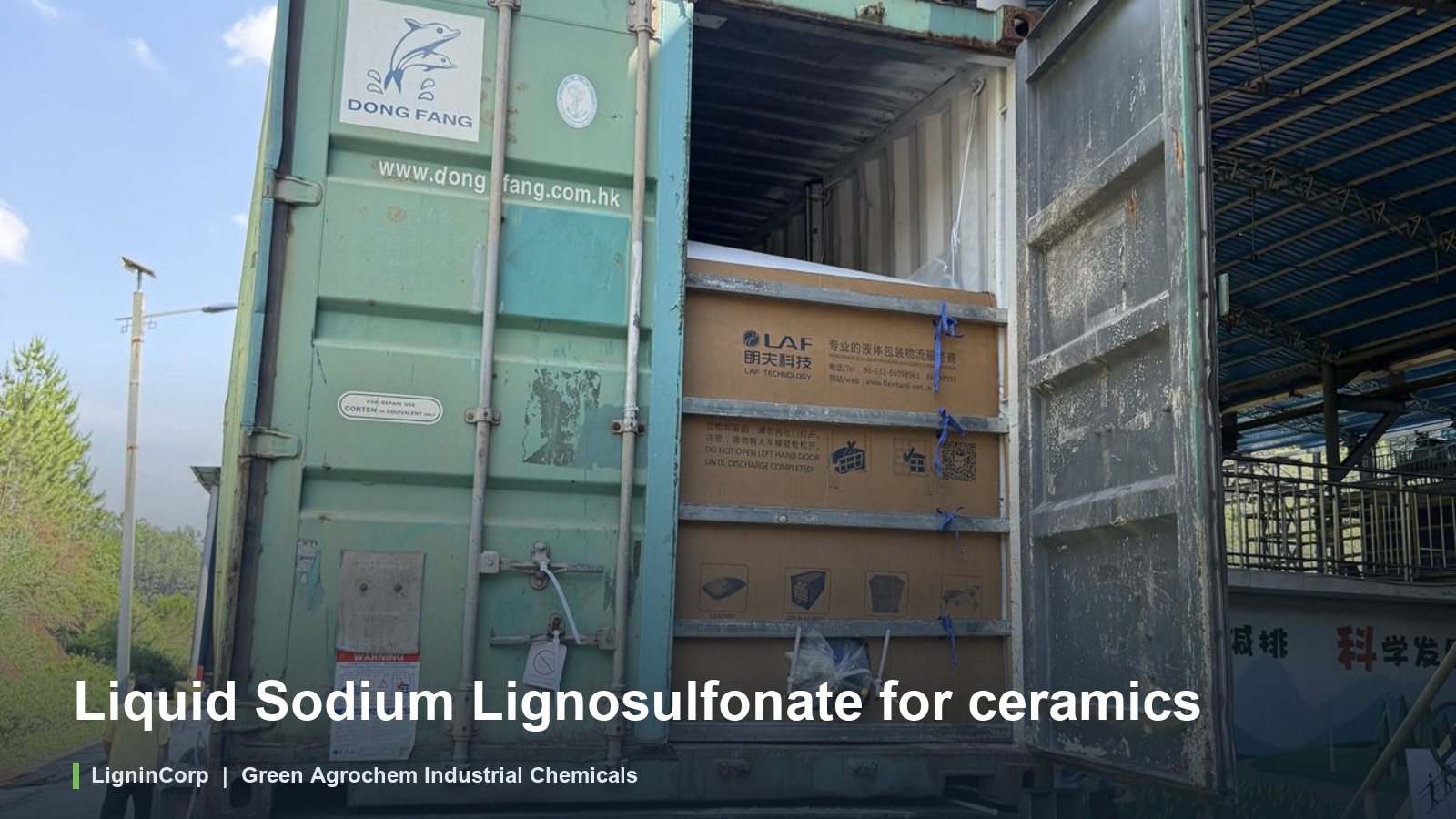
Liquid sodium lignosulfonate is used in ceramics as a binder and deflocculant. It raises the green and dry strength of unfired bodies, helps clay slips flow at lower water content, and acts as a lubricant during pressing and extrusion. The liquid form is convenient for slip and glaze plants that dose by pump. This page covers how it works, which grades to use, typical addition rates from our TDS and how to test it.
How It Works in Ceramic Bodies
- Deflocculant: lignosulfonate adsorbs on clay particles and gives them a negative charge, so they repel each other. The slip becomes more fluid at the same water content, or needs less water for the same flow.
- Binder: as the body dries, the lignosulfonate forms a film between particles, which increases green and dry strength and reduces breakage before firing.
- Lubricant: it eases pressing and extrusion.
- Burn-out: it is organic and burns out during firing; at higher additions a black core can appear if burn-out is incomplete.
Grades for Ceramics
| Grade (code) | Solids | Lignosulphonate (dry basis) | pH | Water-insoluble | Notes |
|---|---|---|---|---|---|
| Liquid NaLS Ceramics Grade (GAC-NaLS-L-1) | 45% min | 45% min | around 9.0 | 2.5% max | For ceramic tile and refractory slips |
| Liquid NaLS Grade One (GAC-NaLS-L) | 45% min | 50% min | 7.0 – 11.0 | 1% max | Low insolubles; ceramics, casting sand, fiberboard |
| Ceramics Binder Liquid (GAC-NaLS-Binder-L) | 45% min | 55% min | — | 1.5% max | Sugar around 20%; binder use |
Addition Rates
The Grade One TDS gives these supplier-recommended starting trial ranges, as dry lignosulfonate on the dry body:
- Ceramic slip: 0.1 – 2.0%.
- Pressed tiles: around 1%, at which the TDS reports that mechanical strength can roughly double; a black core may appear.
For a 45% solids liquid, divide the dry rate by 0.45: 1% dry on the body equals about 2.2% liquid. Count the water in the liquid in the slip water.
Trial Procedure
- Prepare the slip or body with your raw materials and a control without lignosulfonate.
- Add the liquid at three levels within the trial range.
- For slips: measure viscosity or flow time and the water needed for the target flow.
- For pressed or extruded bodies: measure green and dry bending strength and breakage.
- Fire samples and check for black core, colour and fired strength.
- Choose the lowest dose that meets your targets.
Lignosulfonate Compared With Other Ceramic Additives
| Additive | Main role | Points to compare |
|---|---|---|
| Lignosulfonate | Binder and deflocculant in one | Organic, burns out; check black core at high dose |
| Sodium silicate | Deflocculant | Inorganic, stays in the body; no binding film |
| Sodium tripolyphosphate | Deflocculant | Inorganic; often combined with silicate |
| PVA, CMC and other organic binders | Binder | Burn out; usually used for green strength only |
Because lignosulfonate both deflocculates and binds, it can partly replace a separate binder or reduce the plastic clay needed. The Grade One TDS notes that it reduces shrinkage while keeping strength after forming.
Where It Is Added in Tile Production
- Ball milling: add the liquid with the mill water so it disperses the slip during grinding.
- Spray drying: the dried granules carry the lignosulfonate as binder into pressing.
- Pressing: it lubricates and binds the pressed body, raising green strength.
- Firing: it burns out; adjust the firing curve if black core appears.
Incoming Checks for the Liquid
- Batch COA against the TDS: solids, insolubles and pH.
- Mix the container before sampling; liquids can stratify.
- Run a quick slip flow test against a retained reference batch.
Limitations
- Too much can over-deflocculate a slip or cause black core after firing.
- Results depend on clay mineralogy, water quality and other additives.
- Liquids must be protected from freezing; shelf life is 12 months (TDS).
Other liquid grades: liquid lignosulfonate grades compared. Product page: liquid sodium lignosulfonate Grade One.
Frequently Asked Questions
How much sodium lignosulfonate is added to ceramic slip?
The TDS gives a starting trial range of 0.1 – 2.0% dry lignosulfonate on the dry body; for pressed tiles around 1%. Confirm by trial.
Does lignosulfonate increase green strength of ceramics?
Yes. It forms a film between particles as the body dries, raising green and dry strength. The Grade One TDS reports that about 1% in pressed tiles can roughly double mechanical strength.
Why does a black core appear?
Lignosulfonate is organic. At higher additions or with fast firing it may not burn out fully, leaving a dark core.
Which liquid grade suits ceramic slips?
Start with the Ceramics Grade (GAC-NaLS-L-1) or Grade One, which has the lowest insolubles (1% max).
