
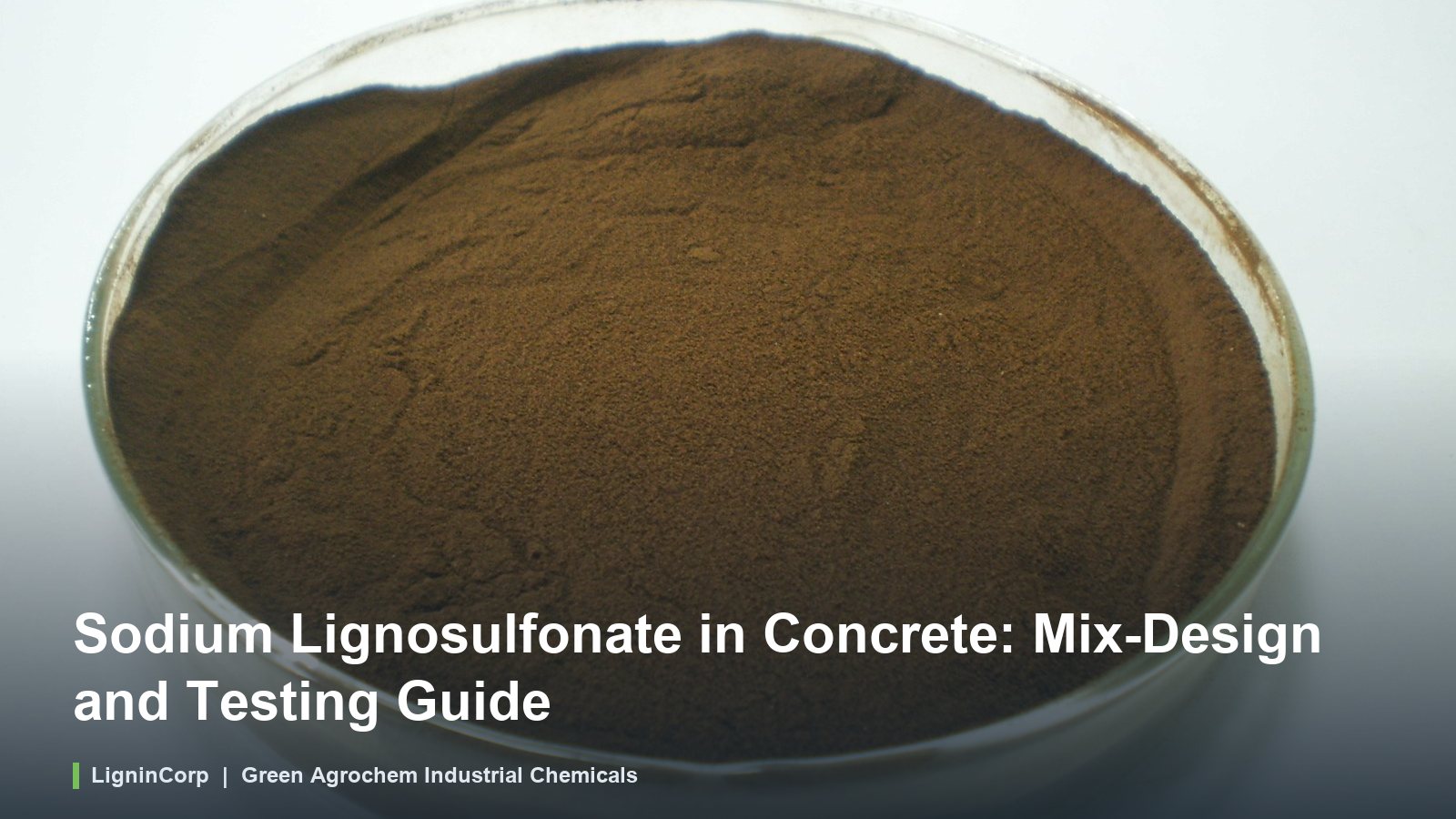
Sodium lignosulfonate is evaluated in concrete primarily as a conventional water-reducing, plasticizing and set-modifying component. It can improve cement-particle dispersion and workability, but its response is strongly dependent on cement chemistry, product grade, dosage, temperature and the other admixtures in the formulation.
This page explains how to qualify sodium lignosulfonate for concrete. For current industrial product specifications, packaging, samples and a lot-specific COA, review the LigninCorp sodium lignosulfonate product page.
How sodium lignosulfonate affects cement paste
Lignosulfonate molecules contain anionic sulfonate groups and can adsorb on cement-particle surfaces. The resulting change in surface interactions helps reduce part of the flocculated structure, releasing entrapped water and improving paste mobility. Depending on the formulation, this may increase workability at constant water or allow some water reduction at a selected workability.
Lignosulfonates may also influence early hydration and setting. The degree of retardation is not fixed: cement mineralogy, sulfate balance, alkalis, fineness, temperature, supplementary cementitious materials and product composition all affect the result.
Suitable application objectives
- conventional plasticizing and moderate water-reduction systems;
- ready-mix concrete where controlled set extension is useful;
- mass concrete or warm-weather formulations after thermal and setting evaluation;
- mortar, masonry and selected dry-mix systems;
- blended admixture packages in which lignosulfonate supports dispersion, set control or formulation economics.
Sodium lignosulfonate should not automatically be positioned as an SNF- or PCE-equivalent high-range water reducer. Where very high water reduction, extended slump retention or self-consolidating performance is required, compare the complete mix using SNF, PCE or a validated blended system.
Why a universal dosage table is misleading
A dosage copied from another cement or supplier does not predict performance in a new mix. Product solids, molecular distribution, sugars and other reducing components can differ between lignosulfonate grades. Cement and SCM changes can also alter adsorption and setting response.
Use the supplier’s current TDS range only as a recommended trial range. Establish the production dosage through controlled testing with the actual cement, aggregates, water, SCMs and companion admixtures. Compare liquid and powder products on an active-solids basis.
Recommended laboratory screening
- Define the target slump or flow, retention interval, air range, setting window and required strength ages.
- Prepare an untreated control at the selected water-to-binder ratio.
- Test several dosages within the supplier-recommended range while keeping materials, temperature and mixing energy constant.
- Measure initial and retained workability, density, air, bleeding, segregation and initial/final set.
- Cast strength specimens using the project curing method and test the specified ages.
- Repeat the selected dosage with all companion admixtures and confirm it in a plant batch.
Air content and freeze–thaw considerations
Some lignosulfonate products can affect measured air, but this does not mean they automatically produce a stable, standards-compliant air-void system. For freeze–thaw exposure, use the appropriate air-entraining admixture and verify fresh-air content, spacing characteristics where required, strength and durability using the applicable project methods.
Common troubleshooting observations
| Observation | Items to investigate |
|---|---|
| Excessive set delay | Active dosage, product grade, cement chemistry, temperature and interaction with retarders. |
| Low workability response | Dosing accuracy, active solids, addition sequence, cement fineness, sulfate balance and clay-bearing fines. |
| Unexpected air | Complete admixture combination, mixing energy, defoamer or air-entrainer compatibility and temperature. |
| Bleeding or segregation | Total water, fines, aggregate grading, paste volume, dosage and mixing sequence. |
| Variable production results | Cement lot, aggregate moisture, solution concentration, dosing calibration and mixing time. |
Product and project acceptance
Separate raw-material acceptance from concrete-performance acceptance. The purchasing specification should identify the grade and agreed chemical or physical limits, while the concrete test plan should define workability, air, setting, stability, strength and applicable durability requirements. Request the current TDS, SDS and lot-specific COA before approval.
For comparison with stronger electrostatic dispersants, see how SNF superplasticizer works. Buyers planning an SNF formulation can also use the SNF procurement and quality checklist.
Request a sample or technical review
Send the cement type, SCM content, target performance, current formulation, trial quantity, packaging and destination to info@greenagrochem.com. LigninCorp will provide the relevant product documents and a recommended starting plan for laboratory evaluation.
