
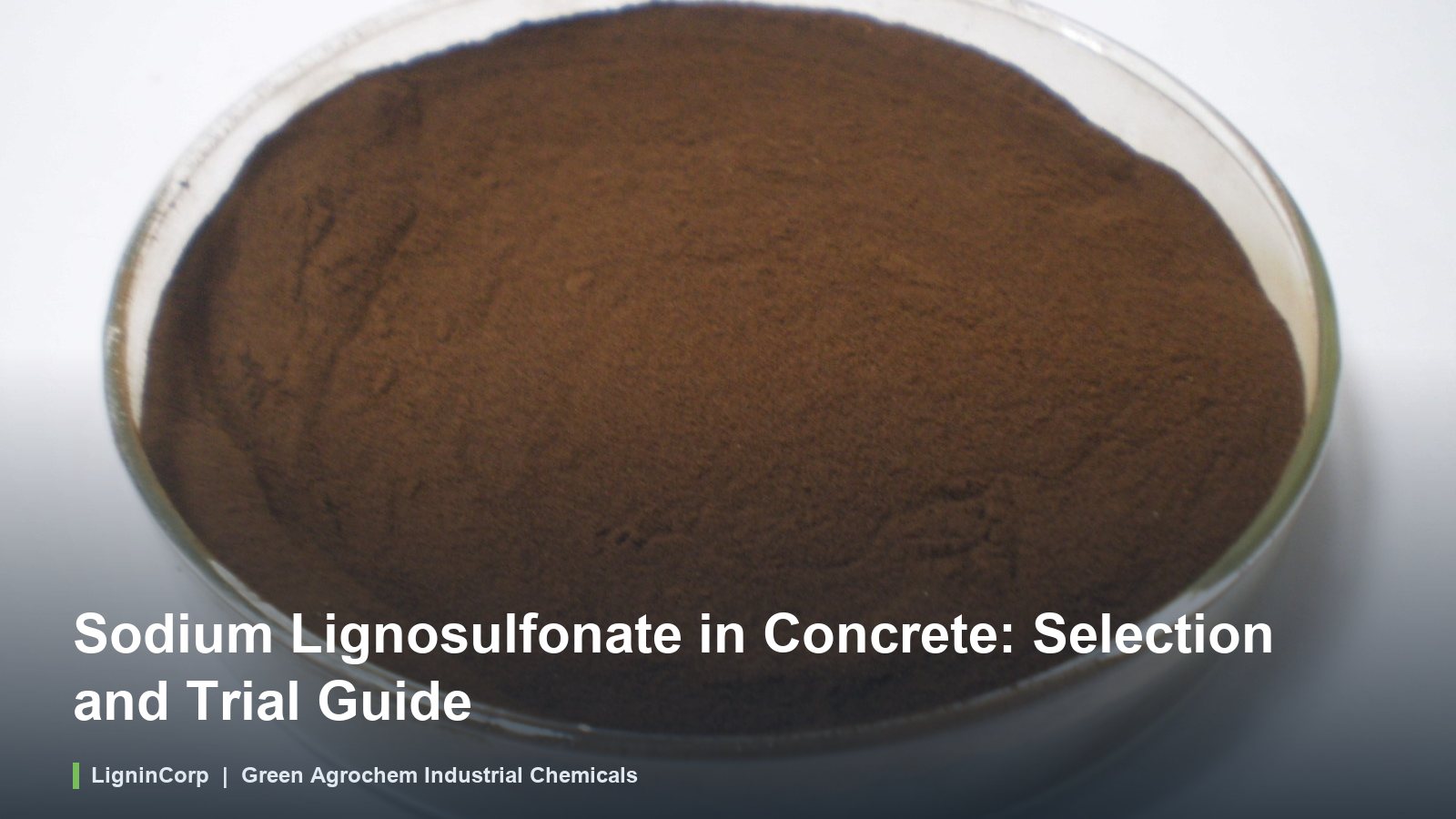
Sodium lignosulfonate concrete admixture is evaluated as a lignin-based dispersing and set-modifying component for concrete and mortar. It can influence cement-particle dispersion, workability, air and setting behaviour, but its response depends on the supplied grade and the complete mix system. Product name alone does not establish a fixed water reduction, strength gain or setting delay.
How sodium lignosulfonate acts in cementitious systems
Anionic lignosulfonate molecules can adsorb on cement particles and help separate agglomerates. This may improve dispersion and change the water demand needed to reach a target consistency. Adsorption and dissolved organic constituents may also affect early hydration. The practical response varies with cement mineralogy and sulfate balance, supplementary cementitious materials, aggregate fines, water chemistry, temperature, mixing energy and other admixtures.
Suitable evaluation objectives
- Workability: compare initial consistency and retention at the actual transport and placement intervals.
- Water-reducing response: determine water demand at equal consistency rather than assuming a published universal percentage.
- Set control: measure initial and final setting time at representative concrete temperatures.
- Air and stability: record air content, bleeding, segregation, finishability and surface condition.
- Hardened performance: test early and specified-age strength and all project-required durability indicators.
Grade and document review
Before a trial, confirm the exact grade, powder or liquid form, active or total-solids basis, moisture, pH, water-insoluble matter, relevant inorganic salts and any grade-specific reducing-sugar information. Review the current TDS, SDS and a representative COA. Specification limits, typical values and test methods should not be mixed in one table without clear labels.
Recommended qualification workflow
- Document the control mix, cement and SCM sources, aggregate moisture, water, temperature and mixing procedure.
- Convert the proposed addition to the correct as-supplied and active-solids basis; account for carrier water in liquid grades.
- Use the current supplier guidance only as a recommended starting trial range. Screen several controlled levels and include the untreated control and current benchmark.
- Measure consistency, retention, air, setting, bleeding and segregation using the applicable project or standard methods.
- Test early and specified-age strength. Add durability testing when required by the exposure class or specification.
- Repeat compatibility trials after changes in cement, SCMs, admixture package, temperature or water source.
- Confirm dosing accuracy, addition sequence and mixing at plant scale before routine use.
Compatibility and limitations
Do not assume automatic compatibility with air entrainers, accelerators, retarders, SNF or PCE superplasticizers. Excessive set delay, unexpected air, slump loss or low early strength should be investigated through active dosage, cement chemistry, temperature, addition sequence and interaction testing. Lignosulfonate should not be described as guaranteeing cement savings, crack prevention, durability or environmental benefits without project-specific evidence.
Choosing between lignosulfonate, SNF and PCE
The appropriate chemistry depends on the required water reduction, workability-retention window, setting profile, early strength, material variability and cost-in-use. Lignosulfonate can be a practical option for moderate dispersion and set-control objectives. SNF or PCE technologies may be evaluated where higher water reduction or different retention behaviour is required. Compare candidates at equivalent active solids in the actual mix rather than by product price per kilogram alone.
Technical and purchasing routes
Review the industrial sodium lignosulfonate product page, the set-control testing guide and the broader lignosulfonate water-reducer guide. For current grade documents, samples, packaging and export support, contact LigninCorp at info@greenagrochem.com.
