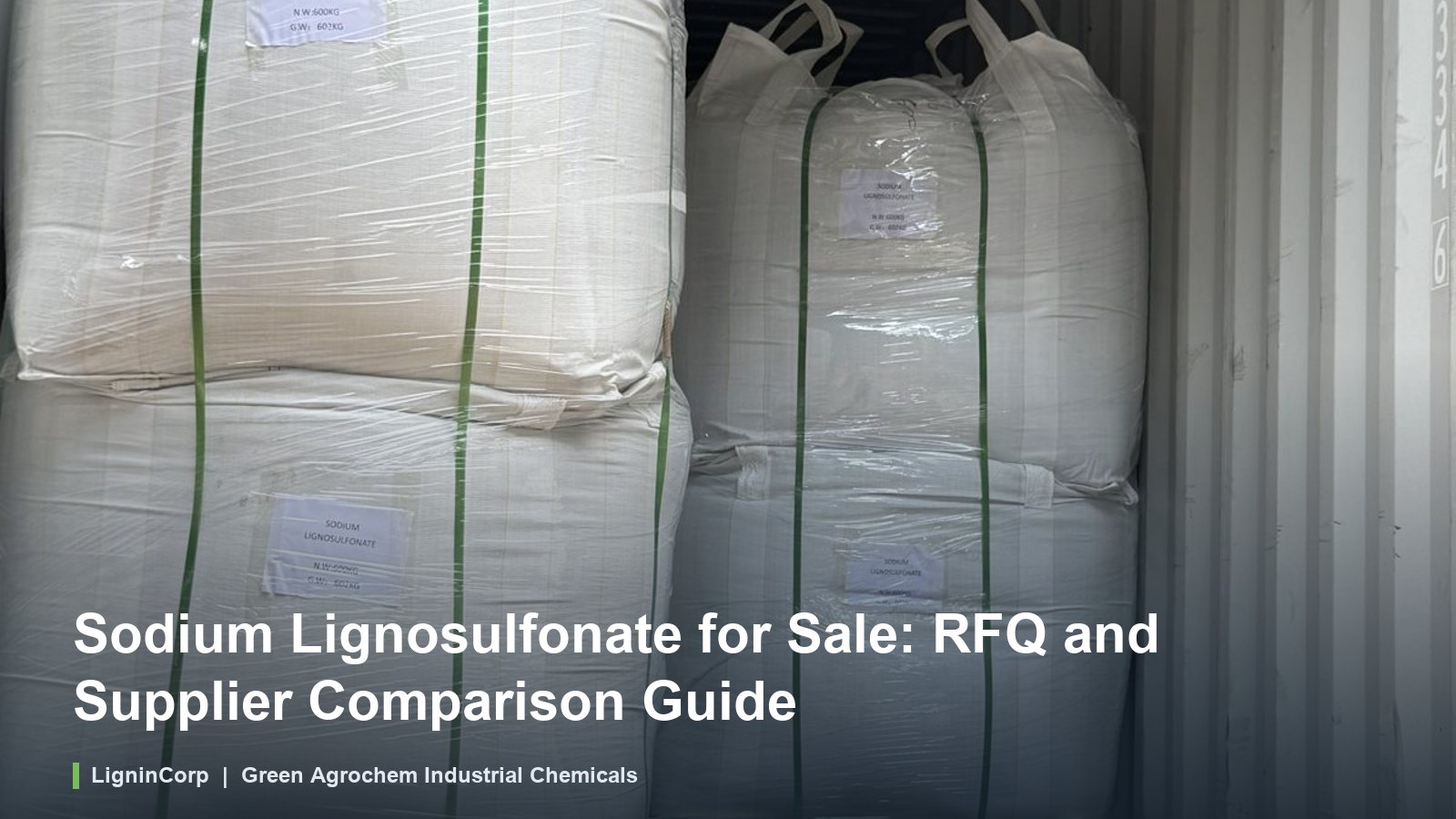
A “sodium lignosulfonate for sale” listing is useful only when a buyer can identify the exact grade, compare offers on the same basis and verify that the supplied lot is suitable for the intended process. A low headline price cannot be evaluated without the product form, solids or moisture basis, specification, packaging, quantity, Incoterm and destination.
This page is an RFQ and offer-comparison guide for industrial buyers. For the currently offered material and its technical scope, begin with the LigninCorp sodium lignosulfonate product page.
Define the Material Before Requesting a Price
Sodium lignosulfonate is a product family rather than one universally interchangeable chemical. Feedstock, processing route, purification, counter-ion balance and finishing can change colour, solubility, ash, reducing sugars, sulfate profile, viscosity and application response. State the required application and acceptance tests instead of requesting “standard sodium lignosulfonate” alone.
| RFQ item | What to specify | Why it changes the offer |
|---|---|---|
| Exact grade and use | Supplier grade code, target process and required function. | Prevents quotation of a cheaper but technically unsuitable material. |
| Physical form | Powder or liquid; for liquid, required solids and delivery form. | Changes handling, freight, storage and usable dry-product cost. |
| Quality requirements | Critical limits, units, basis and agreed test methods. | Allows like-for-like comparison and incoming inspection. |
| Commercial basis | Quantity, packaging, shipment frequency, destination and Incoterm. | Defines freight, handling, duties, risk transfer and landed cost. |
| Documents | Current TDS/SDS, representative COA and market-specific declarations. | Confirms identity, revision status, safety and lot-release controls. |
Compare Quotations on a Dry-Solids and Landed-Cost Basis
Powder and liquid quotations should not be compared by invoice price per tonne alone. For liquid material, convert the as-supplied price to the cost of delivered dry solids using the verified solids value. Then add freight, insurance, duties, customs, local delivery, unloading, packaging disposal and working-capital effects. Include expected process yield only when it comes from a controlled trial in the buyer’s actual system.
The separate sodium lignosulfonate price guide explains quotation variables. For container planning, packaging and storage, use the bulk sodium lignosulfonate procurement guide.
Price, MOQ and Availability: Data Status
| Former page figure | Evidence/status | How buyers should use it |
|---|---|---|
| China: USD 270–450/MT | Unverified historical market estimate; date, grade, Incoterm and source were not identified. | Do not use as a current offer or budget price. Request a dated quotation for the exact grade and destination. |
| Saudi Arabia: about USD 698/MT | Unverified historical market estimate without a comparable commercial basis. | Not suitable for regional comparison. |
| United States: USD 725–745/MT | Unverified historical market estimate without grade, packaging or delivery terms. | Not a LigninCorp selling price or landed-cost benchmark. |
| Laboratory packs: USD 130–1,000+ | Unverified third-party retail range; pack size, purity claim and date were inconsistent. | Do not compare with industrial bulk material. |
| Single 25 kg bag: about USD 190 plus freight | Unverified third-party retail statement. | Not a current LigninCorp quotation. |
| Minimum order of at least 8 tonnes for the lowest rate | Unsupported universal MOQ claim. | MOQ and pricing tier must be confirmed for the grade, packaging and shipment. |
These figures are retained for audit traceability, not presented as current commercial data. A valid quotation should state its issue date and validity, currency, exact grade, quantity, packaging, origin, Incoterm, destination assumptions, lead time and payment terms.
Technical Documents to Request
- TDS: exact grade, revision/date, specification or typical-property status, units, basis and test methods.
- SDS: matching product identifier and supplier, current jurisdictional revision, handling, storage and transport information.
- Representative COA: grade and batch fields, actual results, acceptance limits, units and release authorization.
- Application guidance: any dosage must identify the exact grade and calculation basis and be treated as a supplier-recommended starting trial range, not a universal production value.
- Change control: notice expectations for changes in feedstock, site, process, specification or test method.
Available materials can be requested through the LigninCorp technical document centre.
Sample-to-Order Qualification Workflow
- Screen the supplier and reconcile the grade identity across quotation, label, TDS, SDS and COA.
- Agree critical acceptance properties and methods before testing a sample.
- Run laboratory trials using the actual raw materials, water quality, temperature, addition sequence and equipment conditions.
- Compare the candidate against a control or approved incumbent using predefined pass/fail criteria.
- Confirm handling and storage compatibility at the proposed packaging scale.
- Approve a production trial and establish incoming inspection before recurring orders.
Supplier Comparison Questions
- Is the quoted material manufactured by the named supplier or traded from another source?
- Does the quotation identify one exact grade, production location and form?
- Which properties are release specifications and which are only typical values?
- Can the supplier provide batch traceability and a representative COA before purchase?
- Are packaging, container loading, lead time and Incoterm stated rather than assumed?
- What technical support is available if the application trial does not match the control?
For a broader vendor audit, see How to Evaluate Sodium Lignosulfonate Suppliers. To request a sample or a dated quotation, contact LigninCorp with the application, grade requirements, annual volume, packaging, destination and required documents. You may also email info@greenagrochem.com.
